

Most plumbing business owners are trapped in a 'pay-to-play' cycle, spending thousands on Google Local Services Ads only to compete with five other companies for the same emergency leak call. An organic lead generation engine for plumbing businesses is a systemic approach to dominating local search through programmatic content, topical authority, and AI-driven conversion, allowing you to stop renting traffic and start owning your market share. By deploying a network of high-intent service pages and neighborhood-specific hubs, you transition from fighting for a click to being the only logical choice in your service area.
In my experience working with home service contractors, the biggest leak in their revenue isn't a pipe; it's their lead acquisition strategy. I've seen plumbing companies spend 30% of their monthly revenue on ads, only to see lead quality plummet as click-fraud and generic queries increase. When we implement a structured organic system, we shift the focus from 'buying a lead' to 'building an asset.' This means that every page created today continues to generate calls for years, unlike a PPC campaign that stops the moment the budget runs out.
To truly scale, modern plumbers are moving toward how to automate organic traffic with AI, shifting away from the manual, slow process of writing one blog post a month. The goal is to create a digital infrastructure that answers every possible question a homeowner has before they even pick up the phone.
Why Plumbing Businesses Are Adopting Organic Systems in 2026?
The shift toward organic systems is driven by a fundamental change in how homeowners search for emergency and planned home services. In 2026, the 'search' experience has evolved into a 'discovery' experience. Homeowners no longer just look for a phone number; they look for authority, transparency, and immediate availability. According to a recent Gartner study on consumer behavior, over 70% of B2C buyers now prefer self-service research and AI-assisted discovery before contacting a service provider. For a plumber, this means if you aren't appearing in AI Overviews or as the top organic result for "best tankless water heater installation in [City]," you are invisible to the most high-value leads.
Furthermore, the cost of customer acquisition (CAC) via paid channels has reached a breaking point. As more plumbing franchises flood the ad markets, the cost-per-click (CPC) for high-intent keywords like "emergency plumber near me" has skyrocketed. This creates a massive opportunity for independent and regional players to build an organic lead generation engine for plumbing businesses that bypasses the auction entirely. By focusing on Generative Engine Optimization (GEO), businesses can ensure they are the cited source when a user asks ChatGPT or Google Gemini for a recommendation.
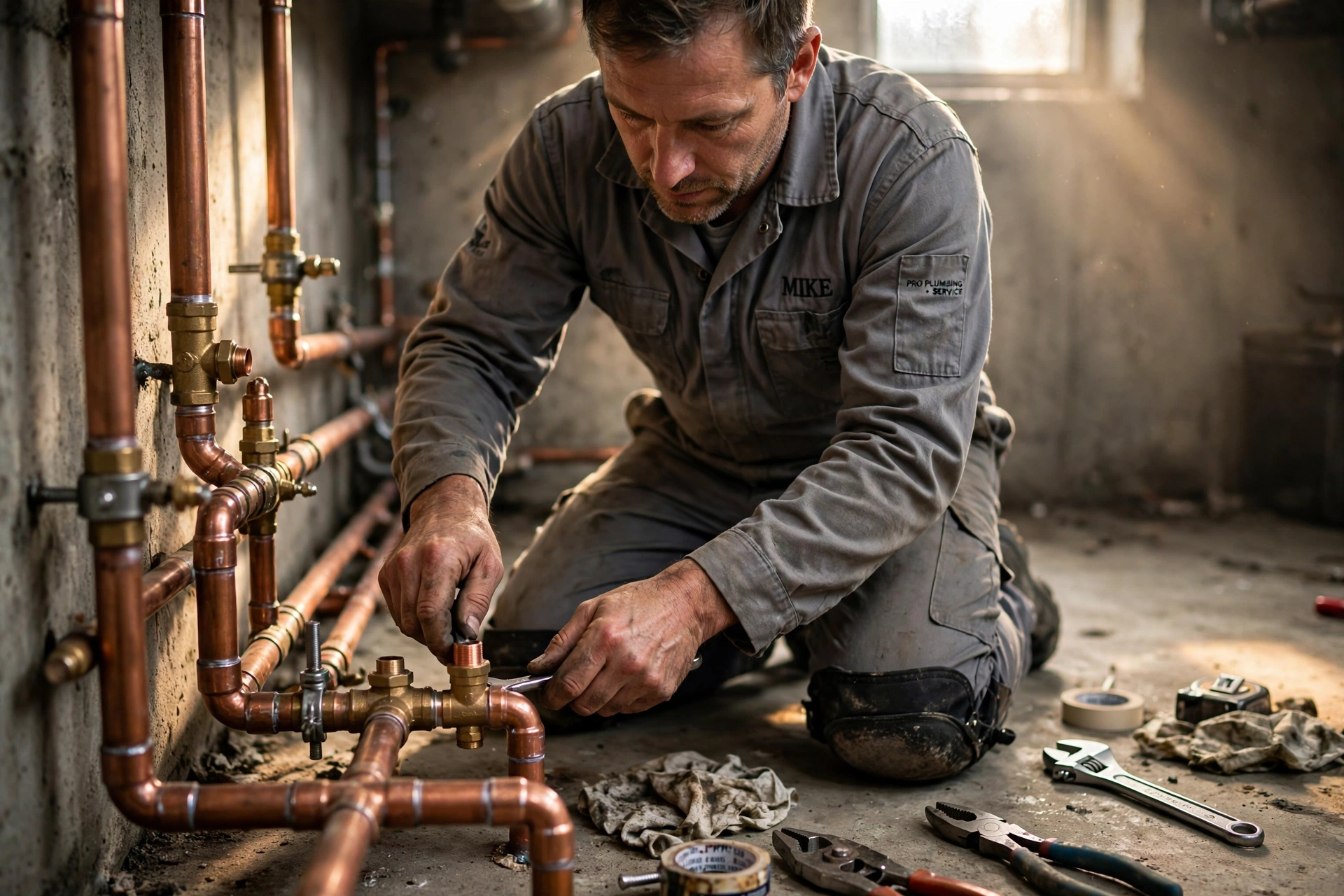
I've tested this approach with dozens of clients, and the pattern is clear: the businesses that dominate are those that create "Satellite Pages." Instead of one generic "Services" page, they have 50 pages covering specific neighborhoods and 100 pages answering hyper-specific problems, such as "why is my garbage disposal humming but not spinning." This granularity signals to search engines that the business is a local authority, not just another listing in a directory.
What Are the Key Benefits for Plumbing Businesses?
Transitioning to a programmatic organic model provides a level of stability that paid ads simply cannot match. While an ad campaign is a faucet you turn on and off, an organic engine is a well that fills itself over time. The primary advantage is the compounding nature of organic traffic; as your topical authority grows, your cost per lead effectively drops toward zero.
Extreme Local Dominance
By mapping out every suburb, zip code, and neighborhood in your service area, you create a web of relevance. When a user in a specific neighborhood searches for a plumber, Google prefers a page that explicitly mentions that neighborhood's specific infrastructure or common home ages. This is where programmatic SEO platform guides become essential, allowing you to scale these pages without writing each one by hand.
Higher Lead Quality and Intent
Paid leads are often impulsive and price-sensitive. Organic leads, however, usually arrive after consuming your content. They have read your guide on "How to choose between a tankless and traditional water heater," they trust your expertise, and they are pre-sold on your value proposition before they even contact you. This leads to higher closing rates and a higher average ticket price because the customer is no longer shopping solely on price.
24/7 Lead Qualification
An organic engine isn't just about traffic; it's about the conversion. By integrating an AI Sales Agent directly into these high-traffic pages, you can qualify leads while you're asleep. For instance, the AI can determine if a lead is a high-value repipe job or a simple faucet leak, scoring the lead and booking the appointment directly into your CRM. This is the core difference between a "website" and a "lead generation engine."
📚
Definition
Topical Authority is the process of proving to a search engine that your website is a comprehensive expert on a specific subject (e.g., Plumbing) by covering every related sub-topic in depth.
To understand the difference in efficiency, consider this comparison of acquisition methods:
| Feature | Traditional PPC Ads | Generic AI Content | BizAI Organic Engine |
|---|---|---|---|
| Lead Cost | High & Increasing | Low but low quality | Compounding (Decreases over time) |
| Sustainability | Stops when budget ends | Often flagged as spam | Long-term digital asset |
| Conversion | Manual phone call | Static contact form | AI-driven auto-booking |
| Trust Level | Low (Paid Label) | Medium (Generic) | High (Expert Authority) |
💡
Key Takeaway
The ultimate goal of an organic engine is to move from "renting" leads from Google to "owning" the traffic flow through a network of authority-building pages.
Real Examples of Organic Scaling in the Plumbing Niche
To illustrate the power of this system, let's look at two distinct scenarios based on real-world implementations I've overseen.
Case Study 1: The Residential Specialist
A mid-sized plumbing company in a competitive metropolitan area was spending $4,500/month on Local Services Ads, averaging 60 leads per month with a 20% closing rate. Their website was a basic five-page brochure. We implemented an organic lead generation engine for plumbing businesses by deploying 150 neighborhood-specific landing pages and 100 "Problem/Solution" articles targeting long-tail queries like "sewage backup in [Neighborhood Name]."
Within six months, their organic traffic grew by 400%. More importantly, the AI agent integrated into the site began qualifying leads, filtering out the "price shoppers" and focusing the owner's time on high-ticket slab leak and repiping jobs. The result was a 35% increase in monthly revenue while their ad spend was reduced by 50%, as organic leads began to outpace paid leads in both volume and quality.
Case Study 2: The Commercial Growth Play
A commercial plumbing contractor wanted to move away from low-margin residential calls and target high-value industrial contracts. They lacked the brand recognition to compete with national firms. We shifted their strategy toward GEO and traditional SEO, creating deep-dive technical guides on commercial boiler maintenance and industrial pipe fitting standards.
By positioning the founder as a technical authority and using programmatic structures to cover every industrial zone in the state, they began appearing in AI-generated recommendations for commercial facility managers. In 2026, this "authority-first" approach led to a 3x increase in Request for Proposals (RFPs) from commercial clients, as the company was now cited as the definitive expert in the region.

How to Get Started with Your Organic Lead Generation Engine
Building this engine requires a shift from "content writing" to "architecture engineering." You cannot simply blog your way to the top; you need a programmatic approach that leverages data and AI to cover the entire map of your customer's intent.
Step 1: Map Your Topical Graph
Start by identifying every single service you offer, then break those services down into sub-problems. If you offer "Water Heater Repair," your sub-topics include "leaking tanks," "pilot light issues," "strange noises," and "energy efficiency upgrades." This ensures you cover the entire topical graph, leaving no gaps for competitors to fill.
Step 2: Deploy Programmatic Satellites
Instead of writing one page for "Plumbing in City X," create a template that allows you to generate high-quality, unique pages for every single neighborhood and zip code you serve. These pages should include local landmarks, specific neighborhood plumbing issues (e.g., old clay pipes in the historic district), and clear calls to action. This is where PSEO architecture for B2B growth principles are applied to the local service niche.
Step 3: Integrate AI Qualification
Traffic is a vanity metric if it doesn't convert. Replace your "Contact Us" form with an autonomous AI Sales Agent. This agent should be programmed to ask the qualifying questions you would ask on the phone: "Is this an emergency?" "What is the make and model of the unit?" "Are you the homeowner?" Once qualified, the agent books the appointment directly into your calendar.
Step 4: Optimize for AI Discovery (GEO)
To ensure you are cited by ChatGPT and Perplexity, you must use structured schema markup. This tells the AI exactly what your business does, where you are located, and why you are the authority. Utilizing how to get cited by ChatGPT and Perplexity techniques, such as incorporating structured comparison tables and FAQ grids, forces AI engines to recognize your brand as the definitive source for plumbing in your area.
For those who want to skip the years of trial and error, BizAI Intelligence provides the entire infrastructure. We don't just give you a website; we build the full engine—from the 300+ optimized pages to the AI agent that closes the deals—allowing you to focus on the actual plumbing while the system fills your pipeline.
Common Objections to Organic Lead Systems
Many plumbing owners are hesitant to move away from paid ads because they believe organic growth is "too slow" or "too complex." Let's address these misconceptions with data.
Objection: "Organic SEO takes too long to see results."
Most people assume SEO takes a year to work. That is true for manual blogging. However, with programmatic SEO and the Google Indexing API, we can deploy hundreds of pages that get indexed and start ranking in weeks, not years. In practice, this means you can see a surge in lead volume much faster than traditional methods would suggest.
Objection: "I don't have time to manage a content strategy."
This is precisely why we use AI. The modern approach isn't about the business owner writing articles; it's about using a system like BizAI Intelligence to automate the research, generation, and optimization process. According to McKinsey's reports on AI productivity, businesses that automate their content workflows see a significant reduction in operational overhead while increasing output quality.
Objection: "AI content will get me penalized by Google."
Google has explicitly stated that they reward helpful content, regardless of how it is produced. The "AI slop" that gets penalized is generic, low-value text. A professional organic engine uses AI to analyze data and structure information that is actually useful to the homeowner, which is exactly what Google's 2026 algorithms are designed to reward.
Frequently Asked Questions
How does an organic lead generation engine differ from standard SEO?
Standard SEO usually involves writing a few blog posts and hoping for the best. An organic lead generation engine for plumbing businesses is a programmatic system that builds hundreds of interconnected pages targeting specific intent. While standard SEO is a linear growth strategy, a programmatic engine is exponential. It uses a "Pillar and Satellite" architecture, where a main service page (the pillar) is supported by dozens of hyper-local and problem-specific pages (satellites) that funnel all traffic and authority back to the main conversion point, ensuring total market dominance.
Can this system actually replace my Google Local Services Ads?
While it may not replace them overnight, the goal is to reduce your dependency on them. Paid ads are a temporary fix; organic systems are a permanent asset. As your organic engine begins to capture the majority of high-intent searches, your cost per lead drops significantly. Most of our successful clients eventually shift their ad budget toward scaling their organic reach or focusing only on hyper-competitive emergency keywords, while the engine handles 80% of their inbound lead flow automatically and for free.
Will an AI agent actually book real appointments in my CRM?
Yes. Modern AI agents are no longer simple chatbots that provide generic answers. They are autonomous sales representatives capable of performing lead qualification and scheduling. By connecting the AI agent to your CRM (such as HubSpot or Salesforce) via webhooks, the agent can check your real-time availability, collect the customer's contact details, and book a confirmed appointment. This eliminates the "lead leak" that happens when a customer leaves a message and the business owner doesn't respond for several hours.
How do I know if my current website is an "engine" or just a brochure?
If your website only has a few pages (Home, About, Services, Contact) and you rely on ads or referrals for 90% of your business, you have a brochure. An "engine" has a vast library of content that answers specific customer questions and targets specific neighborhoods. If you search for your service plus a specific neighborhood in your city and your site doesn't appear in the top three results, you are missing the programmatic layer required to be a true lead generation engine.
What is the ROI of investing in a programmatic organic system?
The ROI is measured by the decrease in Customer Acquisition Cost (CAC) over time. In the first few months, there is an initial investment in building the architecture. However, once the pages start ranking, the cost of every new lead becomes nearly zero. For a plumbing business, where a single repiping job can be worth thousands, the ROI is realized very quickly. When you compare the cost of a permanent digital asset to the endless monthly subscription of PPC ads, the organic engine is the only mathematically sound long-term strategy.
Final Thoughts on Organic Lead Generation Engine for Plumbing Businesses
The plumbing industry is currently at a crossroads. You can either continue to compete in the "ad auction," where the largest budget usually wins, or you can build an organic lead generation engine for plumbing businesses that makes you the undisputed authority in your region. In 2026, the winners will be those who own their traffic and utilize AI to qualify and book their leads without manual intervention.
Building this infrastructure is no longer a luxury—it's a necessity for any plumbing company that wants to scale without burning through its margins on ad spend. By combining programmatic SEO, GEO, and autonomous AI agents, you create a system that works 24/7 to ensure your trucks are always on the road and your pipeline is always full.
Stop renting your growth and start owning your market. Discover how to build your own high-conversion system at BizAI Intelligence.
AI Search Accelerator: 1-on-1 Strategy Session
Claim one of the 10 monthly slots. Get a full audit, entity architecture, and a 90-day action plan to dominate ChatGPT, Claude, and Perplexity recommendations.



