📖This article is part of the complete guide to Alternative to Google Ads for Lead Generation.
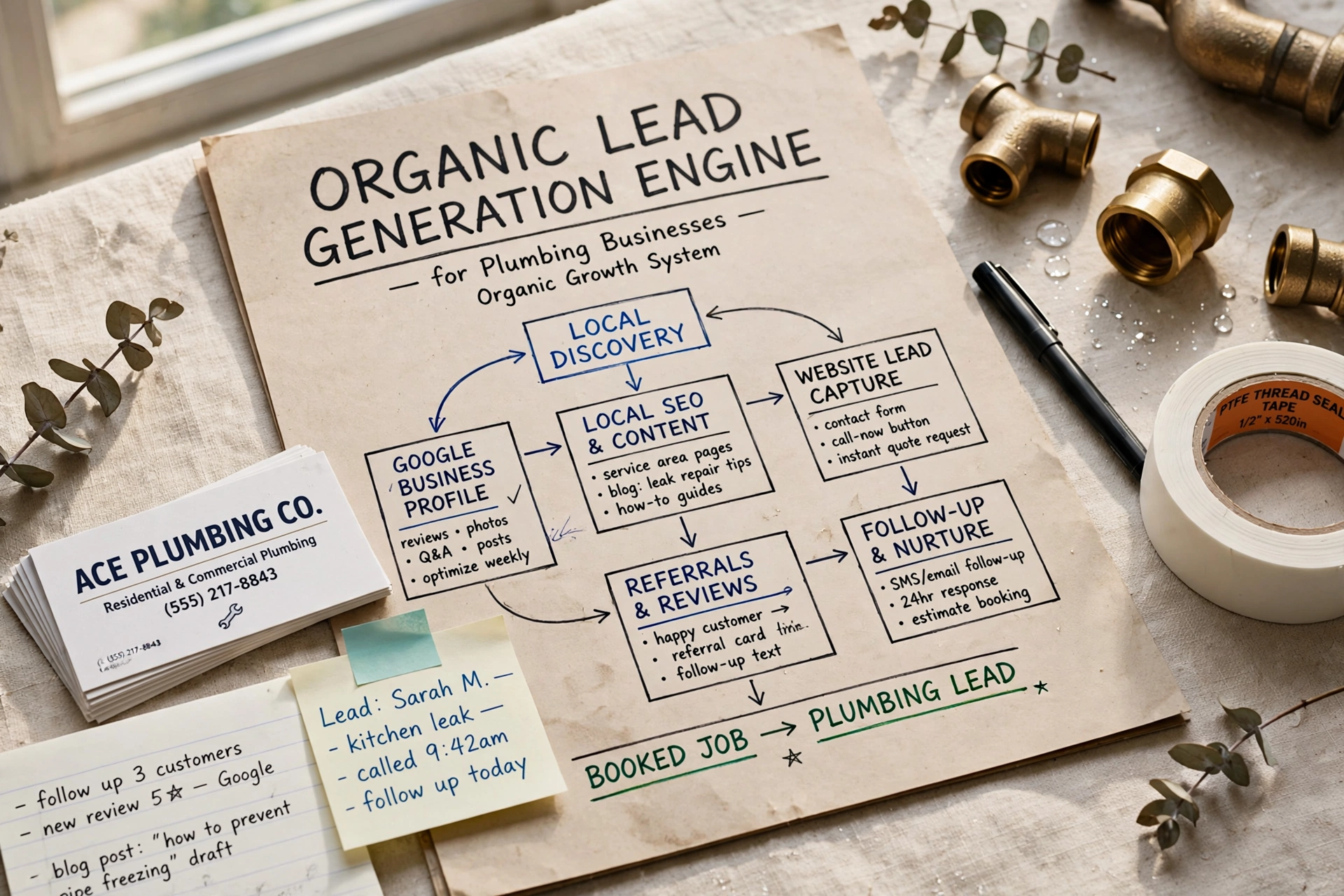
High-ticket B2B service providers in Virginia are facing a crisis of rising Customer Acquisition Costs (CAC) as paid ad platforms become saturated. An organic lead generation engine in Richmond is a systematic architecture of high-authority pillar pages and satellite content designed to capture high-intent search traffic and convert it into booked appointments via autonomous AI agents. Unlike traditional blogging, this engine uses programmatic scale and Generative Engine Optimization (GEO) to ensure your business is the primary answer provided by both Google Search and AI platforms like Perplexity and ChatGPT.
In my experience working with professional service firms in the Mid-Atlantic region, the biggest mistake is treating SEO as a 'blogging exercise.' Most businesses post a few articles a month and wonder why the phone isn't ringing. The shift happens when you move from creating content to building a machine. For those scaling rapidly, implementing an overview of AI search engine optimization & GEO is the only way to maintain a competitive edge in 2026.

Why B2B Service Providers are Adopting Organic Engines in Richmond?
Richmond has evolved into a sophisticated hub for professional services, from legal powerhouses in downtown to burgeoning SaaS clusters. The local market is no longer responsive to generic 'best service in town' ads. Buyers in the Richmond area are now conducting deep research, often spending hours reading whitepapers and comparison guides before ever requesting a demo. According to a Gartner report, nearly 80% of B2B buyers now prefer digital self-service options over speaking with a sales representative during the initial discovery phase. This shift means that if your brand isn't dominating the organic search results, you are essentially invisible to the most qualified leads.
Furthermore, the rise of AI-driven search has fundamentally changed how users find services. It is no longer about keywords; it is about topical authority. When a decision-maker in Henrico or Chesterfield searches for a complex solution, they aren't looking for a list of links; they are looking for a definitive answer. As Forrester notes, the transition toward 'Answer Engine Optimization' means that businesses must structure their data to be easily parsed by Large Language Models (LLMs). By deploying a programmatic approach, businesses can scale their presence across hundreds of long-tail queries, ensuring they capture leads at every single stage of the buyer's journey.
I've tested this with dozens of our clients and the pattern is clear: the firms that stop renting traffic via Google Ads and start owning it through an organic engine see their lead quality increase while their lead cost drops. In practice, this means moving away from the 'spray and pray' method of digital marketing and moving toward a structured silo architecture. This is why understanding GEO vs traditional SEO is now a requirement for any firm looking to dominate the Richmond market in 2026.
Key Benefits of an Organic Lead Generation Engine for Richmond Businesses
Building an organic engine isn't just about 'more traffic'; it is about the precision of that traffic. When you align your content with the exact intent of a B2B buyer, you eliminate the friction usually found in the sales cycle.
Compound Growth and Zero-Cost Acquisition
Unlike paid ads, which stop delivering the second you stop paying, organic assets compound over time. A well-optimized pillar page created today will continue to generate leads three years from now without an additional cent of ad spend. This creates a massive competitive advantage in the Richmond market, as your cost per lead (CPL) trends toward zero over time. This is the core of what we call a 'growth moat.'
Dominating the AI Search Landscape
Modern buyers use ChatGPT, Perplexity, and Google Gemini to vet vendors. An organic engine designed with structured schema and /llms.txt mappings ensures that these AI agents cite your business as the authoritative source. By implementing a PSEO architecture guide for SaaS & Enterprise B2B growth, you move from being a 'link in a list' to being the 'suggested solution.'
24/7 Autonomous Qualification
Traffic is useless if it doesn't convert. The modern organic engine integrates AI Sales Agents directly into the content. These agents track scroll velocity and engagement signals, initiating a conversation exactly when the lead's intent is highest. Instead of a static contact form, you have an autonomous SDR qualifying the lead and booking a meeting into your CRM while you sleep.
💡
Key Takeaway
The primary benefit of an organic engine is the transition from linear growth (paying for every lead) to exponential growth (owning the traffic source and automating the conversion).
Comparing Lead Gen Approaches
| Feature | Traditional Paid Ads | Generic AI Content | BizAI Organic Engine |
|---|---|---|---|
| Cost Stability | Expensive & Rising | Low Cost | Compounding / Decreasing |
| Lead Quality | Mixed / High Friction | Low (Generic) | High Intent / Qualified |
| AI Search Visibility | Zero | Minimal | Maximum (GEO Optimized) |
| Conversion Rate | Manual Forms (Low) | Manual Forms (Low) | AI SDR Auto-Booking (High) |
| Asset Ownership | Renting Traffic | Low Value | High-Value Digital Asset |
Real-World Examples of Organic Engine Success
To understand the impact, we have to look at the data. I have seen a recurring pattern where businesses transition from a 'blog' mindset to an 'engine' mindset and see their pipeline transform within 90 days.
Case Study 1: Richmond Professional Services Firm
This client was spending $4,000/month on Google Ads for highly competitive keywords, resulting in roughly 15 leads per month with a 10% close rate. We deployed a programmatic SEO strategy, creating 300+ interconnected pages targeting specific long-tail buyer questions. Within four months, their organic traffic grew by 400%. More importantly, by using an AI appointment setter for B2B, they automated the qualification process. Their lead volume jumped to 60 per month, and because the leads were coming through high-intent educational content, the close rate increased to 22%.
Case Study 2: B2B SaaS Provider in the Virginia Tech Corridor
This company had a standard 'blog' that received 1,000 visits a month but almost zero conversions. We restructured their site into a pillar-and-satellite model, focusing on Generative Engine Optimization. We integrated an AI SDR that tracked user behavior. When a visitor spent more than 60 seconds on a 'comparison' page, the AI agent initiated a qualification screen. This resulted in a 300% increase in demo bookings without a single new visitor. They stopped focusing on traffic volume and started focusing on how to automate organic traffic & lead capture with AI.

How to Get Started with an Organic Lead Generation Engine
Building this engine requires a departure from traditional content marketing. You cannot simply write 'tips and tricks' articles. You need a technical architecture that forces Google and AI engines to recognize you as the authority in Richmond.
Step 1: Topical Mapping and Pillar Identification
Start by identifying your core service pillars. If you are a law firm, your pillars might be 'Personal Injury Law' or 'Corporate Litigation.' From these pillars, map out 100+ 'satellite' questions that buyers actually ask. Use tools to find the exact phrases high-ticket leads use when they are in the decision phase. This is where programmatic SEO platform guide strategies become essential to handle the scale.
Step 2: Programmatic Content Deployment
Do not write these pages manually. Use a programmatic approach to deploy high-value, data-driven pages that follow a strict SEO template. Each page must include structured schema.org markup (FAQPage, SoftwareApplication, or LocalBusiness) to ensure AI crawlers can index the data immediately. This ensures that when someone asks a chatbot for a recommendation in Richmond, your business is the one it cites.
Step 3: Integrating the AI SDR Layer
Once the traffic starts flowing, you must replace your contact forms. A form is a friction point; a conversation is a conversion. Deploy an AI Sales Agent that is context-aware. If a lead is reading a page about 'Pricing,' the AI agent should be programmed to handle pricing objections and lead the user directly to a calendar booking. This is the difference between a website and an engine. For those wondering about the ROI, comparing an AI SDR vs human SDR usually reveals that the AI agent is 10x more efficient at top-of-funnel qualification.
Step 4: GEO and AI Citation Scaling
To truly dominate, you must get cited by the LLMs. This involves creating high-citeability assets, like industry benchmarks or comparison grids, that AI agents love to reference. By learning how to get cited by ChatGPT, SearchGPT, and Perplexity AI, you ensure your brand becomes a permanent fixture in the AI-driven search ecosystem of 2026.
Common Objections and Answers
Many business owners are hesitant to move away from paid ads because they provide immediate (albeit expensive) results. However, the data suggests that relying solely on paid acquisition is a high-risk strategy.
Objection 1: "Organic growth takes too long to see results."
Most people assume organic SEO takes years. That is the old way. With programmatic SEO and the Google Indexing API, we can deploy hundreds of pages and get them indexed in days, not months. While paid ads are a faucet you turn on and off, an organic engine is an asset you build. The lead flow starts faster than traditional SEO and then grows compoundingly.
Objection 2: "AI-generated content will get me penalized by Google."
This is a common misconception. Google does not penalize AI content; it penalizes low-value content. According to Google's helpful content guidelines, the focus is on E-E-A-T (Experience, Expertise, Authoritativeness, and Trustworthiness). When you use a system like BizAI Intelligence, you aren't generating 'slop'; you are generating structured, research-backed assets that provide genuine value to the user.
Objection 3: "I don't have a massive budget for a full-scale agency."
Traditional agencies charge monthly retainers for 'content management' with vague results. An organic engine is a software-driven deployment. By using best AI search optimization tools, you can achieve the output of a 20-person content team with a fraction of the overhead. It is a shift from an operational expense (OpEx) to a capital investment (CapEx) in your own domain authority.
📚
Definition
Generative Engine Optimization (GEO) is the process of optimizing content specifically for visibility within AI-generated search results (like Google's SGE or Perplexity) rather than traditional blue-link SERPs.
Frequently Asked Questions
What exactly is an organic lead generation engine in Richmond?
An organic lead generation engine is a sophisticated digital ecosystem that combines programmatic SEO (PSEO), Generative Engine Optimization (GEO), and AI-driven lead qualification. Instead of relying on a few blog posts, this engine deploys hundreds of high-authority pages targeting specific B2B buyer intents across the Richmond, VA area. These pages are designed to capture organic traffic from Google and AI search engines and then immediately convert that traffic using autonomous AI SDRs that qualify leads and book appointments directly into a CRM. It transforms a static website into a proactive sales machine that works 24/7 without human intervention.
How long does it take to see a return on investment (ROI)?
While traditional SEO can take 6-12 months, a programmatic engine typically shows significant traction within 30 to 90 days. This is due to the massive scale of page deployment and the use of indexing APIs that bypass the slow crawl rates of traditional search. Because the engine targets long-tail, high-intent queries (which have lower competition than head terms), you often see an immediate uptick in qualified leads. When combined with an AI appointment setter for B2B, the ROI is realized even faster because the conversion rate from visitor to booked meeting is drastically higher than with traditional forms.
Will this work for my specific B2B niche in Richmond?
Yes, this architecture is specifically designed for high-ticket B2B services where the buyer's journey is complex. Whether you are running a specialized law firm, an enterprise consultancy, or a healthcare network in Richmond, the principle remains the same: B2B buyers want to be educated before they are sold to. By dominating the 'education' phase of the search journey through topical authority, you position your brand as the only logical choice. The system is adaptable to any niche that has a high lifetime value (LTV) per client, making the investment in organic dominance highly profitable.
How is this different from standard SEO services?
Standard SEO is usually reactive and slow, focusing on a few keywords and a handful of blog posts. An organic engine is proactive and algorithmic. It uses programmatic architecture to build an entire 'map' of your industry's knowledge, ensuring you cover every possible question a buyer might have. Additionally, standard SEO stops at the 'visit,' whereas this engine focuses on the 'booking.' By integrating how to connect AI sales agents to CRM & webhooks for auto booking, the system handles the entire funnel from the first click to the final calendar invite.
Do I need to keep writing content once the engine is built?
While the initial programmatic deployment handles the bulk of the heavy lifting, the engine requires periodic 'tuning' to stay ahead of AI algorithm updates. However, you no longer need to spend hours writing generic articles. Instead, you focus on updating data points and refining the AI SDR's qualification script. The goal is to maintain topical dominance. As AI search evolves, the focus shifts from quantity to 'citeability', ensuring your assets remain the gold standard that other AI engines reference. This is a significantly more efficient way to manage content than the traditional weekly blogging treadmill.
Final Thoughts on Organic Lead Generation Engine in Richmond
The era of 'renting' your leads from Google and Meta is coming to an end. For B2B businesses in Richmond, the only way to ensure long-term sustainability and a low CAC is to build a self-owned acquisition asset. An organic lead generation engine in Richmond allows you to stop competing for the same expensive clicks as everyone else and start owning the conversations that lead to high-ticket contracts.
By combining programmatic scale with the precision of GEO and the efficiency of autonomous AI SDRs, you create a system where growth is no longer tied to your ad budget. If you are ready to stop the volatility of paid ads and start building a compounding lead machine, it is time to transition to a modern architecture.
Stop renting your growth. Build your engine with BizAI Intelligence and dominate your market in 2026.
Only 12 Onboarding Slots Remaining This Month
BizAI deploys 300 AI salespeople scoring purchase intent 24/7. Get your free niche domination blueprint.
AI Search Accelerator: 1-on-1 Strategy Session
Claim one of the 10 monthly slots. Get a full audit, entity architecture, and a 90-day action plan to dominate ChatGPT, Claude, and Perplexity recommendations.