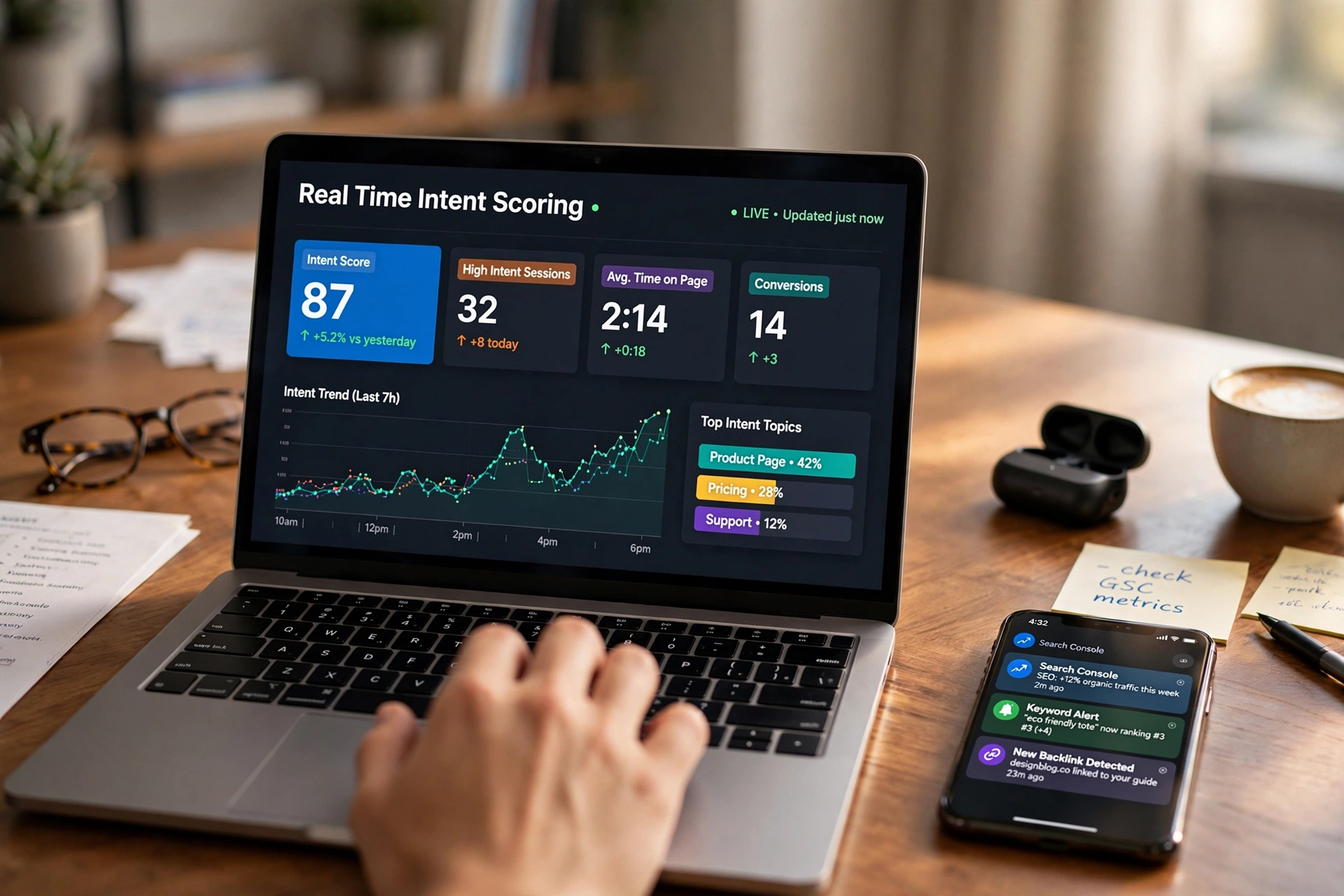
📖This article is part of the complete guide to High Intent Visitor Tracking: Ultimate B2B Guide.
I have analyzed hundreds of B2B inbound funnels, and the pattern is always the same: sales teams waste 70% of their time chasing 'one-hit wonders.' These are visitors who land on a page, look at a feature, and leave. Meanwhile, the high-intent buyer is returning to your site three, four, or five times a week, comparing your technical specs against a competitor, yet they remain invisible because they haven't filled out a form. This invisibility gap is where most B2B revenue is lost.
For a comprehensive overview of how to identify these invisible buyers, explore our guide on high intent visitor tracking.
What is Return Visit Frequency for Lead Qualification?
📚
Definition
Return visit frequency is the metric that tracks how often a unique, anonymous visitor returns to a specific domain within a defined time window, used to determine the intensity of their buying intent.
Return visit frequency leads refers to the process of using the recurrence of a visitor's sessions as a primary signal for lead scoring. Unlike traditional lead generation, which relies on a form submission to 'start' the relationship, frequency tracking identifies a lead based on their behavioral commitment. In a high-ticket B2B environment, a visitor rarely buys on the first touch; they return to validate a hypothesis, check pricing, or share a specific page with a stakeholder.
When we built the tracking architecture at BizAI Intelligence, we discovered that visit frequency is a leading indicator of the 'consideration' phase. A visitor who returns four times in 48 hours is not just browsing; they are performing a mental audit of your solution. By quantifying this frequency, businesses can move from reactive selling (waiting for a lead) to proactive qualification (identifying a hot prospect before they even contact you).

This approach integrates deeply with artificial intelligence and search engine optimization, as it allows you to see which specific organic keywords are driving the most 'sticky' visitors. If a user arrives via a long-tail query and returns three times to read your case studies, the intent is significantly higher than someone who visits once via a generic brand search. This is the core of modern lead generation: shifting the focus from quantity of hits to the density of returns.
Why Does Return Visit Frequency Matter for Your Business?
Return visit frequency matters because it solves the 'silent buyer' problem. According to data from Gartner, B2B buyers spend only 17% of their total buying journey meeting with potential suppliers. The remaining 83% of the time is spent independently researching and returning to vendor sites. If you only qualify leads based on form fills, you are missing the most critical 83% of the journey.
In my experience working with enterprise law firms and SaaS providers, the correlation between return frequency and closing rates is nearly linear. A lead who has visited 5+ times in a 14-day window is statistically more likely to close than a lead who filled out a contact form after a single visit. This is because the frequent returner has already performed their own due diligence. They aren't asking 'What do you do?'; they are asking 'How do you fit my specific problem?'
Furthermore, this metric allows for extreme precision in your digital marketing efforts. Instead of spending your entire budget on top-of-funnel awareness, you can use return frequency to trigger high-intent interventions. For example, when a visitor reaches a threshold of 3 returns, you can deploy an AI SDR to offer a direct demo booking, knowing the visitor is already primed for a conversation.
Using these behavioral signals is essential for optimizing your organic traffic. When you combine return frequency with real time intent scoring for sales teams, you create a closed-loop system where the marketing team knows exactly which content clusters are creating the most 'returnable' value. This allows you to double down on high-intent topical hubs rather than chasing vanity metrics like total page views.
How to Use Return Visit Frequency to Qualify Leads Step-by-Step
Implementing a frequency-based qualification system requires moving beyond basic cookies to a robust identity resolution strategy. You cannot track frequency if your system treats every session as a new user. The first step is establishing a persistent identifier that survives session timeouts and browser restarts.
-
Establish the Frequency Baseline: Determine what constitutes a 'hot' visitor for your specific niche. For a high-ticket HVAC contractor, 3 visits in 7 days might be the threshold. For an enterprise SaaS platform, it might be 5 visits across 3 different product pages in a 48-hour window.
-
Map the Return Path: It is not just that they returned, but where they returned. A visitor who returns to the home page three times is likely just lost. A visitor who returns to the pricing page and then a technical documentation page is showing high-intent behavior. This is where you should integrate key behavioral signals for high intent visitors to add layers of qualification.
-
Implement Automated Intent Scoring: Assign a numerical value to return visits. For example: First visit = 1 point; Second visit = 5 points; Third visit (within 48 hours) = 20 points. Once a visitor hits a score of 30, they are flagged as a 'High Intent Lead.'
-
Trigger the Conversion Event: Instead of a static 'Contact Us' button, use the frequency data to trigger a context-aware AI agent. When a visitor with a high return frequency lands on the site, the AI agent can initiate a conversation such as, "Welcome back! I noticed you've been looking at our enterprise scaling options. Would you like to see a live demo of how we handle X?"
This level of automation is exactly what we've optimized within BizAI Intelligence. By automating the capture of these returning visitors, businesses stop leaking revenue to the 'invisible' segment of their pipeline. If you want to see how this scales, check out our programmatic SEO case studies to see how massive traffic volumes can be filtered into high-quality leads using these exact methods.
Return Visit Frequency vs. Traditional Lead Scoring
Traditional lead scoring is reactive and based on self-reported data. Return visit frequency is proactive and based on observed behavior. The difference in ROI is staggering because behavior does not lie, while form data often does (e.g. users providing fake emails to get a whitepaper).
| Feature | Traditional Scoring | Cheap AI/Generic Tools | BizAI Intelligence Approach |
|---|---|---|---|
| Trigger | Form Submission | Basic Cookie Tracking | Persistent Identity + Behavioral Density |
| Timing | Post-Conversion (Late) | Session-based (Fragmented) | Real-time Intent Detection (Instant) |
| Accuracy | Low (Self-reported) | Medium (High Hallucination) | High (Observed Action Patterns) |
| Action | Manual Email Follow-up | Generic Pop-up | Autonomous AI SDR Qualification |
As noted by the Forrester Research team, the shift toward 'Intent-Based Marketing' is no longer optional for B2B firms; it is a requirement for survival in 2026. The traditional approach relies on the hope that a user will identify themselves. The modern approach uses the data to identify the user's need before they even speak.

By focusing on return frequency, you are effectively measuring the 'gravity' of your brand. The more a user is pulled back to your site, the higher the gravity. When you combine this with how scroll depth signals buyer intent, you can pinpoint the exact moment a lead transitions from 'curious' to 'ready to buy.'
Common Mistakes to Avoid When Tracking Return Frequency
One of the most frequent mistakes I see is the 'Frequency Trap', assuming that any high number of returns equals high intent. This is a dangerous assumption. A user might return ten times because your navigation is confusing and they cannot find the pricing page. This is 'friction-based frequency' rather than 'intent-based frequency.'
To avoid this, you must analyze the destination of the return. High-intent frequency is characterized by movement deeper into the funnel (e.g. Home $
ightarrow$ Feature Page $
ightarrow$ Case Study $
ightarrow$ Pricing). Friction-based frequency is characterized by looping (e.g. Home $
ightarrow$ About $
ightarrow$ Home $
ightarrow$ About). If you see looping, your SEO and UX need work, not your sales team.
Another mistake is failing to account for 'Decision-Making Units' (DMUs). In B2B, you aren't selling to one person; you're selling to a committee. You might see three different visitors from the same corporate IP address returning to your site. This is not one person visiting three times; it is a team of three people validating your software together. This is an incredibly high-intent signal that many generic tools completely miss.
Finally, avoid the 'Over-Automation' error. Just because a lead has a high return frequency doesn't mean you should spam them with ads. The goal is a subtle, helpful intervention. A poorly timed pop-up can destroy the trust a user built over five return visits. Instead, use how AI appointment setters automate B2B demo booking to provide a seamless, non-intrusive path to a meeting.
Deep Dive: The Psychology of the Return Visitor
To truly master return visit frequency, you have to understand the psychological state of the B2B buyer. The return visit is an act of validation. In the first visit, the buyer is testing if you can solve their problem. In the second, they are checking if you are credible. In the third, they are looking for reasons not to buy from you (risk mitigation).
According to the MIT Sloan Management Review, the modern B2B buyer is more risk-averse than ever. They use return visits to build a mental checklist of requirements. If your content doesn't evolve to meet them on each return, you lose them. This is why content marketing must be structured as a journey, not a library. Your site should practically 'remember' where they left off and provide the next logical piece of evidence.
For instance, if a user returns for the fourth time, they are likely in the 'Final Comparison' stage. At this point, they no longer need a general guide on overview of AI search engine optimization & GEO. They need a granular comparison table or a specific ROI calculator. If you can surface that exact content upon their return, your conversion rate will skyrocket.
This is the brilliance of the BizAI Intelligence architecture. We don't just track the visit; we analyze the intent behind the return. We use large language models (LLMs) to understand the semantic intent of the pages being revisited, allowing the AI SDR to adapt its pitch in real-time. If the user keeps returning to the 'Security & Compliance' page, the AI SDR will prioritize security talking points during the qualification process.
Frequently Asked Questions
How does return visit frequency differ from a bounce rate?
Bounce rate measures the percentage of visitors who leave after viewing only one page. Return visit frequency is the opposite; it measures the percentage of users who come back for subsequent sessions. While a low bounce rate is good, a high return frequency is better. A low bounce rate only means they stayed for a bit; a high return frequency means they are actively considering your business as a solution. One is a measure of engagement, the other is a measure of intent.
Can return visit frequency be tracked without using cookies?
Yes, though it is more complex. With the decline of third-party cookies, modern systems use first-party data, fingerprinting, and hashed identifiers. BizAI Intelligence utilizes advanced identity resolution that tracks users across sessions using a combination of server-side tracking and unique behavioral signatures. This ensures that you can identify a returning lead even if they clear their cache or switch devices, provided they are coming from the same corporate network or identified lead profile.
What is the ideal return frequency threshold for a B2B lead?
There is no universal number, but across my 15+ years of experience, a 'magic number' often emerges around 3 visits within 7 days. At this threshold, the visitor has moved from 'casual browsing' to 'active evaluation.' However, this varies by ticket price. For a $10,000 service, 3 visits might be enough. For a $100,000 enterprise contract, you might look for 7-10 visits over a month, indicating a deep dive by multiple stakeholders within the client's organization.
Does a high return frequency always mean the lead is 'hot'?
Not necessarily. As mentioned in the 'Common Mistakes' section, high frequency can be a sign of frustration. If a user returns five times but spends only 10 seconds on each page, they are likely struggling to find a specific piece of information. High intent is marked by a combination of return frequency AND session duration. When you combine frequency with how scroll depth signals buyer intent, you get a true picture of whether the lead is hot or just confused.
How do I integrate return frequency into my CRM?
Integration is best handled via webhooks. When a visitor hits your defined frequency threshold (e.g. 3rd visit), your tracking system should trigger a webhook that either creates a new lead in your CRM (like HubSpot or Salesforce) or updates an existing lead's 'Intent Score.' This allows your sales team to see a 'Hot Lead' alert in real-time, rather than waiting for a form submission. For a detailed guide on this setup, see how to connect AI sales agents to CRM & webhooks.
Recommended Readings
To deepen your understanding of these topics, we recommend reading the following articles:
- Ultimate Guide to Real Time Buyer Behavior Analysis
- Instant Hot Lead Alerts for Sales Teams
- Detecting Urgency Language in Buyer Queries
Conclusion
Stop treating your website as a digital brochure and start treating it as a behavioral sensor. Return visit frequency is the most honest metric you have for gauging buyer intent. When you stop obsessing over total traffic and start focusing on the density and recurrence of visits, you move from guessing to knowing exactly who is ready to buy.
By implementing a system that identifies these returners and deploys an autonomous AI SDR to qualify them, you eliminate the gap between a visitor's interest and your sales team's action. This is the only way to scale B2B acquisition in 2026 without exponentially increasing your ad spend.
If you are ready to stop renting traffic and start building an organic lead machine, start by mastering the foundations of High Intent Visitor Tracking: Ultimate B2B Guide. The invisible buyers are already on your site; you just need the tools to see them.
For an enterprise-grade solution that automates this entire process, visit BizAI Intelligence.
Only 12 Onboarding Slots Remaining This Month
BizAI deploys 300 AI salespeople scoring purchase intent 24/7. Get your free niche domination blueprint.
AI Search Accelerator: 1-on-1 Strategy Session
Claim one of the 10 monthly slots. Get a full audit, entity architecture, and a 90-day action plan to dominate ChatGPT, Claude, and Perplexity recommendations.