📖This article is part of the complete guide to High Intent Visitor Tracking: Ultimate B2B Guide.
In my experience working with enterprise B2B firms, the single most expensive mistake a sales team can make is treating a 'contact us' form submission as the only signal of intent. By the time a lead fills out a form, they have often already spent 20 minutes on your site, analyzed your pricing, and compared you to three competitors. If you only react to the form, you are reacting to the end of the journey, not the journey itself. Real time intent scoring flips this script by quantifying buyer heat as it happens, allowing AI agents to intervene exactly when the prospect's interest peaks.
For a comprehensive overview of the underlying technology, explore our guide on high intent visitor tracking.
What is Real Time Intent Scoring?
📚
Definition
Real time intent scoring is the process of assigning a numerical value to a website visitor's level of purchase intent based on their live behavioral data, updated instantly as they interact with specific pages and elements.
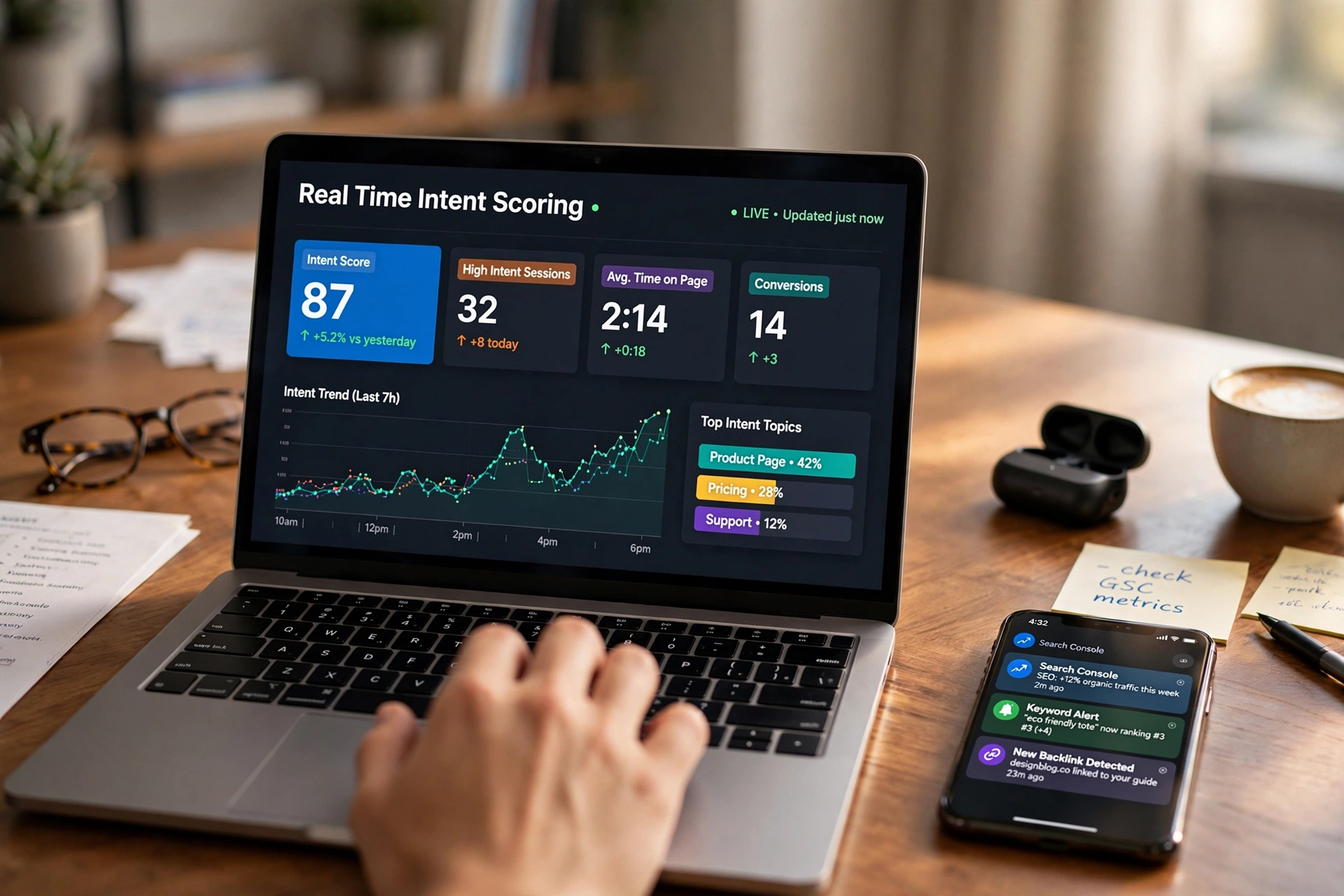
Real time intent scoring is the algorithmic quantification of buyer behavior. Unlike traditional lead scoring, which often relies on static data (like job title or company size) or delayed triggers (like a downloaded whitepaper), real time scoring monitors the 'digital body language' of the user. It looks at the velocity of page views, the specific sequence of high-value pages visited, and the engagement depth of the session to generate a score that fluctuates in milliseconds.
When we built the scoring engine at BizAI Intelligence, we discovered that the sequence of actions is far more predictive than the total number of actions. A user who visits a 'Pricing' page and then immediately navigates to 'Case Studies' is mathematically more likely to convert than a user who spends an hour reading a single blog post. Real time intent scoring captures this nuance by assigning different weights to different actions. For example, visiting a 'Terms of Service' page might be a +20 point signal, while reading a generic 'About Us' page is only +2 points.
This system enables a state of 'hyper-responsiveness.' Instead of waiting for a lead to enter a CRM via a form, the system identifies when a visitor hits a specific threshold, say, 85 points, and triggers an immediate action. This could be an AI SDR initiating a chat, a notification to a human account executive, or a personalized offer appearing on the screen. This transition from reactive to proactive engagement is the foundation of modern digital marketing for high-ticket services.

Why Does Real Time Intent Scoring Matter for B2B Growth?
Real time intent scoring matters because it solves the 'leaky bucket' problem in the B2B sales funnel. According to research from Gartner, B2B buyers spend only 17% of their total buying journey interacting with a potential supplier. The remaining 83% is spent on independent research. If you cannot identify and engage those buyers during that 83% window, you are essentially guessing who your best leads are.
In my experience, the cost of a delayed response in B2B is astronomical. A study by the Harvard Business Review indicates that companies that respond to leads within an hour are seven times more likely to have a meaningful conversation with a prospect than those who wait even 24 hours. Real time intent scoring removes the 'wait' entirely. By the time the user reaches their peak intent, your system has already identified them and is ready to engage.
Furthermore, this approach significantly optimizes the efficiency of your sales team. Most SDRs waste 60% of their day chasing leads that have 'gone cold' or were never high-intent to begin with. When a team utilizes real time scoring, they stop dialing blindly and start focusing only on users who are currently showing high-velocity intent. This shifts the SDR's role from a 'cold caller' to a 'concierge' who reaches out at the exact moment the prospect is thinking about the solution.
Integrating this with AI SDR vs Human SDR frameworks allows a business to scale. While a human cannot monitor 1,000 simultaneous sessions, an AI agent can. When the score hits the target threshold, the AI agent engages, qualifies the lead based on the behavioral data, and books the meeting directly into the CRM. This ensures that no high-intent visitor ever leaves the site without a clear next step.
How to Implement Real Time Intent Scoring Step by Step
Implementing a real time scoring system requires a shift from 'page-view tracking' to 'behavioral mapping.' You cannot simply count hits; you must weight intent. Here is the technical approach to building a high-converting scoring engine.
Step 1: Define Your High-Value Pages (The Intent Map)
Not all pages are created equal. You must categorize your site into intent tiers. Tier 1 pages (Pricing, Demo Request, Case Studies, Compare X vs Y) should carry the highest weights. Tier 2 pages (Educational blog posts, Whitepapers) carry medium weight. Tier 3 (Home, About, Contact) carry low weight. For instance, a visit to a 'Comparison' page should immediately add 30 points to a score, as it indicates the user is in the 'decision' stage of the funnel.
Step 2: Establish Behavioral Weighting
Beyond the page, look at the action. Using scroll depth signals can tell you if a user actually consumed the content or just bounced. A user who scrolls 80% of a pricing page is far more valuable than one who bounces after 2 seconds. Similarly, tracking mouse hesitation on a 'Buy Now' button can signal an intent-to-purchase that is just missing a final piece of confidence. These micro-signals are summed in real time to update the user's total score.
Step 3: Set Your Engagement Thresholds
Decide at what point a 'visitor' becomes a 'hot lead.' This is typically a numerical value (e.g. 70 points). Once the threshold is crossed, a trigger is fired. At BizAI Intelligence, we recommend a multi-tiered trigger system: at 50 points, a subtle AI greeting appears; at 80 points, the AI agent proactively asks a qualifying question; at 100 points, the system triggers an urgent alert to the sales team via Slack or email.
Step 4: Connect to an Automated Action Layer
Scoring is useless without action. The score must be tied to a delivery mechanism. This is where automated inbound lead qualification comes into play. The scoring engine should feed directly into your CRM (HubSpot, Salesforce) or a webhook that triggers an AI appointment setter. This creates a closed loop: Behavior $
ightarrow$ Score $
ightarrow$ Trigger $
ightarrow$ Qualification $
ightarrow$ Meeting.
💡
Key Takeaway
Real time intent scoring is not about the total points, but the velocity of the score. A user who goes from 0 to 80 in three minutes is a far more urgent lead than one who reaches 80 over three weeks.
Real Time Intent Scoring vs Traditional Lead Scoring
To understand the leap in efficiency, we must compare the old way of qualifying leads with the modern, behavioral-driven approach. Traditional scoring is retrospective; it looks at what the user did in the past. Real time scoring is prospective; it looks at what the user is doing right now.
| Feature | Traditional Scoring | Generic AI Chatbots | BizAI Real Time Scoring |
|---|---|---|---|
| Data Source | Form fills & Email clicks | Basic keyword triggers | Live behavioral signals & velocity |
| Response Time | Hours to Days | Immediate (but generic) | Immediate & context-aware |
| Accuracy | Low (Static data) | Medium (Keyword based) | High (Pattern recognition) |
| Engagement | Reactive (Wait for lead) | Passive (Wait for click) | Proactive (Triggered by intent) |
| Outcome | High lead decay | Low conversion rates | High-velocity demo bookings |
As shown in the table, generic AI chatbots often fail because they are 'blind' to the user's journey; they treat a first-time visitor and a returning high-intent buyer the same way. The modern approach uses the data from return visit frequency to customize the greeting. If a user has visited the site four times in two days and is currently on the pricing page, the AI agent doesn't say 'Hello, how can I help you?'; it says 'I see you've been researching our enterprise plan, would you like to see a live demo of the ROI calculator?'

Common Mistakes in Intent Scoring
While powerful, real time intent scoring can be misconfigured, leading to 'alert fatigue' or a poor user experience. I've seen many companies implement these systems only to have their sales teams ignore the alerts because they were too noisy.
Mistake 1: Over-weighting Low-Intent Actions
One of the biggest errors is assigning too many points to 'educational' behavior. If a user reads five blog posts, they are interested in the topic, not necessarily your product. If you treat a blog-reader as a high-intent lead, your SDRs will waste time on people who are just researching for a school project or a competitor's analysis. Only assign heavy weights to 'commercial' pages.
Mistake 2: Ignoring the 'Cool-down' Period
Intent is not permanent. A user who was 'hot' on Tuesday might be 'cold' by Friday. A common mistake is failing to implement a decay function. In a professional system, scores should naturally decay over time. If a user doesn't return for 48 hours, their score should drop. This ensures that the sales team is always prioritizing the most currently active leads.
Mistake 3: Aggressive Intervention
There is a fine line between being 'helpful' and being 'creepy.' If an AI agent pops up the moment a user hits 10 points, it feels like a surveillance state. The engagement must be timed to the psychological state of the buyer. Wait until the user has shown a clear pattern of high intent, such as visiting the pricing page twice, before initiating a direct sales conversation.
Mistake 4: Lack of CRM Integration
If the intent score lives only in a dashboard and isn't pushed to the CRM, the data is siloed. The salesperson should be able to see the 'Intent Journey' inside the lead's profile in HubSpot or Salesforce. Knowing that a lead scored 95 points because they spent ten minutes on the 'Enterprise Security' page allows the salesperson to tailor the pitch specifically to security concerns.
Mistake 5: Relying on a Single Signal
No single signal is 100% accurate. Urgency language tracking is powerful, but if it's the only metric, you'll get false positives. The most accurate scoring systems use a 'composite' approach, combining page visits, scroll depth, return frequency, and interaction time. The intersection of these signals is where the truth lies.
Frequently Asked Questions
How does real time intent scoring differ from a standard heatmap?
Heatmaps are retrospective and aggregate; they show you where most people clicked over the last month. Real time intent scoring is individual and immediate; it shows you what this specific person is doing right now. While a heatmap tells you that your pricing button is popular, intent scoring tells you that 'User X' from 'Company Y' has just clicked that button for the third time in ten minutes and is ready for a demo.
Can real time intent scoring work for low-traffic B2B sites?
Yes, and it is arguably more important for low-traffic sites. When you only get 100 visitors a day, you cannot afford to let a single high-intent lead slip through the cracks. While a high-traffic site can rely on volume, a low-traffic site must rely on precision. Identifying the two people per day who are truly in a buying window allows a small team to punch far above their weight class.
Does this approach conflict with GDPR or privacy laws?
Real time scoring relies on behavioral data, which is generally processed as 'pseudonymous' until the user identifies themselves (e.g. via a form or cookie consent). As long as your privacy policy clearly states that you use behavioral analytics to improve user experience and you have a compliant cookie consent banner, this is a standard industry practice. The key is to focus on behavioral patterns rather than attempting to deanonymize users through illicit means.
How do I know if my scoring threshold is set too high or too low?
This requires a 'tuning phase.' If your sales team is overwhelmed with leads that aren't converting, your threshold is too low. If your AI agents are rarely triggering despite high traffic, your threshold is too high. I recommend starting at a moderate level and reviewing the 'lead quality' weekly. Adjust the weights of specific pages based on which pages actually correlate with closed-won deals in your CRM.
Can AI actually qualify a lead based on intent scoring alone?
Intent scoring identifies the opportunity to qualify, but the AI agent performs the actual qualification. The score tells the AI 'When to talk,' and the AI agent then asks the 'Who, What, and Why' questions. The combination of behavioral intent (the score) and declared intent (the AI conversation) is the most powerful qualification engine available in 2026.
Conclusion
Real time intent scoring represents the end of the 'spray and pray' era of B2B sales. In a market where buyers are more informed and less patient than ever, the ability to distinguish a curious browser from a desperate buyer in real time is a massive competitive advantage. By mapping your high-value pages, weighting behavioral signals, and connecting that data to an automated action layer, you transform your website from a static brochure into a dynamic lead-generation machine.
If you are tired of renting expensive traffic from ads only to have it bounce without a trace, it is time to build a system that captures intent the moment it happens. For a deeper dive into the architecture of this system, return to our High Intent Visitor Tracking: Ultimate B2B Guide.
Ready to stop guessing and start closing? Visit BizAI Intelligence to deploy a programmatic SEO and AI-powered qualification engine that fills your pipeline while you sleep.
Only 12 Onboarding Slots Remaining This Month
BizAI deploys 300 AI salespeople scoring purchase intent 24/7. Get your free niche domination blueprint.
AI Search Accelerator: 1-on-1 Strategy Session
Claim one of the 10 monthly slots. Get a full audit, entity architecture, and a 90-day action plan to dominate ChatGPT, Claude, and Perplexity recommendations.