📖This article is part of the complete guide to High Intent Visitor Tracking: Ultimate B2B Guide.
In my experience working with high-ticket B2B firms, the most expensive mistake a company can make is treating every website visitor as a generic lead. I once analyzed a SaaS portfolio where 95% of traffic was 'educational' (low intent), yet the sales team spent 60% of their time chasing these visitors. By shifting the focus toward specific behavioral signals high intent visitors exhibit, we were able to increase the meeting-set rate by 40% simply by ignoring the noise and targeting the signal.
For a comprehensive overview, explore our guide on high intent visitor tracking.
What are Behavioral Signals for High Intent Visitors?
📚
Definition
Behavioral signals high intent visitors exhibit are specific, trackable digital actions that correlate with a high probability of purchase, moving a user from the 'awareness' phase to the 'decision' phase of the buyer's journey.
Behavioral signals are the digital breadcrumbs that differentiate a casual browser from a qualified buyer. While traditional lead generation relies on the user filling out a form, behavioral signals allow you to identify intent before the user even identifies themselves. This involves tracking micro-interactions, such as the specific sequence of pages visited, the time spent on pricing tables, and the interaction with high-value assets, to build a predictive profile of the visitor's intent.
When we deploy programmatic SEO architecture for SaaS, we don't just look for traffic; we look for intent-rich clusters. A visitor who lands on a 'What is AI?' page is low intent. A visitor who lands on a 'Pricing for Enterprise AI' page, spends four minutes reading the terms of service, and returns three times in 48 hours is exhibiting high-intent behavioral signals. These markers provide a quantitative basis for lead scoring, removing the subjectivity from the sales qualification process.

Why Do Behavioral Signals Matter for B2B Pipeline Growth?
Identifying behavioral signals high intent visitors leave behind is the only way to solve the 'leaky bucket' problem in B2B acquisition. According to Gartner's 2024 B2B Buying Cycle research, buyers now spend only 17% of their total purchase journey meeting with potential suppliers. This means 83% of the decision-making process happens autonomously on your website. If you are not tracking behavioral signals, you are blind to 83% of your sales cycle.
When a business can identify these signals in real-time, they can transition from passive lead capture to active intent interception. Instead of waiting for a 'Contact Us' form, an autonomous AI agent, like those integrated into BizAI Intelligence, can trigger a personalized conversation the moment a high-intent threshold is crossed. This reduces the time-to-lead response from hours to milliseconds, which is a fundamental requirement in the 2026 competitive landscape.
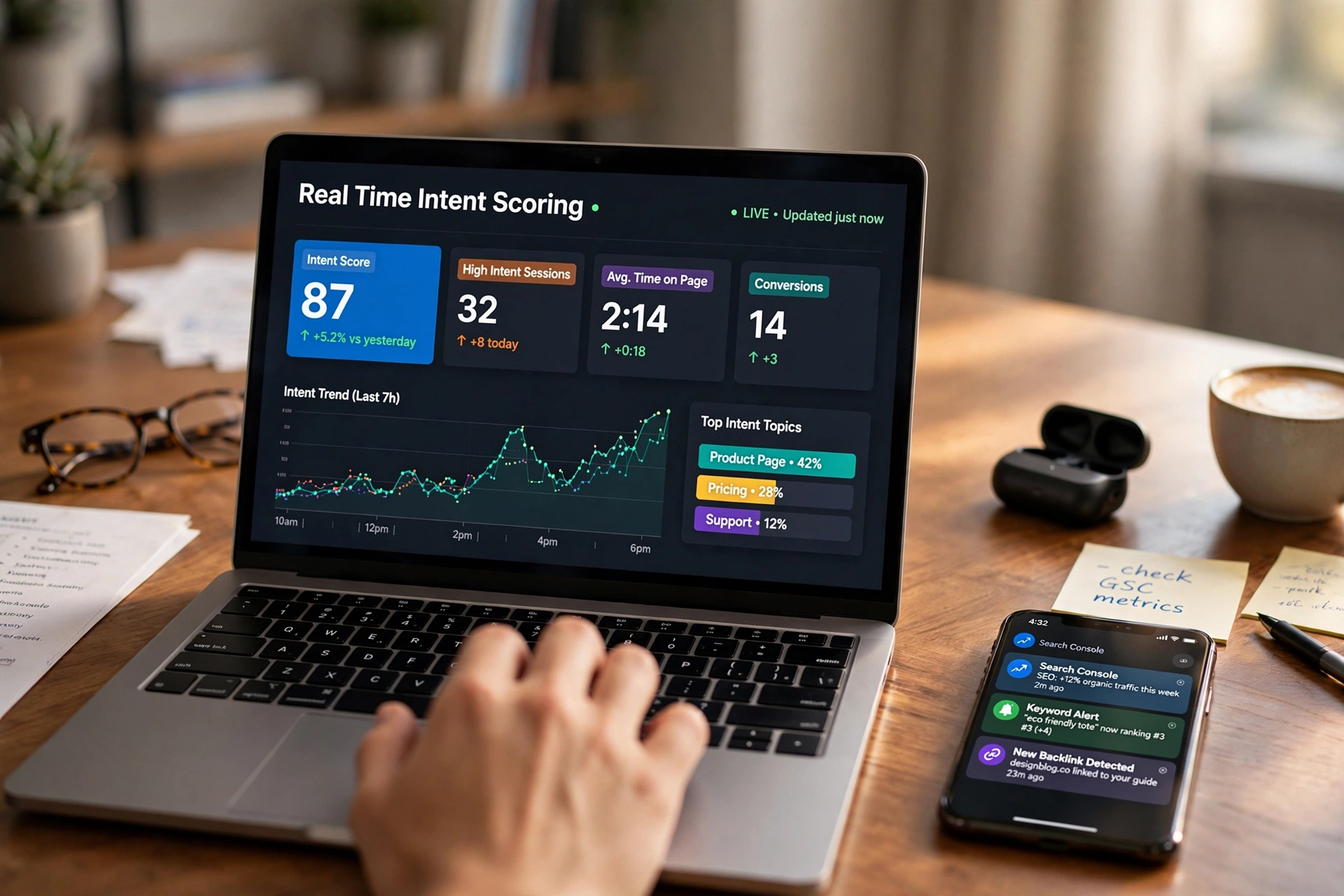
Furthermore, leveraging these signals allows for hyper-efficient resource allocation. By utilizing real time intent scoring for sales teams, companies can ensure their most expensive assets (senior account executives) are only speaking with prospects who have already demonstrated a quantitative intent to buy. This eliminates the 'tire-kicker' phenomenon and drastically improves the ROI of the entire sales organization.
How to Identify and Track High Intent Behavioral Signals?
Implementing a system to capture behavioral signals requires a shift from page-view tracking to event-based tracking. You must define a 'High Intent Event' (HIE) and assign it a numerical value. The goal is to create a cumulative intent score that triggers an action once it hits a specific threshold.
First, identify your 'Power Pages.' These are pages that only a serious buyer would visit, such as pricing, integration documentation, or comparison pages (e.g. YourProduct vs Competitor). A visit to a pricing page should carry a higher weight than a visit to a blog post. For those scaling their reach, integrating these pages into a programmatic SEO platform guide ensures that these high-intent landing pages are indexed and discoverable at scale.
Second, track engagement depth. Simple page views are vanity metrics. You need to track actual consumption. This is where scroll depth signals buyer intent becomes essential. A user who scrolls 90% of a technical specification page is fundamentally different from a user who bounces after 10 seconds. High-intent visitors typically exhibit slower reading speeds on complex sections and higher scroll depth on value-proposition sections.
Third, analyze return patterns. A single visit is often an accident or a quick check. However, return visit frequency is a massive indicator of intent. When a visitor returns to the same pricing page three times within a week, they are likely in the final stage of a comparison matrix. By tracking return visit frequency for lead qualification, you can identify the precise moment a prospect is ready to buy.
Fourth, monitor interaction patterns. This includes things like clicking 'expand' on FAQ sections or using a pricing calculator. Advanced systems also track mouse hesitation as purchase intent signal, where a user hovers over a 'Book Demo' button but doesn't click, indicating a final moment of friction that a well-timed AI chatbot could resolve.
The Modern Approach to Intent Tracking
To truly scale, you must move away from manual tracking and toward an automated, AI-driven engine. The traditional way of tracking intent was based on rudimentary Google Analytics goals, which were lagging indicators. The generic AI approach uses basic chatbots that trigger on a timer, often annoying the user. The modern approach, pioneered by BizAI Intelligence, combines programmatic content scale with real-time behavioral triggers.
| Feature | Traditional Manual Approach | Generic AI Chatbots | BizAI Intelligence Approach |
|---|---|---|---|
| Signal Detection | Static Forms / Page Views | Simple Time-on-Page | Event-based Behavioral Scoring |
| Response Time | Hours/Days (Manual Follow-up) | Instant but Generic | Context-Aware AI SDR Trigger |
| Scale | Manual Page Creation | Generic Content | 300+ Programmatic Intent Pages |
| Intent Accuracy | Low (Guesses based on lead source) | Medium (Basic triggers) | High (Multi-signal validation) |
By utilizing how to automate organic traffic with AI, businesses can create hundreds of satellite pages targeting specific buyer questions. Each page is then equipped with an AI agent that monitors behavioral signals in real-time. When the visitor's score hits the 'High Intent' mark, the AI agent doesn't just say 'Hello'; it says, 'I see you're looking at our Enterprise Pricing and the API documentation; would you like to see a demo of our integration flow?'

Common Mistakes in Intent Behavioral Tracking
One of the most frequent mistakes I see is 'Signal Overloading.' Companies try to track 50 different variables, resulting in a noise-to-signal ratio that makes the data useless. The key is to identify the 3-5 core markers that actually correlate with closed-won deals. If you track every mouse movement without a clear hypothesis, you are just collecting data, not generating intelligence.
Another critical error is failing to align the signal with the response. If a visitor is exhibiting high intent by reading a technical whitepaper, triggering a generic 'Want a discount?' popup is a conversion killer. The response must be contextually aligned with the signal. This is why we focus on how to connect AI sales agents to CRM, ensuring the AI knows exactly what the user was reading before it initiates the conversation.
Finally, many businesses ignore the 'Negative Signal.' A high-intent visitor can quickly become a low-intent visitor if they encounter a broken link or a confusing UI. If a user spends ten minutes on a page but repeatedly clicks a non-functional element, that is a signal of frustration, not intent. Your scoring system must be able to deduct points for negative behavioral markers to avoid wasting your sales team's time on frustrated users.
Frequently Asked Questions
What is the most accurate behavioral signal for high intent?
While no single signal is 100% accurate, the combination of visiting a pricing page and a 'Comparison' page within the same session is the strongest indicator. According to research by the B2B Institute, users who engage in multi-page 'value validation' (pricing + reviews + technical specs) are 5x more likely to convert than those who only visit a landing page. This is why a cluster-based approach to tracking is superior to single-page tracking.
How do I distinguish between a researcher and a buyer?
A researcher typically consumes a high volume of top-of-funnel content (blogs, guides) but rarely visits pricing or integration pages. A buyer, however, exhibits 'deep-dive' behavior on specific solution pages. By monitoring tracking urgency language in visitor sessions, you can identify buyers who use terms like 'implementation time,' 'deployment,' or 'compliance' in their search or interaction patterns, whereas researchers use 'what is' or 'how does it work.'
Does AI really improve the detection of behavioral signals?
Yes, because AI can process multi-dimensional data in real-time. A human analyst can see that 10% of users visit the pricing page, but an AI can see that users who visit the pricing page after reading three specific blog posts and spending 2 minutes on the 'About Us' page have a 70% conversion rate. This allows for the deployment of AI SDRs and autonomous appointment setters that trigger only when the statistical probability of a lead is highest.
How often should I update my behavioral intent scores?
Intent scores should be dynamic and updated in real-time. A visitor's intent can change in a single session. They may start as a casual browser and move to high intent within five minutes of finding a specific case study. Using a real-time engine ensures that the AI agent engages at the 'Peak of Intent,' which is the moment the user is most open to a sales conversation. Waiting for a daily batch report is an obsolete strategy in 2026.
Can behavioral signals be used for cold outreach?
Absolutely. By using 'intent data' from third-party providers combined with your own first-party behavioral signals, you can identify which accounts are visiting your site anonymously. When you see an IP address from a target Fortune 500 company exhibiting high-intent signals on your pricing page, your sales team can reach out to the decision-makers at that company with a highly relevant, non-generic pitch. This is the core of the modern AI SDR vs Human SDR efficiency model.
Conclusion
Mastering the behavioral signals high intent visitors leave behind is no longer an optional 'growth hack'; it is the baseline for B2B survival in 2026. When you stop relying on static forms and start leveraging real-time event data, from scroll depth and return frequency to mouse hesitation, you transform your website from a digital brochure into a high-performance acquisition engine. By automating the detection of these signals through a system like BizAI Intelligence, you ensure that no high-intent prospect ever slips through the cracks.
To build a complete system for capturing and converting these leads, return to our High Intent Visitor Tracking: Ultimate B2B Guide and start implementing a programmatic approach to your organic growth today.
For more information on scaling your inbound machine, visit bizaigpt.com.
Only 12 Onboarding Slots Remaining This Month
BizAI deploys 300 AI salespeople scoring purchase intent 24/7. Get your free niche domination blueprint.
AI Search Accelerator: 1-on-1 Strategy Session
Claim one of the 10 monthly slots. Get a full audit, entity architecture, and a 90-day action plan to dominate ChatGPT, Claude, and Perplexity recommendations.