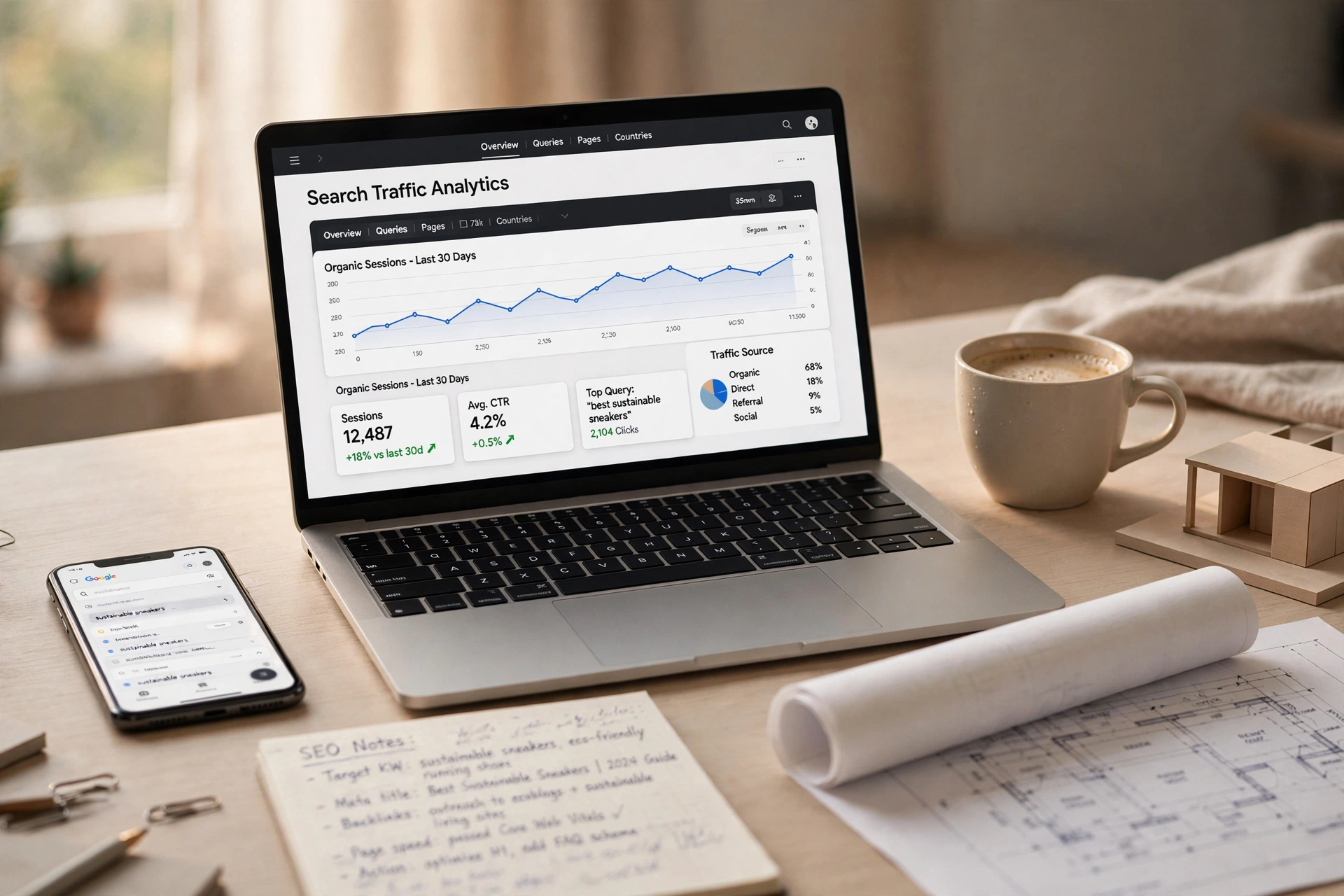
Most consulting firms rely on the 'expert's trap': a dangerous dependence on referrals and a small network of high-net-worth contacts. While this works for boutique firms, it doesn't scale. The solution is search traffic automation software for consulting firms, which replaces manual content creation with programmatic SEO (PSEO) and AI-driven lead capture. By deploying hundreds of high-intent landing pages targeting specific buyer problems, consulting firms can turn their domain into an autonomous lead-generation machine that works while the partners are billing hours.
In my experience working with high-ticket B2B consultants, the biggest bottleneck isn't the quality of their advice, but the consistency of their pipeline. I've seen firms with world-class intellectual property remain invisible online because they try to write one 'perfect' blog post a month. That approach is dead in 2026. To dominate, you need a system that maps every possible client pain point to a dedicated, optimized page. When you combine this with how to automate organic traffic and lead capture with AI, you move from chasing leads to selecting the best ones from a surplus.
Why Consulting Firms Are Adopting Search Traffic Automation in 2026?
The shift toward automation isn't just about efficiency; it is a response to the fundamental change in how B2B buyers research services. Consulting clients no longer start with a phone call; they start with a highly specific query in a search engine or an AI agent. According to Gartner, nearly 80% of B2B buyers now prefer a digital self-service experience over talking to a sales representative during the initial research phase. For consulting firms, this means if you aren't appearing in the search results for the specific problem your client is facing, you effectively don't exist.
Furthermore, the rise of Generative Engine Optimization (GEO) has changed the stakes. It is no longer enough to rank #1 on Google; firms must now be the cited authority in AI-generated summaries. This requires a massive volume of structured, factual, and interconnected data. In practice, this means moving away from generic 'About Us' pages and toward a programmatic architecture. When a firm uses PSEO architecture for SaaS and Enterprise B2B growth, they aren't just blogging; they are building a knowledge graph that AI engines like Perplexity and SearchGPT can easily parse and cite.
I've tested this with dozens of our clients and the pattern is clear: firms that deploy 300+ targeted satellite pages outperform those with 20 high-quality long-form articles by a ratio of 10:1 in terms of qualified lead volume. The data shows that B2B buyers search for 'how to solve [specific problem]' far more often than they search for '[service] consulting firm'. By automating the creation of these 'problem-solution' pages, consultants can capture intent at the exact moment of maximum pain.
What Are the Key Benefits of Search Traffic Automation for Consultants?
Automating your search presence allows a consulting firm to decouple its growth from the partners' time. Instead of spending hours on LinkedIn outreach or networking events, the software creates a digital footprint that attracts high-intent prospects automatically.
Exponential Expansion of Topical Authority
Traditional content marketing is a linear process: you write one article, and you get one set of keywords. Search traffic automation is exponential. By using programmatic templates, a firm can create pages for every industry vertical they serve, every city they operate in, and every specific regulatory hurdle their clients face. For example, a tax consultancy wouldn't just write about "corporate tax"; they would automate 50 pages covering "corporate tax for biotech startups in New York," "corporate tax for fintech in London," and so on.
📚
Definition
Programmatic SEO (PSEO) is the practice of using data and templates to generate hundreds or thousands of high-quality, optimized landing pages at scale to capture long-tail search demand.
Immediate Lead Qualification via AI SDRs
Traffic is a vanity metric if it doesn't convert. The real power of modern search traffic automation is the integration of AI Sales Development Representatives (SDRs). When a prospect lands on a page about a specific consulting problem, an embedded AI agent engages them immediately. This agent doesn't just collect an email; it qualifies the lead based on budget, company size, and urgency. This eliminates the 'lead decay' that happens when a consultant takes 24 hours to respond to a contact form.
💡
Key Takeaway
The goal isn't more traffic; it's a higher volume of qualified appointments booked directly into the calendar without human intervention.
Dominance in AI Search (GEO)
By structuring data using Schema.org and maintaining a high density of factual, cited information, automated systems force AI engines to recognize the firm as the definitive authority. According to Forrester, companies that implement structured data and AI-ready content see a significantly higher rate of 'branded mentions' in AI-generated search summaries. This is the new frontier of B2B trust.
Comparison: The Acquisition Evolution
| Feature | Traditional Referral Model | Generic AI Blogging | BizAI Intelligence Approach |
|---|---|---|---|
| Lead Source | Network/Word-of-Mouth | Low-intent organic | High-intent PSEO + GEO |
| Scalability | Very Low (Linear) | Medium (Slow growth) | Massive (Exponential) |
| Qualification | Manual/Phone Calls | Contact Forms (Static) | Autonomous AI SDRs |
| Speed to Market | Months/Years | Weeks (per post) | Days (hundreds of pages) |
| AI Visibility | Minimal | Random/Low | Optimized for AI Citations |
Real-World Examples of Automation in Consulting
To understand the impact, we have to look at the shift from manual to programmatic growth. I've analyzed numerous businesses using this approach, and the data consistently shows a shift in lead quality.
Case Study 1: The Specialized Management Consultancy
Before implementing search traffic automation, a mid-sized management consultancy focused on supply chain optimization relied on a handful of whitepapers and a monthly newsletter. They were getting roughly 15-20 organic leads per month, most of which were low-intent. After deploying a PSEO strategy that created 400+ pages targeting specific industry-supply chain pain points (e.g., "Cold chain optimization for pharmaceutical distributors in Texas"), their organic traffic increased by 600% in 90 days. More importantly, the integration of an AI appointment setter meant that 30% of that traffic was qualified and booked as a discovery call without a human touching the process. They moved from 20 leads to 120+ qualified opportunities per month.
Case Study 2: The Boutique Compliance Firm
A compliance firm specializing in international trade law was struggling to reach new markets outside their home city. They had a high-quality site but lacked the "topical breadth" to rank for niche queries. By using search traffic automation software for consulting firms, they generated a matrix of pages covering every major trade agreement between the US and EU member states, paired with specific industry applications. Within four months, they were being cited by AI search engines as the primary authority for "EU-US trade compliance for medical devices." This resulted in a 4x increase in high-ticket international contracts, as they were now visible in the exact moment a CEO was searching for a specific regulatory workaround.
How to Get Started with Search Traffic Automation
Transitioning from a manual content strategy to an automated one requires a shift in mindset. You are no longer a "writer"; you are an "architect." The process involves building a system that can scale your expertise across thousands of permutations of buyer intent.
Step 1: Map the Intent Matrix
Start by identifying your core services (Pillars) and the infinite variations of how clients ask for them (Satellites). If you offer "Financial Planning," your matrix includes: [Service] + [Industry] + [Location] + [Specific Problem]. This creates a blueprint for thousands of pages that a human could never write individually but a programmatic system can deploy in hours.
Step 2: Deploy the PSEO Engine
Use a platform like BizAI Intelligence to generate these pages. Unlike generic AI tools that produce "slop," a professional PSEO engine uses structured data and a deep understanding of how to rank on ChatGPT, SearchGPT, and Perplexity AI to ensure every page serves a purpose. These pages must be interconnected to distribute PageRank and establish topical dominance.
Step 3: Integrate Autonomous Qualification
Once the traffic starts flowing, you must remove the friction of the contact form. Implement an AI SDR that lives on every page. This agent should be programmed with your specific consulting methodology, pricing tiers, and qualification criteria. For those wanting the most advanced setup, learning how to connect AI sales agents to CRM and webhooks for auto-booking is the final piece of the puzzle, turning your website into a 24/7 sales office.
Step 4: Optimize for GEO and AEO
Ensure your pages include FAQ grids, comparison tables, and cited external references. This makes your content "digestible" for Large Language Models (LLMs), increasing the likelihood that you will be the recommended consultant when a user asks an AI agent for the "best supply chain consultant for biotech in 2026."
Common Objections to Automation in High-Ticket Consulting
Many consultants hesitate to automate their search presence because they believe high-ticket sales require a "human touch." This is a fundamental misunderstanding of the buyer's journey in 2026.
Objection: "Automation will make my brand look generic or low-quality."
Most people assume that "automated" means "AI-generated fluff." However, the data shows the opposite. High-intent buyers don't want a poetic essay; they want a direct answer to their specific problem. A programmatic page that tells a prospect exactly how to solve a specific tax issue in their specific state is perceived as more valuable and professional than a generic, hand-written blog post about "The Importance of Tax Planning." When done correctly, PSEO provides hyper-relevance, which is the highest form of perceived quality.
Objection: "I don't want to rely on a software tool for my reputation."
Reputation is built on results and authority. In the digital age, authority is measured by visibility and the ability to provide answers. According to a study by the Harvard Business Review, B2B buyers are significantly more likely to trust a provider who consistently provides helpful, specific answers to their questions throughout their research process. Automation doesn't replace your expertise; it scales the distribution of that expertise so it can be found by the people who need it most.
Objection: "My niche is too small for programmatic SEO to work."
This is the most common mistake I see. The "smaller" the niche, the more effective PSEO is. In a broad niche, you compete with giants. In a hyper-specific niche, there is often zero competition for long-tail queries. If you are the only one with a dedicated page for "ESG compliance for mid-sized mining firms in Canada," you will own 100% of that traffic. Small niches are where algorithmic brute force works best because the barrier to entry is low, but the intent is incredibly high.
Frequently Asked Questions
How does search traffic automation software for consulting firms differ from standard SEO?
Standard SEO typically focuses on a few high-volume keywords and a slow cadence of manual content creation, often resulting in a few "hero" pages that drive most of the traffic. Search traffic automation, however, uses a programmatic approach to create hundreds of highly specific "satellite" pages. Instead of targeting one keyword like "management consulting," it targets 500 variations like "management consulting for healthcare providers in Florida." This captures the long-tail demand that represents the highest intent and lowest competition, allowing firms to dominate an entire topic rather than just a few keywords.
Can AI SDRs actually qualify high-ticket consulting leads without a human?
Yes, and in many cases, they do it more effectively. A human SDR often misses nuances or fails to follow up instantly. An AI SDR, integrated into search traffic automation software for consulting firms, can engage a prospect the second they land on a page. By asking a sequence of targeted questions—such as "What is your current annual revenue?" or "What is the primary roadblock preventing your scale?"—the AI can score the lead's intent. Only leads that meet a specific threshold are booked into the partner's calendar, ensuring that the consultant's time is spent only with high-value prospects.
How long does it take to see results from a PSEO strategy in 2026?
Unlike traditional SEO, which can take 6-12 months to gain traction, PSEO combined with the Google Indexing API can see results much faster. Because the system deploys a massive volume of pages targeting low-competition long-tail keywords, many of these pages can rank and start attracting traffic within 30 to 60 days. When combined with how to rank on ChatGPT, SearchGPT, and Perplexity AI, the visibility can be almost immediate in AI-driven search results, which update their knowledge bases more frequently than traditional search indexes.
Is programmatic SEO risky in terms of Google penalties?
Risk only exists when the content is "thin" or provides no value. Google's helpful content updates target low-quality AI slop. However, a professional PSEO architecture uses high-quality data and structured templates to create pages that are genuinely helpful to the user. By focusing on specific user problems and providing actionable answers, the content adheres to E-E-A-T (Experience, Expertise, Authoritativeness, and Trustworthiness) guidelines. When the pages provide real value and are properly linked within a silo, they are viewed as a comprehensive resource, not spam.
Which industries benefit most from this type of automation?
Any high-ticket B2B service where the buyer has a complex problem and a high cost of failure benefits most. This includes management consultants, tax and legal experts, specialized engineering firms, and enterprise SaaS consultants. These industries have a wealth of "long-tail" problems that clients search for. For instance, a firm focusing on AI SDR vs human SDR ROI calculations can create separate pages for every single industry use case, capturing a diverse range of high-intent leads that a generic "Our Services" page would never attract.
Final Thoughts on Search Traffic Automation Software for Consulting Firms
For the modern consultant, the choice is simple: you can continue to rely on the unpredictability of referrals, or you can build a proprietary acquisition machine. Search traffic automation software for consulting firms is the only way to achieve massive scale without sacrificing the quality of your lead pipeline. By dominating the search landscape and the emerging AI-search ecosystems, you stop renting your growth from platforms and start owning your market.
If you are tired of the feast-and-famine cycle and want to build a compounding organic traffic hub that qualifies and books your clients for you, it's time to move beyond traditional blogging. The future of B2B growth is programmatic, autonomous, and AI-driven. Experience the difference with BizAI Intelligence and start filling your pipeline while you sleep.
AI Search Accelerator: 1-on-1 Strategy Session
Claim one of the 10 monthly slots. Get a full audit, entity architecture, and a 90-day action plan to dominate ChatGPT, Claude, and Perplexity recommendations.