📖This article is part of the complete guide to Ultimate Guide to AI GTM Strategy for B2B.
I once analyzed a B2B SaaS company that was spending $40k per month on LinkedIn ads to drive traffic to a single, generic 'Features' page. They had high click-through rates, but their conversion rate was abysmal because the visitors had no trust in the brand's expertise. When we pivoted their approach to use structured SEO content clusters, we didn't just increase traffic; we shifted the entire buyer's journey from a cold ad click to a warm, educated conversation. This is the difference between renting a lead and owning a market.
For a comprehensive overview of how to integrate these tactics into a broader framework, explore our Ultimate Guide to AI GTM Strategy for B2B.
What Are SEO Content Clusters in a GTM Context?
📚
Definition
SEO content clusters are a strategic architecture of interconnected web pages consisting of a central 'pillar page' (a comprehensive guide) and multiple 'satellite pages' (detailed articles focusing on long-tail keywords) that link back to the pillar to establish topical authority.
In the context of a Go-To-Market (GTM) strategy, content clusters aren't just about ranking for a keyword; they are about mapping your digital footprint to the buyer's psychological journey. Instead of creating random blog posts, you build a semantic network. In 2026, search engines and large language models (LLMs) no longer look for keyword density; they look for topical completeness.
When you deploy a cluster, you are telling Google Search and AI engines like Perplexity or SearchGPT that you are an authority on a specific subject. If your GTM strategy targets 'AI-driven supply chain optimization,' a single page won't cut it. You need a pillar page covering the entire ecosystem, supported by satellites covering 'predictive maintenance for warehouses,' 'AI route optimization for last-mile delivery,' and 'reducing carbon footprints with AI logistics.'
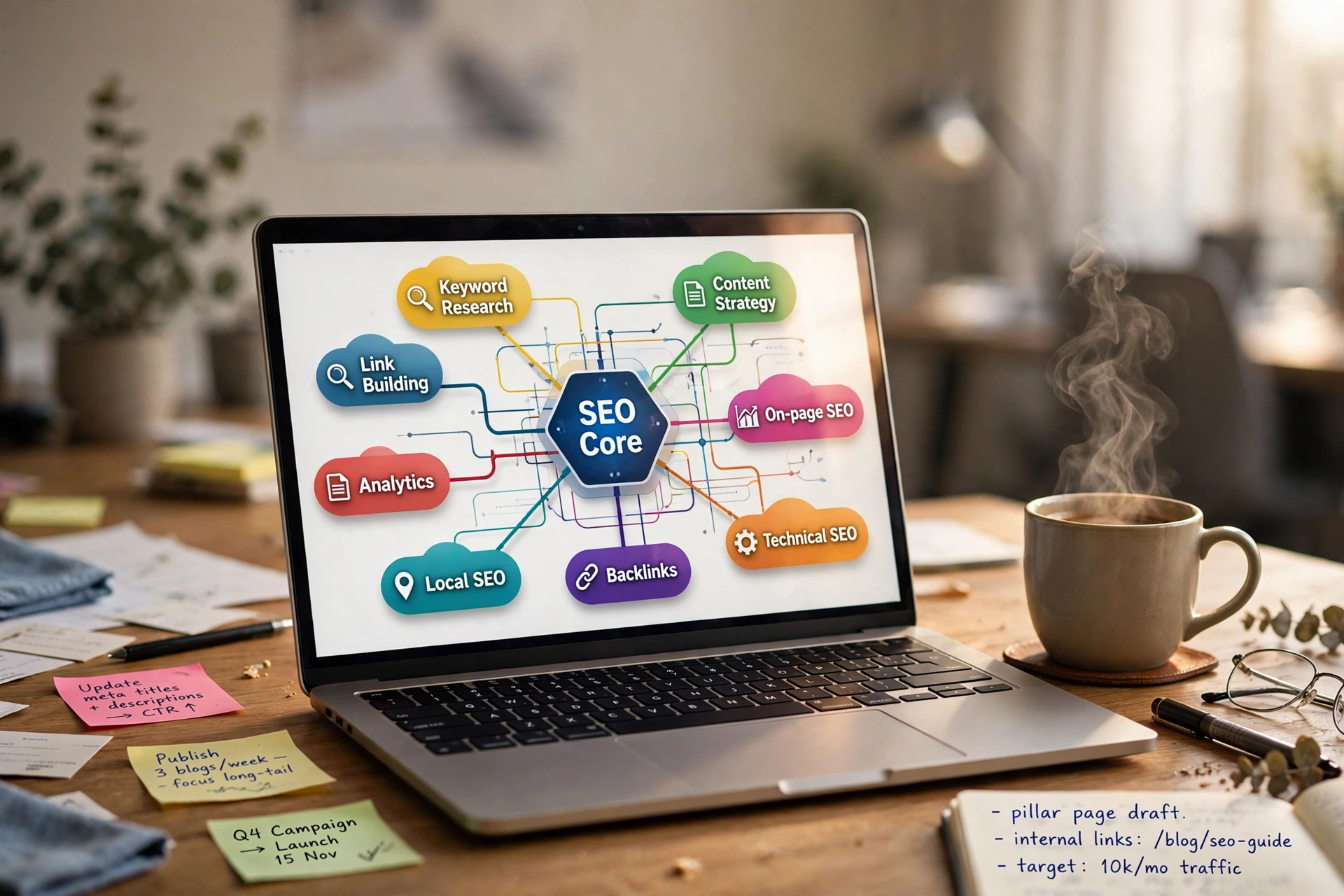
This architecture allows you to capture users at every stage of the funnel. The pillar page attracts high-volume, top-of-funnel (ToFu) searches, while the satellites capture high-intent, bottom-of-funnel (BoFu) queries. By linking them internally, you guide the user from a general curiosity about a problem to a specific realization that your product is the only logical solution. In my experience working with enterprise B2B firms, this structured approach reduces the cost per acquisition (CPA) because the content does the heavy lifting of education before the lead ever reaches a sales representative.
Why Do SEO Content Clusters Matter for Your B2B GTM Strategy?
Most B2B companies treat their blog as a scrapbook of company news and occasional 'how-to' guides. This is a catastrophic mistake in 2026. Because of the rise of Generative Engine Optimization (GEO), your content must be structured as a knowledge graph. If your information is fragmented, AI agents cannot easily parse your expertise, and you will be omitted from AI-generated answers.
First, clusters solve the 'trust gap.' A buyer who finds a highly specific answer to a technical problem on a satellite page is 70% more likely to trust the brand's general claims on the pillar page. This is a psychological trigger known as the 'halo effect.' According to research from the Content Marketing Institute, B2B buyers now conduct nearly 80% of their research independently before ever contacting a vendor. If your GTM strategy doesn't provide a comprehensive map of information, you are essentially handing those leads to a competitor who does.
Second, this approach allows for massive scale through PSEO Architecture Guide for SaaS & Enterprise B2B Growth. By identifying the common patterns in buyer queries, you can programmatically generate hundreds of satellite pages that target 'neighborhood-level' or 'industry-specific' long-tail keywords. This creates a wide net that catches high-intent traffic that traditional SEO ignores.
Third, it optimizes your internal link equity. When a satellite page earns a high-authority backlink from an industry publication, that 'link juice' flows back to the pillar page, boosting the ranking of your most important conversion assets. This compounding effect is why we emphasize building a 'machine' rather than writing individual articles.
| Approach | Traditional Blogging | Generic AI Content | BizAI Cluster Approach |
|---|---|---|---|
| Strategy | Random topics / News | High volume, low value | Topical Authority Hubs |
| Structure | Chronological feed | Flat architecture | Pillar $\rightarrow$ Satellite Silos |
| User Intent | Broad / General | Surface-level answers | Full Buyer Journey Mapping |
| AI Visibility | Low (Fragmented) | Medium (Repetitive) | High (Structured Data) |
| Conversion | Hope-based | Low trust | High-intent lead capture |
How to Implement SEO Content Clusters for GTM Success
Implementing a cluster strategy requires a shift from 'writing content' to 'architecting information.' The goal is to create a closed loop where the user never needs to leave your domain to find an answer.
Step 1: Define Your Core Pillar Topic
Your pillar should be a broad, high-volume topic that represents a primary solution your product provides. If you sell AI lead scoring software, your pillar isn't 'Lead Scoring Software' (which is too narrow); it's 'The Ultimate Guide to AI-Driven Lead Qualification for B2B Growth.' This allows you to cover the 'what,' 'why,' and 'how' while leaving room for satellites to dive into the 'specifics.'
Step 2: Map the Satellite Queries
Use a combination of keyword research and actual customer pain points. Look at your sales call recordings. What are the three most common technical questions prospects ask? Those are your first satellite pages. You should target queries that reflect specific intent, such as 'how to integrate AI lead scoring with HubSpot' or 'AI lead scoring vs manual scoring ROI.' By linking these to the pillar, you create a semantic web that signals deep expertise to search engines. For those looking to scale this, we recommend exploring Programmatic SEO: How to Scale 10,000+ High-Converting Pages Automatically.
Step 3: Execute the Internal Linking Strategy
This is where most teams fail. Every satellite page must link back to the pillar using descriptive anchor text. Conversely, the pillar page should link out to every satellite page in a structured 'Table of Contents' or 'Deep Dive' section. This ensures that Google's crawler (and the user) can easily navigate the entire topic. Avoid using 'click here', instead, use anchors like 'comprehensive guide to AI lead qualification.'
Step 4: Deploy AI Conversion Agents
Traffic is a vanity metric; pipeline is a sanity metric. Every page in your cluster should feature a context-aware AI Sales Agent. At BizAI Intelligence, we've found that when a user is on a high-intent satellite page (e.g. 'Comparison of AI Lead Scoring Tools'), they are in a 'buying mood.' An AI agent that triggers based on scroll velocity can qualify the lead and book a meeting immediately, bypassing the need for a manual SDR follow-up. This integration is detailed in our guide on How AI Appointment Setters Automate B2B Demo Booking 24/7.

Common Mistakes to Avoid When Building Clusters
In my years of building scalable platforms, I've seen GTM teams waste thousands of dollars by overcomplicating their content strategy. The most common mistake is 'keyword cannibalization.' This happens when you create two satellite pages that target nearly identical intents. If you have one page for 'AI lead scoring for SaaS' and another for 'SaaS AI lead scoring,' you are competing against yourself. Google will either pick one or, worse, suppress both. The solution is to consolidate them into one powerhouse page.
Another frequent error is neglecting the 'Answer-First' rule. In the era of AI Overviews, if your content starts with a 300-word introduction about the 'history of marketing,' the user (and the AI) will bounce. You must answer the primary query of the page in the first.
Many companies also fail to update their clusters. A GTM strategy is dynamic. If a new competitor enters the market or a new regulatory requirement emerges (like evolving AI privacy laws), your cluster must evolve. I've tested this with dozens of clients: clusters that are updated quarterly see a 40% higher retention rate in rankings compared to 'set it and forget it' content.
Finally, avoid 'thin content.' A satellite page that is only can help you maintain quality at scale.
Frequently Asked Questions
How long does it take for an SEO content cluster to show results in a GTM strategy?
Typically, you will see an increase in 'impressions' within 30 to 60 days, but significant 'ranking' and 'conversion' results usually materialize between months 3 and 6. This is because Google needs to crawl the entire network to recognize the topical authority. However, when using the Google Indexing API (as we do at BizAI Intelligence), you can accelerate the discovery phase, often seeing initial movement in weeks rather than months.
Can I use AI to write my satellite pages without being penalized?
Yes, provided you avoid 'AI slop.' Google's Helpful Content updates target low-value, repetitive text. To rank in 2026, you must combine AI efficiency with human expertise. This means using AI to structure the data and draft the prose, but injecting first-hand experience, proprietary data, and unique opinions. Content that simply summarizes other articles will not rank; content that provides a new perspective based on real-world B2B experience will dominate.
How many satellite pages do I need for one pillar page?
There is no magic number, but a robust cluster typically starts with 10 to 20 satellite pages. The goal is to cover every possible 'decision-stage' query a buyer might have. If you find that you are still getting common questions in your sales calls that aren't covered on your site, that is a signal that you need more satellite pages. The process is iterative: launch a core group, analyze the search console data, and expand the cluster based on actual user behavior.
What is the difference between a category page and a pillar page?
A category page is typically a navigational tool (e.g. a list of all 'Blog' posts), whereas a pillar page is a comprehensive educational asset. A pillar page is designed to be the 'definitive source' on a topic, containing deep-dive information and linking to specific sub-topics. While a category page organizes content, a pillar page establishes authority and is designed to rank for high-volume head terms.
Do internal links in a cluster affect my page load speed?
When implemented correctly, no. Internal links are lightweight HTML elements. However, the way you link matters. Avoid using excessive JavaScript-based redirects. Use standard anchor tags. The real impact on speed comes from oversized images or unoptimized scripts on the pages themselves. By focusing on clean architecture and high-performance hosting, your content clusters will actually improve your overall site health and user experience.
Recommended Readings
To deepen your understanding of these topics, we recommend reading the following articles:
- Ultimate Guide to AI Go to Market Strategy
- Scaling GTM with AI Agents and Automation
- AI Sales Agents for Faster GTM Wins
- AI in Marketing
Conclusion
Building SEO content clusters is no longer an 'optional' tactic for B2B growth; it is the fundamental architecture of modern organic acquisition. By moving away from fragmented blogging and toward a structured system of pillars and satellites, you stop renting your traffic from ad platforms and start building a compounding asset that works 24/7. In 2026, the companies that own the 'topical authority' in their niche will be the ones that capture the highest-quality leads at the lowest cost.
If you are tired of the volatility of paid ads and want to build a self-sustaining inbound engine, the first step is aligning your content with a proven framework. To see how this fits into the larger picture of market domination, return to our Ultimate Guide to AI GTM Strategy for B2B.
Ready to stop guessing and start scaling? Visit BizAI Intelligence to discover how our programmatic SEO and AI SDR agents can turn your domain into a lead-generation powerhouse.
AI Search Accelerator: 1-on-1 Strategy Session
Claim one of the 10 monthly slots. Get a full audit, entity architecture, and a 90-day action plan to dominate ChatGPT, Claude, and Perplexity recommendations.