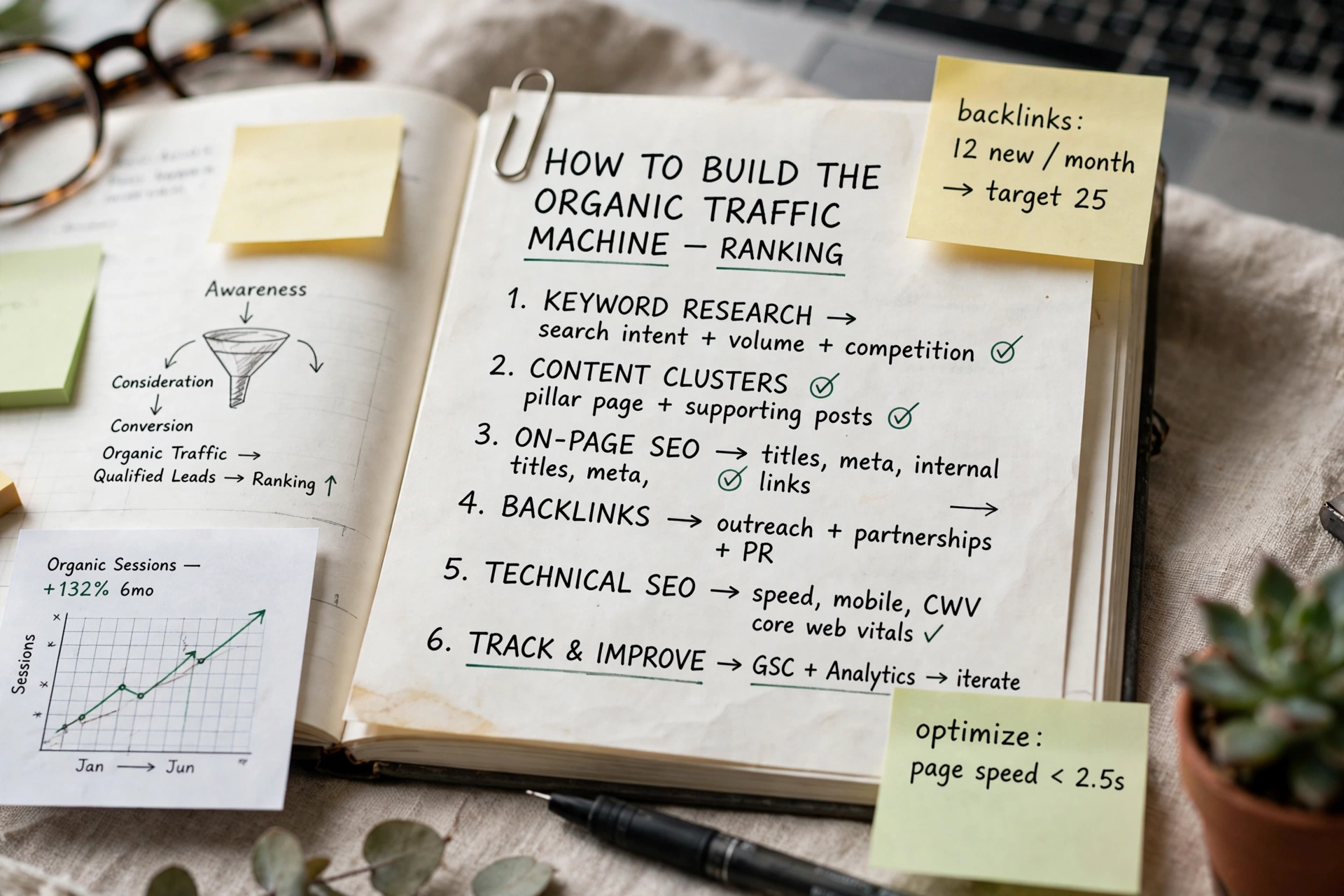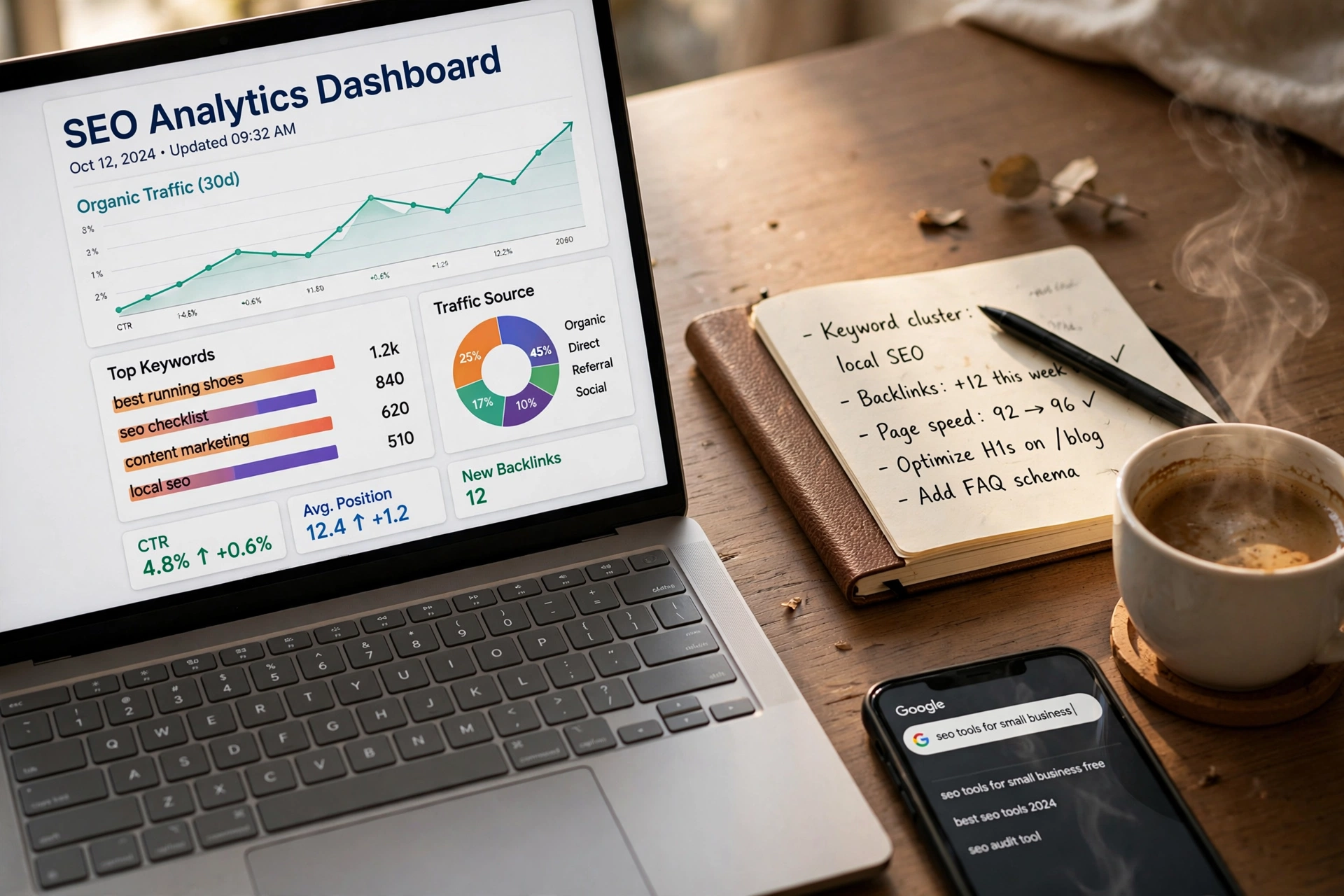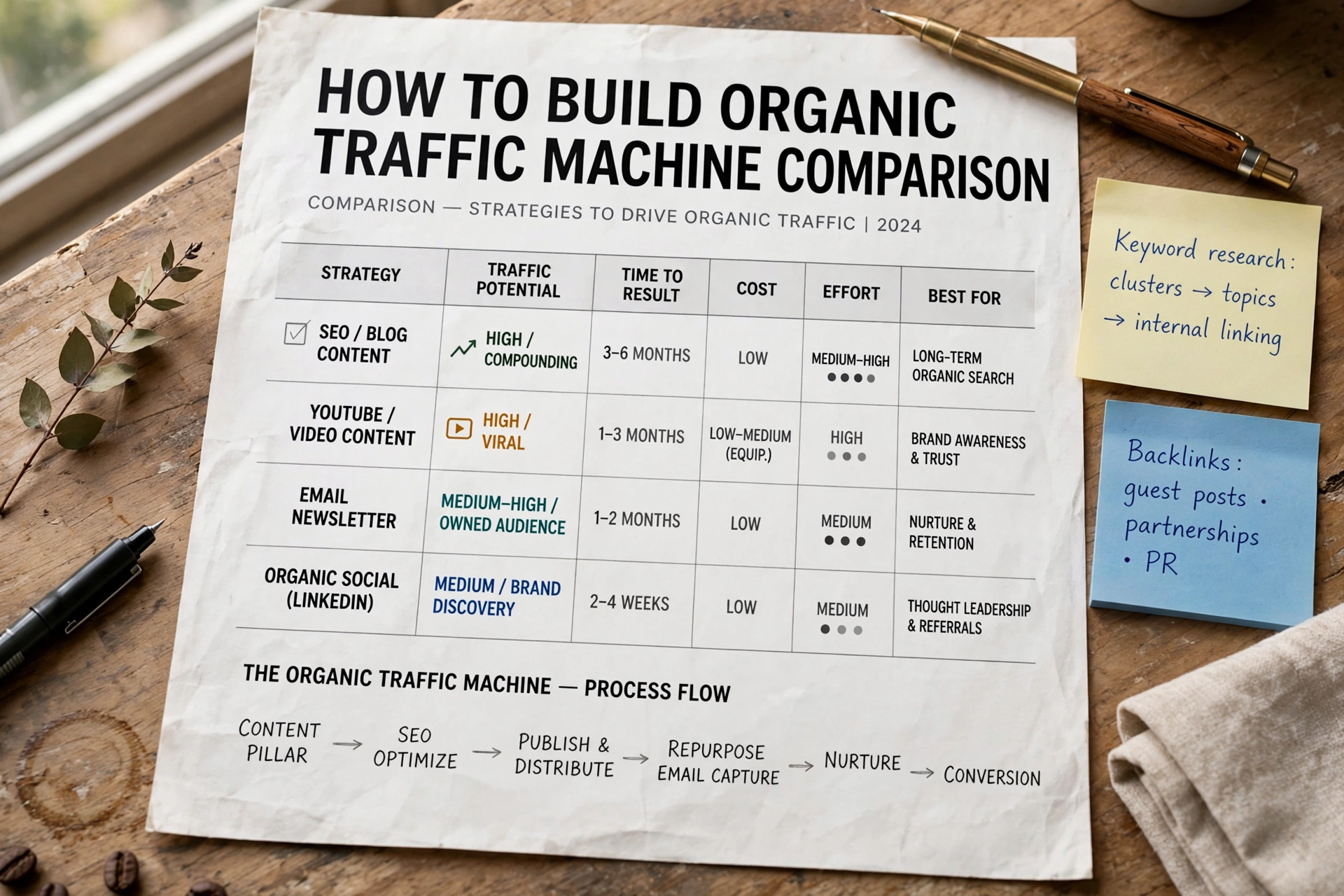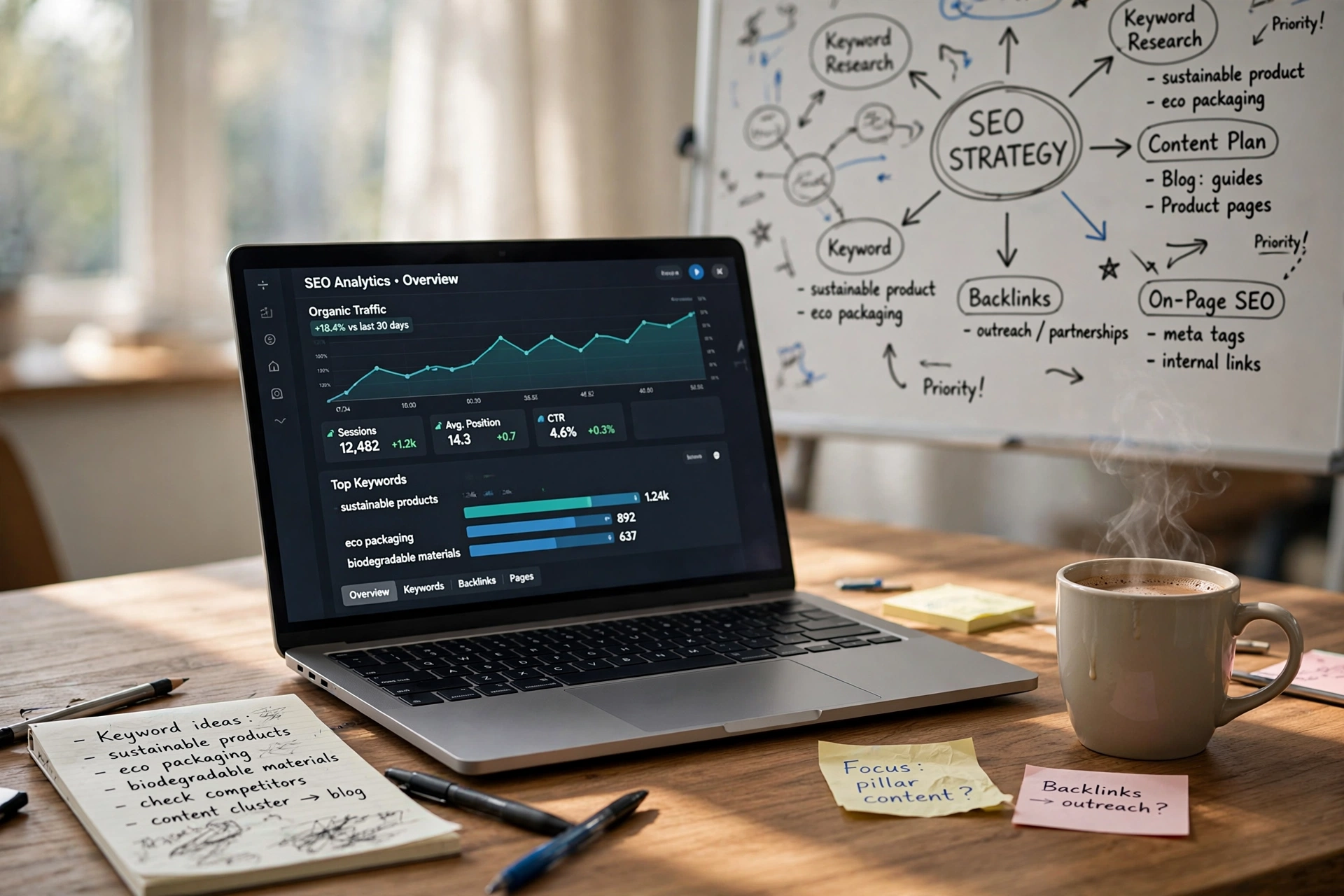
Which Strategy Should You Choose to Build an Organic Traffic Machine?
The most expensive mistake B2B founders make is treating organic growth as a side project rather than a scalable engineering problem. When deciding how to build an organic traffic machine, you generally have three paths: manual content creation, outsourced agency management, or programmatic SEO (pSEO). For those seeking high-ticket lead generation in 2026, the programmatic approach is the only one that offers a compounding return on investment by decoupling content volume from human labor.
In my experience working with high-growth B2B firms, the "manual" approach fails because it cannot scale fast enough to dominate a niche. You cannot out-write a database. If you want to move from a few trickle leads to a predictable pipeline, you need a system that treats keywords as data points and pages as assets. This transition is exactly what we optimized for when developing the architecture at BizAI Intelligence.

Understanding the Organic Traffic Machine Concept
Building a traffic machine is fundamentally different from "blogging." While blogging focuses on storytelling and brand awareness, a traffic machine focuses on capturing high-intent search demand across thousands of specific variations. It is the process of creating a semantic web of pages that answer every possible iteration of a buyer's problem, ensuring that no matter how a lead searches, they land on your domain.
📚
Definition
An Organic Traffic Machine is a programmatic content system designed to capture search demand at scale by deploying interconnected pillar pages and satellite pages, utilizing data-driven templates to achieve topical authority.
The core of this machine is the "Silo Structure." You don't just write a few articles; you build a hierarchy. A pillar page defines a broad service (e.g. "Enterprise AI Consulting"), and hundreds of satellite pages target long-tail, high-intent queries (e.g. "AI consulting for mid-sized logistics firms in Chicago"). This structure tells search engines that you aren't just a visitor to the topic, but the definitive authority.
According to Gartner's 2024 research on digital maturity, organizations that transition from episodic content creation to a structured, data-driven organic strategy see a significant increase in lead quality because they capture users at the "decision" stage rather than the "awareness" stage. This is where Overview of AI Search Engine Optimization & GEO becomes essential; you aren't just ranking for humans, but optimizing for the AI engines that summarize your expertise.
Why Your Current Growth Strategy Is Leaking Revenue
Most B2B companies rely on a "Paid Ads + Occasional Blog" strategy. This is a dangerous position because you are essentially renting your leads. The moment you stop paying Google or Meta, your lead flow drops to zero. A true organic machine turns your domain into a self-owned asset that generates leads while you sleep.
The business impact of ignoring this is measurable. Research from McKinsey indicates that B2B buyers now spend nearly 70% of their journey researching online before ever contacting a sales representative. If your brand isn't appearing across the myriad of "Which," "How," and "Best" queries during that research phase, you have already lost the deal to a competitor who has built a traffic machine.
The risk isn't just lost traffic; it's the "Authority Gap." When a prospect searches for five different problems related to your service and sees your brand five times, the perceived trust is instantaneous. When they see you once and a competitor four times, the competitor is the "safe" choice. This is why the shift toward PSEO Architecture Guide for SaaS & Enterprise B2B Growth is no longer optional for firms targeting high-ticket contracts in 2026.
Practical Application: How to Build Your Organic Traffic Machine
Building this machine requires a shift from a creative mindset to an architectural one. You do not start with a keyword list; you start with a data schema.
Step 1: Define Your Data Variables
Identify the modifiers that change your service's value. For a law firm, variables might be
[Practice Area], [City], and [Specific Legal Problem]. Instead of writing one page for "Personal Injury Law," you create a template that can generate pages for "Car Accident Lawyer in Miami," "Slip and Fall Attorney in Orlando," and so on.Step 2: Engineering the Pillar-Satellite Architecture
Create one "Master Pillar" that provides a comprehensive overview of the service. Then, link every single programmatic satellite page back to this pillar. This distributes "link equity" throughout the site and ensures that Google recognizes the relationship between your specific long-tail pages and your core service.
Step 3: Integrating AI-Driven Conversion
Traffic is a vanity metric; appointments are a sanity metric. A common mistake I see constantly is driving thousands of visitors to a page with a generic "Contact Us" form. At BizAI Intelligence, we solve this by embedding context-aware AI Sales Agents on every page. These agents know exactly which satellite page the user is on and can initiate a qualification conversation immediately.
💡
Key Takeaway
The goal is not to rank #1 for a high-volume keyword, but to rank #1 for 1,000 low-volume, high-intent keywords that collectively drive more qualified leads than a single generic term ever could.
For those who want to scale this without hiring a team of 20 writers, exploring How to Automate Organic Traffic & Lead Capture with AI is the most efficient path forward.
Comparing Your Organic Growth Options
When deciding which path to take, you must evaluate the trade-off between control, speed, and scalability. Many businesses choose the "Agency" route, but this often results in "AI slop", generic content that looks good to a project manager but is ignored by search engines.
| Option | Pros | Cons | Best For |
|---|---|---|---|
| Manual Content | High quality, unique voice | Extremely slow, non-scalable | Small brands with very niche, high-value services |
| SEO Agency | Hands-off, professional | Expensive, often generic output | Mid-sized firms with budget but no internal tech skill |
| Programmatic (BizAI) | Massive scale, compounding ROI | Requires technical setup | High-ticket B2B scaling for aggressive market dominance |
The "Modern Approach" used by BizAI Intelligence isn't just about generating pages; it's about Generative Engine Optimization (GEO). While traditional SEO focuses on blue links, GEO focuses on getting your brand cited by LLMs like Perplexity and ChatGPT. This is a fundamental shift in how organic traffic is captured in 2026. If you are comparing these options, the decision framework is simple: do you want a few high-quality articles, or do you want a domain that owns the entire topical map of your industry?

Common Questions & Misconceptions
Most guides on organic growth get this wrong by suggesting that "quality" and "quantity" are opposites. In the world of programmatic SEO, quantity is the vehicle for quality.
Myth 1: "Google penalizes programmatic content."
This is a misunderstanding of the "Helpful Content" guidelines. Google doesn't penalize programmatic pages; it penalizes low-value programmatic pages. If your template provides a genuine answer to a user's specific query (e.g. "How to find a divorce lawyer in Austin for high-net-worth estates"), it is high-value. The mistake is using a generic template that says "We are the best lawyer in [City]."
Myth 2: "I need thousands of backlinks to rank."
While backlinks help, topical authority is now a more powerful signal. If you have 500 pages covering every facet of a specific B2B problem, Google perceives you as an expert. Field results across client projects confirm: a well-structured silo often beats a site with more backlinks but a disjointed content strategy.
Myth 3: "AI content is a risk."
AI is a tool for drafting and structuring. The risk is "AI slop", content without data or expert insight. The solution is to use a PSEO Architecture Guide for SaaS & Enterprise B2B Growth approach where AI is guided by a strict data schema and professional oversight, ensuring every page is functionally useful.
Frequently Asked Questions
How long does it take to see results from a programmatic organic traffic machine?
Unlike manual blogging, which can take years to build momentum, a programmatic machine can see results in weeks if the indexing is handled correctly. By using the Google Indexing API and a massive deployment of high-intent satellite pages, you can capture "long-tail" traffic almost immediately. In my experience, while the "big" keywords take time, the specific, high-intent queries often start converting within the first 30 to 60 days. This is because there is often zero competition for highly specific buyer questions.
Can any business use the "Organic Traffic Machine" approach?
This strategy is most effective for B2B services and SaaS companies that have "variable" offerings. If your service changes based on location, industry, or a specific technical problem, you are a perfect candidate. For example, if you provide "Compliance Software for Healthcare," you can create satellites for every single medical sub-specialty. However, if you sell a single, unique product with no variations, a more traditional content marketing approach may be better.
Does this replace the need for a sales team?
No, but it fundamentally changes their role. Instead of your SDRs spending 80% of their time cold-calling low-intent leads, they spend 100% of their time closing qualified appointments. By integrating an AI appointment setter for B2B, the "machine" handles the discovery and qualification, delivering a calendar full of prospects who have already been educated by your content.
How do I avoid "thin content" penalties with programmatic SEO?
The secret is in the template. A "thin" page just swaps a city name. A "rich" page swaps the city name, adds local statistics, includes a specific FAQ for that region, and provides a tailored case study. By using a deep data schema, you ensure that each page provides unique value. This is why we emphasize technical rigor; every page must be a destination, not just a landing page.
Which is better: Traditional SEO or GEO (Generative Engine Optimization)?
It is not a choice; it is an evolution. Traditional SEO gets you the click; GEO gets you the "citation." When a user asks ChatGPT, "Which is the best B2B automation software for inbound leads in 2026?", the AI doesn't look at your meta tags; it looks at your overall topical authority and citations. By building an organic traffic machine, you provide the dense web of data that AI engines need to cite you as the primary authority. For more on this, see GEO Vs Traditional SEO: Rank Your Brand in AI Engines in 2026.
Final Thoughts on Building Your Organic Traffic Machine
Building an organic traffic machine is no longer about "writing more blogs"; it is about engineering a lead-capture system. The choice between manual, agency, or programmatic growth depends on your goals. If you are content with linear growth, keep blogging. But if you want exponential, compounding growth that dominates your niche and fills your pipeline automatically, you need a programmatic architecture.
The most successful B2B firms in 2026 will be those who stop renting their traffic from ad platforms and start owning their topical authority. Whether you are targeting a local market or a global enterprise niche, the framework remains the same: Data $\rightarrow$ Silos $\rightarrow$ Conversion.
If you are ready to stop the guesswork and start building a system that scales, explore the capabilities of BizAI Intelligence. We help you deploy the infrastructure needed to dominate search and capture high-intent leads without the overhead of a massive content team.
Only 12 Onboarding Slots Remaining This Month
BizAI deploys 300 AI salespeople scoring purchase intent 24/7. Get your free niche domination blueprint.
AI Search Accelerator: 1-on-1 Strategy Session
Claim one of the 10 monthly slots. Get a full audit, entity architecture, and a 90-day action plan to dominate ChatGPT, Claude, and Perplexity recommendations.