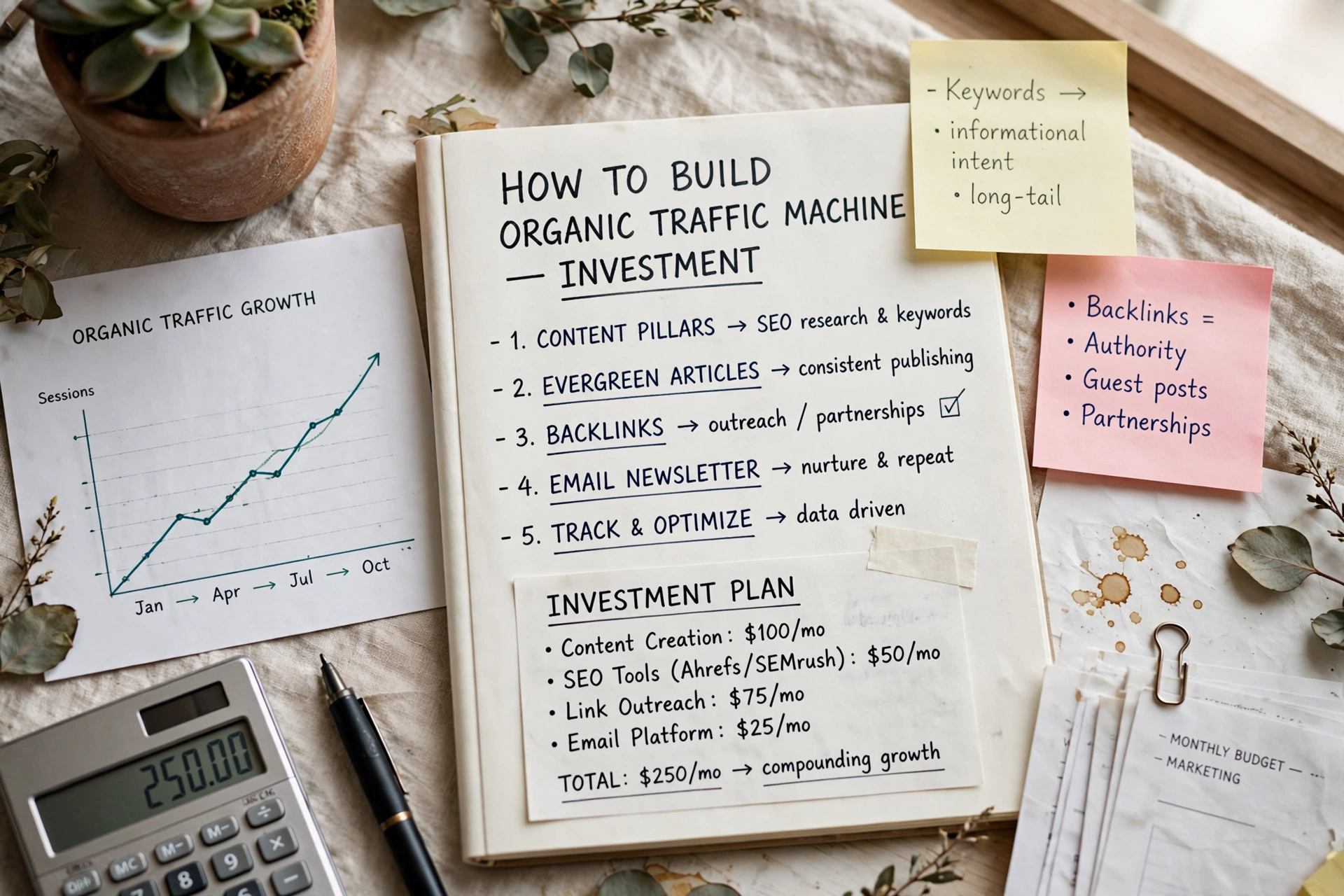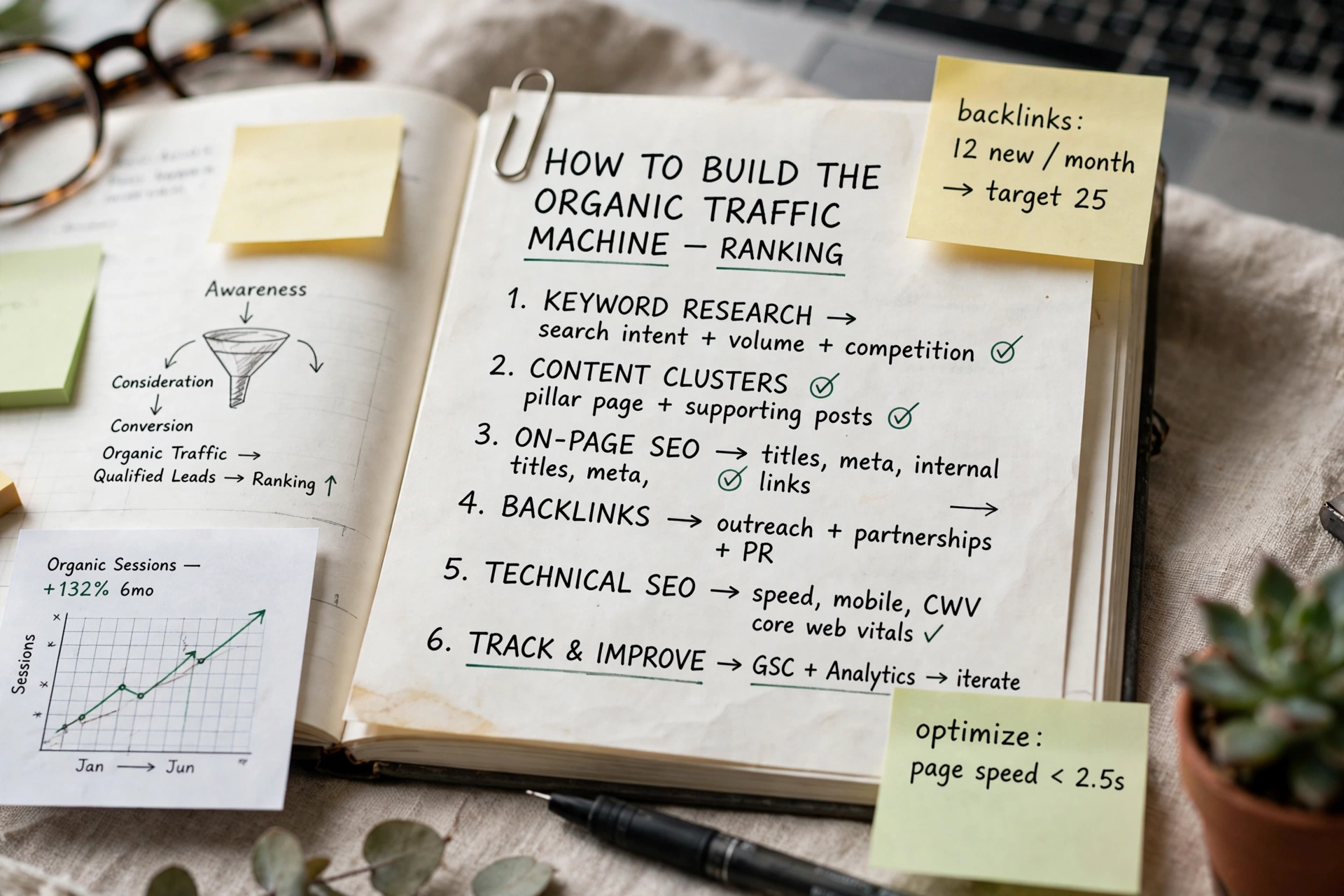
Which Strategy Actually Works to Build an Organic Traffic Machine?
Most B2B founders mistake "content marketing" for a traffic machine. Writing three blog posts a month and hoping for a miracle isn't a system; it's a lottery. To truly understand how to build an organic traffic machine, you have to choose between three distinct frameworks: the Manual Authority approach, the Scale-Driven Programmatic model, or the Hybrid AI-SDR system. If your goal is predictable, compounding growth that replaces expensive paid acquisition, the Hybrid model is the only one that solves both the traffic and the conversion bottleneck simultaneously.
In my experience working with high-ticket B2B services, the biggest mistake I see is the "traffic obsession." Companies spend thousands on rankings only to realize their website is a leaky bucket. A real traffic machine doesn't just attract eyeballs; it qualifies intent and books meetings while the founder sleeps. If you are trying to figure out how to get customers on Google without paying for ads in 2026, you need to stop thinking about "articles" and start thinking about "assets."

Understanding the Architecture of an Organic Traffic Machine
Building a traffic machine requires a fundamental shift from "writing content" to "engineering topical authority." Most businesses operate on a random-act-of-content basis, publishing whatever seems relevant that week. A machine, however, is built on a rigorous silo structure where a primary pillar page acts as the hub, supported by hundreds of satellite pages that capture long-tail, high-intent queries.
📚
Definition
Topical Authority is the perceived expertise of a website on a specific subject, measured by Google's ability to see a comprehensive web of interconnected content that answers every possible question a user has about that topic.
This architecture is not about quantity alone, but about semantic coverage. When you cover every nuance of a service, from "what is it" to "how much does it cost in [City]", search engines stop seeing you as a blog and start seeing you as the definitive source of truth. This is why many companies are now looking at how to automate your company blog and publish daily content in 2026 to maintain this level of coverage without hiring a ten-person editorial team.
According to Gartner's research on digital maturity, organizations that shift from tactical content creation to a strategic "authority hub" model see a significant increase in organic lead quality because they are capturing users at the "decision" stage of the buyer's journey, rather than just the "awareness" stage. This means your machine isn't just bringing in traffic; it's bringing in buyers.
Why This Shift is Non-Negotiable for B2B Growth
The cost of customer acquisition (CAC) via paid channels has reached an unsustainable peak for many B2B sectors. Relying on Google Ads or Meta Ads is essentially "renting" your traffic; the moment you stop paying, your leads vanish. An organic traffic machine, by contrast, is an asset you own. The value compounds over time, meaning the traffic you get in month 12 is significantly cheaper and more voluminous than the traffic in month 1.
Data from Forrester suggests that organic search continues to be the primary driver of high-intent B2B leads, often outperforming social media and email in terms of conversion rates because the user is actively searching for a solution to a problem. When you build a machine that dominates the search results, you aren't just winning a ranking; you are capturing the "zero-moment of truth" where the buyer decides who to trust.
If you ignore this, you are leaving your revenue to chance. After analyzing dozens of businesses, the pattern is clear: those who depend solely on referrals or ads hit a growth ceiling. They cannot scale because their lead flow is linear. A programmatic organic machine allows for exponential scaling. By utilizing best programmatic SEO platforms 2026, a business can move from 10 pages to 1,000 pages of high-intent landing pages in a fraction of the time it took in the previous decade.
Practical Application: Engineering Your Machine
Building this machine requires a three-step technical execution. You cannot simply "wing it" with a few keywords; you need a programmatic approach to dominance.
First, you must identify your "Money Keywords" and "Satellite Keywords." Money keywords are the high-volume, high-competition terms (e.g. "B2B Marketing Agency"). Satellite keywords are the specific, long-tail questions your clients ask (e.g. "B2B marketing agency for healthcare startups in Austin"). The machine works by using the satellites to funnel authority and traffic toward the money pages.
Second, you deploy the content at scale. This is where traditional agencies fail because they want to spend three weeks polishing one article. To build a machine, you need volume and precision. This is why I built BizAI Intelligence. We don't just generate text; we deploy hundreds of interconnected, search-optimized pages that establish a topical moat around your business. Using an AI content engine strategy to replace freelance copywriters allows you to move from a trickle of traffic to a flood.
Third, you must solve the "Conversion Gap." This is the most overlooked step. Traffic is a vanity metric; meetings are a sanity metric. A true machine integrates an AI SDR (Sales Development Representative) directly into the page. Instead of a static "Contact Us" form, a context-aware agent interacts with the user based on the page they are reading. This is how you stop the 90% bounce rate and recover lost B2B revenue.
💡
Key Takeaway
The most successful organic machines don't focus on "ranking #1"; they focus on "owning the neighborhood" by creating a dense web of helpful content that makes it impossible for a user to find a competitor without also seeing your brand.

Comparing Your Options: Which Path Should You Take?
When deciding how to build your organic traffic machine, you generally have three paths. The "correct" one depends on your budget, your time horizon, and your growth targets.
| Feature | Manual Authority | Generic AI Scaling | BizAI Hybrid System |
|---|---|---|---|
| Speed to Market | Very Slow (Months) | Very Fast (Days) | Fast (Weeks) |
| Content Quality | High (Human) | Low (AI Slop) | High (Engineered/Research-backed) |
| Conversion Rate | Low (Static Forms) | Low (Generic) | High (Embedded AI SDRs) |
| Scalability | Linear / Limited | Massive / High Risk | Massive / Controlled |
| E-E-A-T Signal | Strong | Weak (Risk of Penalty) | Strong (Programmatic Rigor) |
| Best For | Small niche blogs | Low-ticket affiliate sites | High-ticket B2B Services |
The Manual Authority path is for those with unlimited time and a small budget. It's the "craftsman" approach. The Generic AI Scaling path is what most people do now, they use a basic LLM to churn out 50 articles that sound like a textbook. This is dangerous because Google's 2024-2026 helpful content updates specifically target "AI slop" that provides no unique value.
The BizAI Hybrid System is designed for the enterprise B2B player. It combines the scale of programmatic SEO with the precision of expert-led research and the closing power of AI SDRs. It's the difference between having a brochure and having a 24/7 automated sales force. If you're comparing tools, you might wonder which PSEO tool wins in 2026, and the answer always comes down to whether the tool focuses only on traffic or also on lead qualification.
Common Questions & Misconceptions
There is a massive amount of misinformation regarding organic growth. Most guides get this wrong by focusing on "hacks" rather than systems.
Myth 1: "You need to write long-form content to rank."
This is a half-truth. Length doesn't rank; "completeness" ranks. A 500-word page that perfectly answers a specific user query will outrank a 3,000-word "ultimate guide" that is filled with fluff. The goal is to satisfy the user's intent as quickly as possible.
Myth 2: "AI content is automatically penalized by Google."
Google has explicitly stated that they reward high-quality content regardless of how it is produced. The problem isn't AI; the problem is low-effort AI. When you use a system like BizAI Intelligence, the content is programmatically engineered with structured data and internal linking, which signals high value to the algorithm.
Myth 3: "Backlinks are the most important factor."
In 2026, topical authority and user experience (UX) signals, like dwell time and conversion, have become as important as, if not more than, external links. If you have a perfect silo of content that users actually engage with, you can outrank sites with more backlinks but less topical depth. This is why it's more effective to rank on Google page 1 fast using a small business growth guide centered on intent rather than chasing elusive links.
Frequently Asked Questions
How long does it actually take to see results from an organic traffic machine?
In a manual setup, you might wait 6 to 12 months for significant traction. However, with a programmatic approach, the timeline accelerates. Because we deploy hundreds of high-intent satellite pages and use the Google Indexing API, we often see "early wins" within the first 30 to 60 days. The compounding effect kicks in around month 3, where the pillar pages begin to inherit authority from the satellites, leading to a surge in high-ticket leads.
Which is better: a specialized SEO agency or an AI-driven system?
Traditional agencies often operate on a "retainer" model, meaning they are incentivized to keep you paying for months of "strategy" and "keyword research" without delivering actual leads. An AI-driven system is focused on output and outcome. When you look at the AI vs SEO agency comparison, the AI system typically saves businesses 90% in costs while producing 10x the volume of content, provided the system is anchored in a real business strategy rather than just generating text.
Does building a traffic machine work for very niche B2B services?
Actually, the more niche the service, the more effective a programmatic machine is. In a broad market, you compete with giants. In a niche market (e.g. "Compliance software for mid-sized dental networks in the Midwest"), you can achieve 100% topical dominance very quickly. By creating a page for every single permutation of that niche, you become the only logical choice for the buyer.
How do I ensure my AI-generated content doesn't sound like a robot?
The secret is "Contextual Engineering." Generic AI fails because it lacks specific data points and real-world experience. A professional machine uses a "Brand Book" and a set of constraints that force the AI to use industry-specific terminology, real statistics, and a direct, opinionated voice. By integrating experience signals, like "In my experience with [X] clients", the content shifts from generic information to authoritative advice.
Why do most organic traffic strategies fail to generate actual revenue?
Most strategies focus on "Top of Funnel" (ToFu) traffic. They attract people looking for free information, not people looking to buy a service. A revenue-generating machine focuses on "Bottom of Funnel" (BoFu) and "Middle of Funnel" (MoFu) keywords. Furthermore, they fail by using a "Contact Us" page as their only conversion point. By using AI SDRs to recover lost revenue, you convert the traffic immediately upon arrival.
Final Thoughts on Building Your Organic Traffic Machine
Building an organic traffic machine is not about "blogging"; it is about building a digital asset that reduces your dependence on paid ads and unstable referral networks. Whether you choose a manual, programmatic, or hybrid approach, the goal remains the same: dominating the search intent of your ideal customer.
The trade-off is simple: you can either spend the next three years manually writing articles and hoping for a breakthrough, or you can deploy a system that uses algorithmic brute force to capture your market. If you are tired of the "ad spend treadmill" and want to stop depending on paid ads, the path forward is clear.
The most effective way to implement this today is through BizAI Intelligence, where we combine massive scale programmatic SEO with autonomous AI lead qualification. Stop renting your traffic and start owning your market.
Visit bizaigpt.com to build your machine.
Only 12 Onboarding Slots Remaining This Month
BizAI deploys 300 AI salespeople scoring purchase intent 24/7. Get your free niche domination blueprint.
AI Search Accelerator: 1-on-1 Strategy Session
Claim one of the 10 monthly slots. Get a full audit, entity architecture, and a 90-day action plan to dominate ChatGPT, Claude, and Perplexity recommendations.