Which Strategy Is Right For Your Business: Comparing Organic Traffic Machines
Most B2B founders treat organic growth as a lottery ticket, hoping that a few well-written blogs will eventually trigger a windfall of leads. I've seen this pattern dozens of times: a company spends six months on "high-quality" content that attracts thousands of visitors, yet the CRM remains empty because the traffic has zero buyer intent. If you are trying to figure out how to build an organic traffic machine that actually converts, you must first decide between three distinct architectures: the Manual Authority approach, the Scaled AI approach, and the Programmatic Engine. The right choice depends entirely on your ticket price, your current technical debt, and how quickly you need to dominate your niche in 2026.
For those who need immediate scale, the answer is almost always a Programmatic SEO (pSEO) framework paired with an AI SDR. While manual blogging builds deep trust, it cannot compete with the algorithmic brute force of hundreds of intent-optimized pages. If you want to stop depending on paid ads, you need a system that captures long-tail queries before your competitors even know they exist.
What Exactly Is an Organic Traffic Machine?
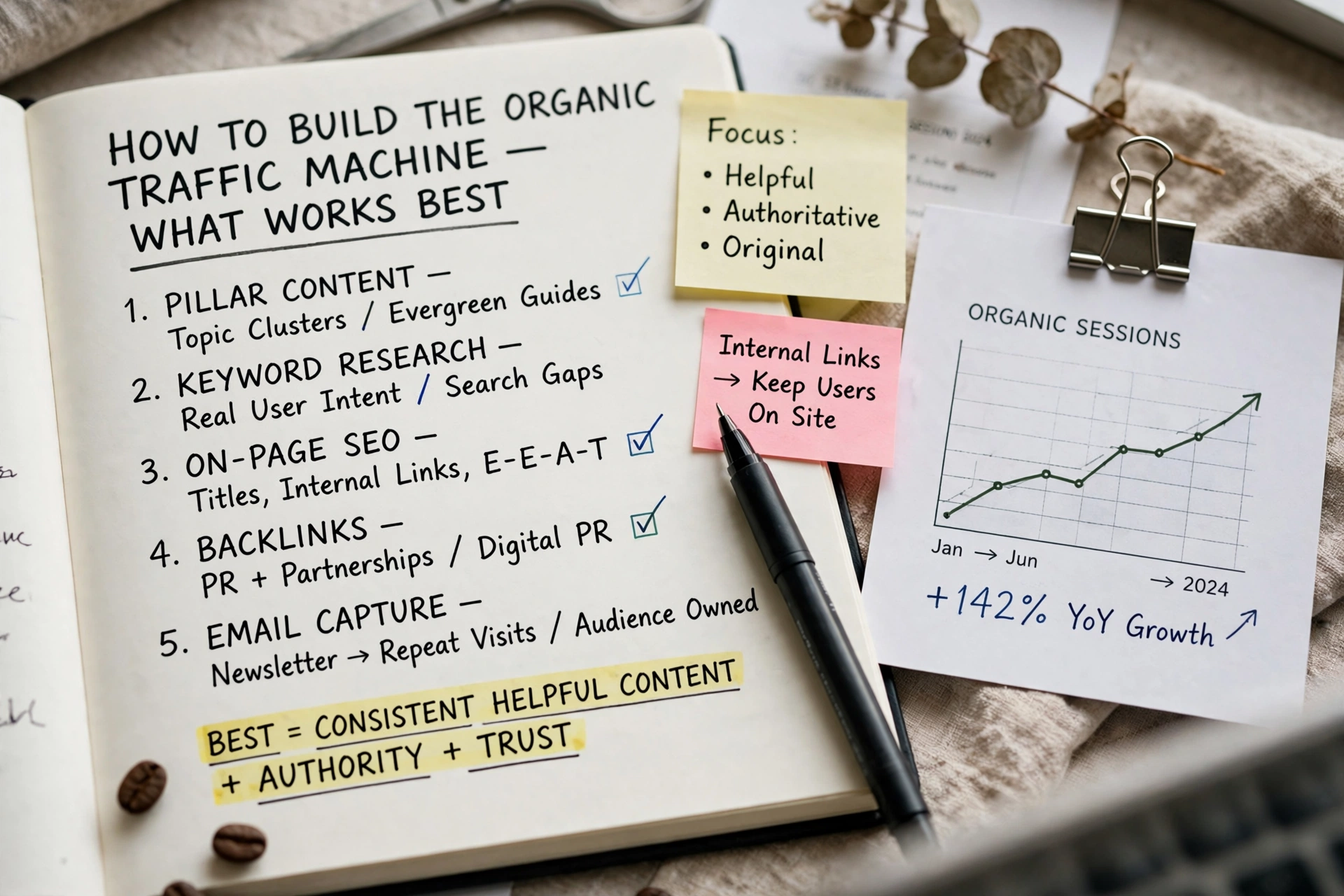
An organic traffic machine is not just a blog; it is a technical ecosystem designed to capture, qualify, and convert search intent at scale without recurring ad spend. Unlike traditional content marketing, which focuses on "brand awareness," a traffic machine focuses on "topical dominance." This means creating a network of pillar pages and satellite pages that answer every possible question a buyer has during their decision journey.
📚
Definition
Topical Dominance is the state where a domain is recognized by search engines as the definitive authority on a specific subject, causing its pages to rank higher across a broad spectrum of related keywords, regardless of individual page strength.
In my experience working with high-ticket B2B service providers, the biggest mistake I see is the "Random Act of Content." Companies write about whatever the CEO feels like that week. A true machine operates on a data-driven map. It identifies "money keywords", queries that signal a high intent to buy, and builds a structured silo around them. This involves utilizing artificial intelligence to analyze search patterns and search engine optimization to ensure those pages are indexed and ranked.
According to a recent report by Gartner, by 2026, traditional search volume will decline as users shift toward AI-powered answer engines. This means a modern traffic machine must be optimized for both Google Search and Generative Engine Optimization (GEO). You cannot simply write for humans anymore; you must write in a way that LLMs (Large Language Models) can easily parse, cite, and recommend. This requires structured data, clear hierarchies, and factual density.
Why Building a Traffic Machine Is Essential for 2026 Revenue
The economics of B2B acquisition have shifted. Paid ads (PPC) have become a "tax" on growth; as more competitors enter the auction, the Cost Per Acquisition (CPA) climbs, eating your margins. A traffic machine transforms your marketing from a variable expense into a compounding asset. When you own the organic real estate for your primary service, your lead cost effectively drops toward zero over time.
The business impact of this shift is measurable. Forrester research indicates that B2B buyers are now 70% through their buying journey before they even contact a sales representative. If you aren't the one providing the answers during that 70% of their research, you are essentially handing your leads to the competitor who is. By the time a lead reaches out to you, they shouldn't be asking "What do you do?" but rather "How quickly can we start?"
Moreover, the risk of relying on a single channel is too high. I've seen businesses lose 40% of their pipeline overnight because of a single algorithm update or a sudden spike in LinkedIn ad costs. A diversified organic machine creates a moat around your business. By deploying a strategy that includes AI blog automation, you ensure that your domain remains fresh and relevant, which signals stability and authority to both users and search engines.
The consequence of inaction is "Invisible Brand Syndrome." If you cannot be found when a decision-maker searches for a specific solution to their problem in their specific city or industry, you do not exist in their mind. In a world of digital marketing saturation, the only way to stand out is to be the most helpful, most visible, and most authoritative source of information in your niche.
Practical Application: How to Build Your Machine Step-by-Step
Building this machine requires a transition from "writing articles" to "engineering assets." Whether you are using a manual approach or a professional system like BizAI Intelligence, the blueprint remains the same: Research, Architecture, Distribution, and Conversion.
Step 1: The Intent Map
Stop looking at search volume and start looking at intent. High-volume keywords are often "informational" (e.g. "What is SEO?"), which brings traffic but not revenue. You want "transactional" or "investigational" keywords (e.g. "best SEO agency for law firms in New York"). Map out every pain point your customer has and create a keyword cluster for each.
Step 2: Pillar and Satellite Architecture
Create one massive "Pillar Page" that covers the core topic comprehensively. Then, build 10 to 50 "Satellite Pages" that dive into specific long-tail variations. For example, if your pillar is "Corporate Tax Law," your satellites would be "Corporate Tax Law for SaaS Startups," "Corporate Tax Law for Medical Practices," and so on. This is where programmatic SEO platforms become a force multiplier, allowing you to deploy hundreds of these pages in days rather than years.
Step 3: The Conversion Layer
Traffic is a vanity metric; leads are a sanity metric. Every page must have a clear conversion mechanism. In the old days, this was a "Contact Us" form. In 2026, it is an AI SDR. By embedding a context-aware agent that knows exactly which page the user is reading, you can qualify the lead in real-time. If a user is reading a page about "Emergency Plumbing in Miami," the AI shouldn't ask "How can we help?" it should ask "Do you have an active leak right now?" This is why Why Programmatic SEO Fails Without AI SDRs is such a critical conversation for B2B growth.
Step 4: Indexing and Amplification
Google is slower to index than it used to be. Use the Google Indexing API to force your new pages into the crawl queue. Then, amplify these pages via social signals and internal linking. If you are trying to rank on Google Page 1 fast, your internal link structure must be a perfect silo, ensuring that "link juice" flows from your high-authority pillars down to your high-conversion satellites.
💡
Key Takeaway
The most successful organic machines do not just attract traffic; they treat every single visitor as a lead to be qualified by an AI agent, eliminating the "leak" between the search result and the booked meeting.
Comparing Your Options: Which Machine Should You Build?
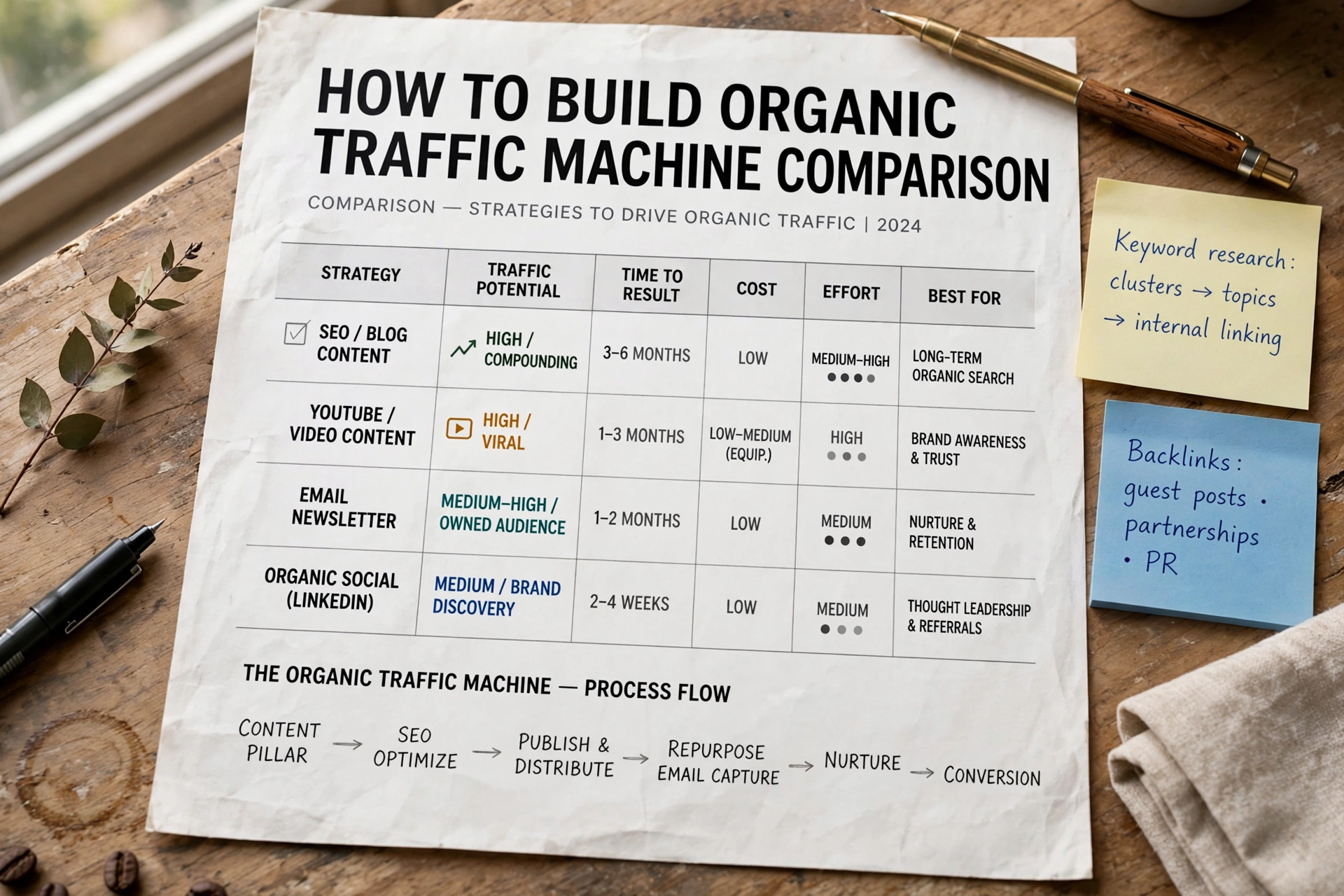
Not every business needs a 1,000-page programmatic engine. The "which" depends on your goals. Below is a comparison of the three primary paths to building an organic traffic machine.
| Feature | Manual Authority | Scaled AI Content | Programmatic Engine (BizAI) |
|---|---|---|---|
| Speed to Market | Very Slow (Months/Years) | Medium (Weeks) | Very Fast (Days) |
| Content Volume | Low (1-4 posts/mo) | Medium (20-50 posts/mo) | High (300-900+ pages/mo) |
| Cost Structure | High (Expensive Writers) | Low (Tool Subscriptions) | Fixed (System Investment) |
| Intent Precision | High (Human Nuance) | Variable (Can be "slop") | Extremely High (Data-Driven) |
| Lead Conversion | Manual/Forms | Manual/Forms | Autonomous AI SDRs |
| Best For | Rare, Ultra-High Ticket | General B2B SaaS | High-Ticket Professional Services |
Now, here is where it gets interesting: most companies try to mix these in a way that fails. They use a "Scaled AI" approach but keep "Manual" conversion forms. This creates a massive gap in the user experience. A user who finds a highly specific, AI-generated page expecting a quick answer will be frustrated by a generic "Contact Us" form that takes 24 hours for a human to answer.
When you use a system like BizAI Intelligence, you are combining the volume of the Programmatic Engine with the precision of a professional sales team. It is the only way to effectively replace freelance copywriters without sacrificing the quality of your brand's voice.

Common Questions and Misconceptions
There is a lot of noise in the SEO world, and most guides get the fundamentals wrong. Here are the most common myths I encounter when consulting with B2B owners.
Myth 1: "AI Content will get me penalized by Google."
This is the most persistent lie in the industry. Google has explicitly stated that they reward high-quality content regardless of how it is produced. The problem isn't AI; the problem is "AI Slop", generic, repetitive, and unhelpful text. When you use a programmatic approach that focuses on specific user intent and provides real value, Google doesn't care if a human or an LLM wrote it. They care if the user found the answer.
Myth 2: "I need a huge budget to build a traffic machine."
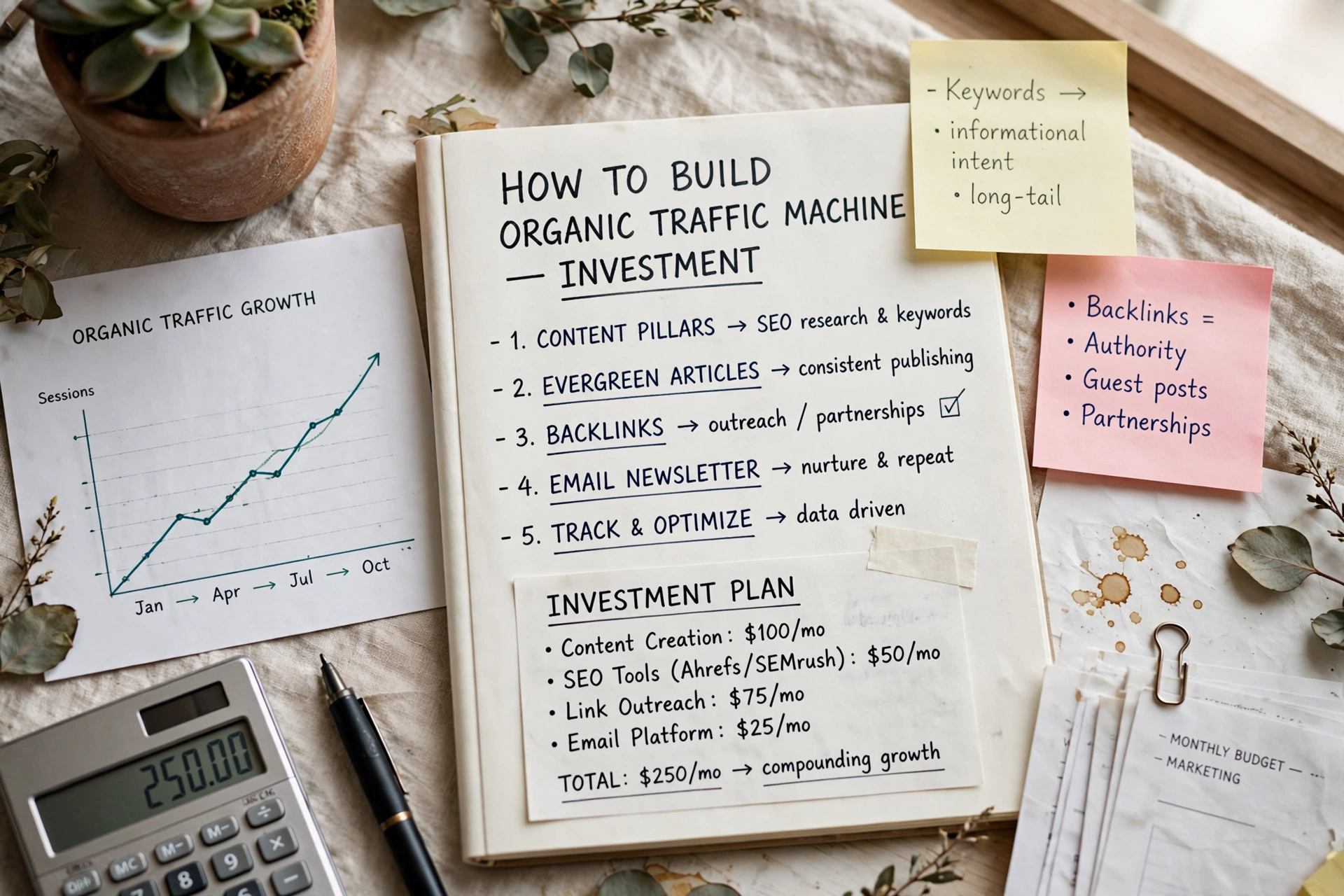
Actually, the opposite is true. The "Traditional Agency" model is the most expensive way to grow. Paying a retainer for a few blog posts a month is a slow bleed. The modern way is to invest in a system. By utilizing AI vs SEO agencies, small businesses can now achieve the same organic footprint as a Fortune 500 company for a fraction of the cost.
Myth 3: "More traffic always equals more revenue."
This is a dangerous misconception. I have seen sites with 100,000 monthly visitors and $0 in new revenue because they were targeting "top of funnel" keywords. Traffic is a vanity metric. The only metric that matters is "Qualified Lead Velocity." A machine that brings in 500 highly targeted visitors who are ready to buy is infinitely more valuable than one that brings in 50,000 people looking for free templates.
Frequently Asked Questions
Which organic traffic strategy is best for a local B2B service?
For local professional services, such as law firms or HVAC contractors, the Programmatic Engine is the clear winner. Local intent is highly fragmented; people don't just search for "Lawyer," they search for "Personal Injury Lawyer in [Neighborhood]." Building a machine that generates a dedicated, optimized page for every localized variation allows you to capture this "near me" intent. When combined with an AI SDR that can book appointments directly into your calendar, you move from a passive website to an active lead-generation asset.
How long does it actually take to see results from an organic machine?
While traditional SEO can take 6 to 12 months to show momentum, a programmatic approach utilizing the Google Indexing API can often see pages ranking within weeks. The key is to target "low-competition, high-intent" long-tail keywords first. By dominating these niches quickly, you build the domain authority necessary to eventually rank for the more competitive, high-volume head terms. In my experience, the "compounding" effect starts in month three, where growth becomes exponential rather than linear.
Do I need to keep writing manual blogs if I have a programmatic engine?
Yes, but the purpose changes. Your programmatic engine handles the "capture" (the wide net), while your manual content handles the "conversion" (the deep trust). I recommend a 90/10 split. 90% of your volume should be automated, intent-driven pages, and 10% should be deep-dive thought leadership pieces, case studies, and "founder-led" content. This proves to the user, and the search engine, that there is a real human expert behind the machine.
Can a traffic machine work for very high-ticket enterprise sales?
Absolutely, but the "conversion" layer must be more sophisticated. For a $50k+ service, a user won't buy from a chatbot, but they will let a chatbot qualify them. The AI SDR should be programmed to act as a concierge, gathering specific business data (company size, current pain points, budget) and then seamlessly handing the lead off to a human account executive. This ensures that your sales team only spends time on "Gold" leads, while the machine filters out the noise.
What is the risk of relying solely on organic traffic in 2026?
The primary risk is "Platform Dependency." If you only rely on Google, you are at the mercy of their updates. To mitigate this, your organic machine should be a hub that feeds other channels. Use your high-performing organic pages to build an email list or a WhatsApp community. By converting website visitors into WhatsApp leads, you move the relationship from a platform you don't control (Google) to a platform you do (your contact list).
Final Thoughts on Building Your Organic Traffic Machine
Deciding how to build an organic traffic machine comes down to a choice between slow, linear growth and rapid, algorithmic scaling. If you are comfortable with the traditional pace of content marketing, the manual approach is a safe bet. However, if you are looking to dominate your niche and stop the hemorrhage of cash spent on paid ads, the programmatic engine is the only logical choice for 2026.
The goal is to create a system where your website does the heavy lifting of prospecting, qualifying, and scheduling, leaving you to do what you do best: closing deals and delivering results. Stop renting your traffic from Google and Meta; it is time to build and own your acquisition engine.
If you are ready to deploy a high-scale organic machine with embedded AI qualification, explore the capabilities of BizAI Intelligence. We help B2B companies replace inefficient agencies with an automated inbound acquisition system that works 24/7. Whether you need to automate your company blog or deploy a full pSEO architecture, the machine is ready.
Only 12 Onboarding Slots Remaining This Month
BizAI deploys 300 AI salespeople scoring purchase intent 24/7. Get your free niche domination blueprint.
AI Search Accelerator: 1-on-1 Strategy Session
Claim one of the 10 monthly slots. Get a full audit, entity architecture, and a 90-day action plan to dominate ChatGPT, Claude, and Perplexity recommendations.