📖This article is part of the complete guide to High Intent Visitor Tracking: Ultimate B2B Guide.
In my experience working with high-ticket B2B service providers, the most expensive mistake a sales team can make is treating a 'window shopper' and a 'desperate buyer' with the same urgency. I once analyzed a legal firm's lead flow where 40% of their high-value leads used phrases like 'immediately,' 'urgent,' or 'deadline' in their search queries or chatbot interactions, yet the firm took 24 hours to respond. By the time the SDR called, the lead had already signed with a competitor who responded in fifteen minutes. This gap is where revenue leaks occur.
For a comprehensive overview of how these signals fit into a larger strategy, explore our guide on high intent visitor tracking.
What is Urgency Language Tracking?
📚
Definition
Urgency language tracking is the process of using semantic analysis and Natural Language Processing (NLP) to identify specific keywords and phrases within a visitor's session, such as search queries, form inputs, or AI chatbot interactions, that indicate a compressed buying timeline.
Urgency language tracking is not about monitoring clicks; it is about monitoring intent through linguistics. When a B2B buyer moves from the 'education phase' to the 'decision phase,' their vocabulary shifts. They stop searching for "how does [product] work" and start searching for "[product] implementation timeline" or "emergency [service] provider." By tracking these semantic markers in real-time, businesses can trigger immediate alerts to sales teams or deploy an autonomous AI agent to close the gap.
In 2026, this is achieved through Large Language Models (LLMs) integrated into the website's frontend. These models don't just look for a keyword list; they understand the context of urgency. For instance, "I need this fixed now" carries a different weight than "I am researching how to fix this now." The former is a high-intent urgency signal; the latter is merely a temporal marker.
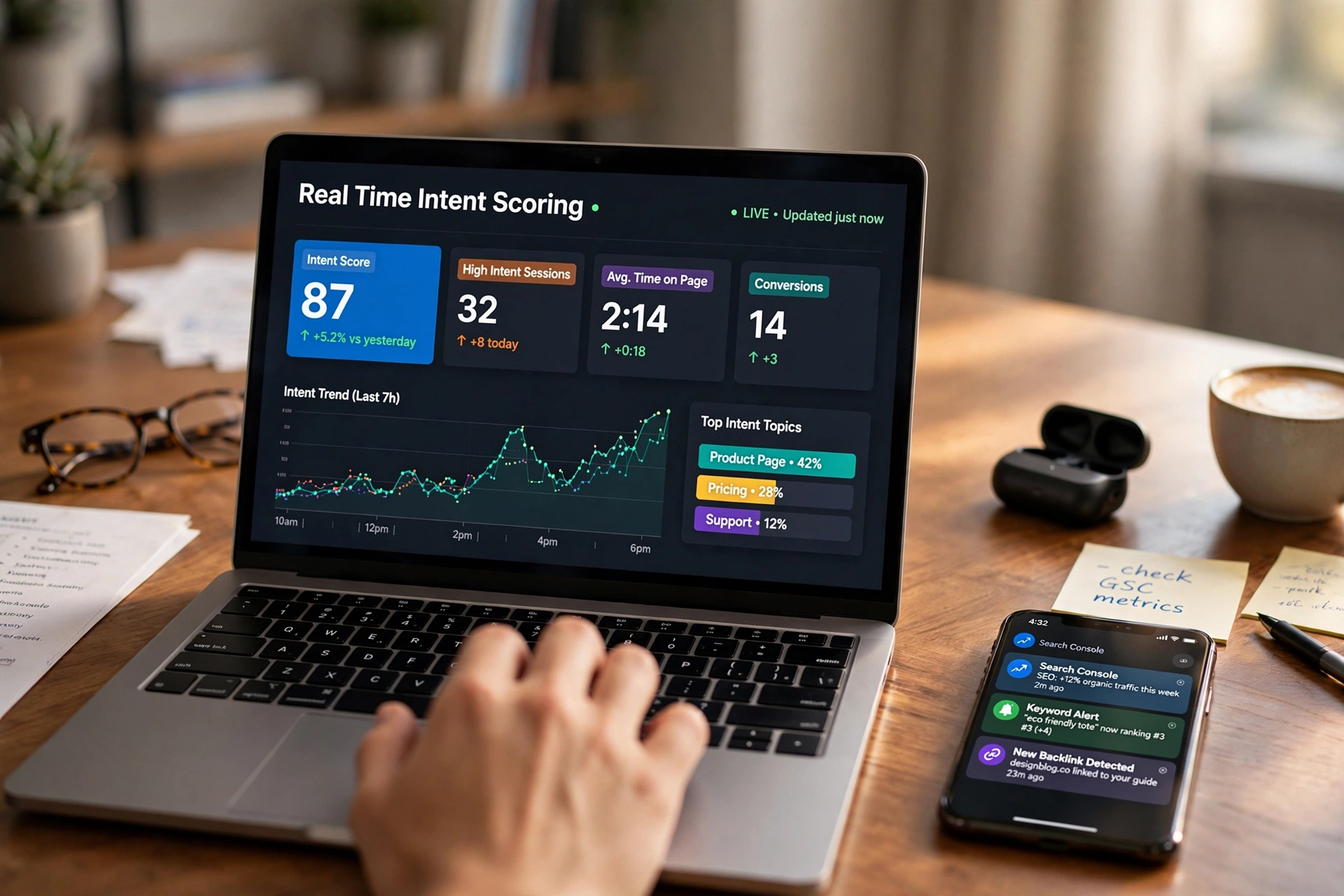
According to research by the Content Marketing Institute, the ability to personalize a response based on the perceived urgency of a lead increases the likelihood of conversion by nearly 25% in professional services. When you combine this with real time intent scoring for sales teams, you transform your website from a static brochure into a dynamic lead-filtering engine.

Why Does Urgency Language Tracking Matter for Your Business?
Urgency language tracking matters because B2B buying cycles are notoriously long and leaky. The primary reason for lead churn in high-ticket sectors is the "responsiveness gap." If a buyer is experiencing a critical pain point, such as a legal crisis, a server outage, or a compliance deadline, their willingness to pay a premium increases as their timeframe shrinks.
First, it enables Hyper-Priority Routing. Most companies route leads based on company size or industry. However, a small company with an urgent, high-stakes problem is often more valuable than a large company just "browsing for next year." By identifying urgency language, you can bypass the standard queue and send the lead directly to a senior closer.
Second, it informs the Sales Narrative. If a visitor has spent ten minutes reading about "rapid deployment" and "emergency implementation," the sales rep should not start the call with a generic company history. Instead, they should open with: "I see you're looking for a fast turnaround; we have a streamlined onboarding process that can get you live in 48 hours." This immediate alignment creates an psychological bond of trust.
Third, it maximizes the ROI of AI SDRs. When an AI agent detects urgency language, it can pivot from "educating the user" to "aggressive appointment setting." It stops offering whitepapers and starts offering calendar slots for the next two hours. This shift is essential for businesses using AI appointment setters for B2B to maintain a high conversion rate.
As noted by the B2B Institute, buyers are 70% more likely to purchase from a vendor that can demonstrate an understanding of their specific timeline constraints during the first interaction. This is why semantic tracking is no longer optional for enterprise-grade growth.
How to Implement Urgency Language Tracking Step by Step
Implementing urgency language tracking requires a transition from basic keyword tracking to semantic intent analysis. You cannot rely on simple "if/then" logic; you need a system that understands the nuance of B2B communication.
Step 1: Map Your Urgency Lexicon
Start by auditing your historical lead data. Look at the emails and chat logs of your fastest-closing deals. Identify the common phrases they used. Common categories include:
- Temporal Markers: "Immediately," "by Friday," "ASAP," "urgent," "emergency."
- Pain Amplifiers: "Critical," "blocking," "down time," "deadline," "compliance failure."
- Comparison Urgency: "Better than [Competitor] for fast setup," "Quickest implementation."
Step 2: Deploy Semantic Listeners
Integrate an LLM-based listener into your site's interaction points. This includes your search bar and your AI chatbot. Instead of just recording the query, the listener should categorize the query into an "Urgency Score" (e.g. Low, Medium, High). For example, a search for "pricing" is Medium intent; a search for "urgent pricing for immediate startup" is High Urgency.
Step 3: Integrate with Behavioral Signals
Urgency language should not exist in a vacuum. It must be correlated with behavioral signals for high intent visitors. If a user uses urgency language AND has a high scroll depth for buyer intent, the probability of a sale is nearly 90%. If they use urgency language but bounce after 5 seconds, it may be a bot or a low-quality lead.
Step 4: Trigger Autonomous Actions
Once a high-urgency signal is detected, trigger an automated action. This could be a pop-up offering a "Priority Consultation" or an AI agent that interrupts the browsing experience to say: "It sounds like you're on a tight deadline. Would you like to book a 15-minute emergency call with our lead architect right now?"
Step 5: Closed-Loop Feedback
Feed the result of these leads back into your AI. If users who use the word "immediately" actually close at a higher rate, increase the weight of that word in your scoring algorithm. This creates a compounding effect where your lead qualification becomes more accurate over time.
For those scaling this process, implementing a PSEO architecture for SaaS allows you to create thousands of satellite pages targeting specific "emergency" or "urgent" long-tail keywords, ensuring you capture this traffic at the source.
Urgency Tracking: Traditional vs. Modern Approaches
Many businesses still use "Legacy Intent Tracking," which is essentially just counting how many times a user visits a pricing page. This is a blunt instrument that misses the nuance of human desperation and urgency.
| Feature | Traditional Approach | Cheap AI Approach | BizAI Intelligence Approach |
|---|---|---|---|
| Detection Method | Page-hit counting | Basic Keyword matching | Semantic NLP + Behavioral Context |
| Response Time | Manual follow-up (Hours/Days) | Generic chatbot response | Autonomous AI SDR Instant Booking |
| Accuracy | Low (Guesses intent) | Medium (High hallucinations) | High (Cross-referenced with signals) |
| Scalability | Low (Requires manual SDRs) | Medium (Low quality output) | Extreme (Programmatic + AI Agents) |
In my experience, the "Cheap AI" approach fails because it lacks a feedback loop. It might flag every single mention of the word "now" as urgent, leading to "alert fatigue" for sales teams. BizAI Intelligence solves this by combining semantic language tracking with mouse hesitation intent and other behavioral markers to ensure that only truly high-intent, urgent leads are escalated.
Common Mistakes to Avoid in Urgency Tracking
Tracking urgency is a powerful tool, but if mismanaged, it can alienate your prospects or burn out your sales team. Here are the most common pitfalls I see in 2026.
1. Over-Reliance on Single Keywords
Setting an alert for the word "Urgent" is a mistake. Users often use the word ironically or in contexts that aren't business-critical (e.g. "I have an urgent question about your blog post"). You must use a Large Language Model to analyze the sentiment and intent around the keyword, not just the presence of the word itself.
2. The "Creepy" Factor
There is a fine line between being responsive and being invasive. If a user types "I need a lawyer immediately" and a pop-up instantly appears saying "We know you're in a hurry!", it can feel like the site is spying on them. Instead, frame the response as a helpful offer: "Many of our clients in urgent situations find our priority scheduling most helpful. Would you like to see available slots for today?"
3. Ignoring the Return Visit Pattern
Urgency can be a flash in the pan. Some users exhibit high urgency on the first visit, disappear for a week, and then return. Failing to track return visit frequency for lead qualification means you might treat a returning "urgent" lead as a brand new one, missing the historical context of their pain point.
4. Lack of CRM Integration
If your urgency tracking system is not connected to your CRM via webhooks, the data is useless. The urgency signal must be appended to the lead record so the salesperson sees a "🔥 HIGH URGENCY" tag before they even pick up the phone. Without this, the data stays in the marketing silo and never reaches the revenue-generating side of the business.
5. Miscalculating the "Urgency Window"
In B2B, urgency has a half-life. If a lead is urgent on Monday, they are likely a lost lead by Wednesday if not contacted. Many companies treat "Urgent" as a category rather than a timer. You must implement a decay function where the priority of a lead drops if the response time exceeds a specific threshold (typically 15-30 minutes for high-urgency signals).
Frequently Asked Questions
Does urgency language tracking work for low-ticket B2B products?
While it is most effective for high-ticket services where the cost of inaction is high, it can work for low-ticket SaaS. In these cases, urgency language usually relates to a "migration deadline" or a "software failure." However, the ROI is lower because the lead value doesn't justify an expensive manual response. For low-ticket items, use urgency tracking to trigger an automated discount or a specialized "fast-start" onboarding sequence rather than a live sales call.
How do you prevent AI hallucinations when scoring urgency?
To prevent hallucinations, the AI should not be asked to "guess" the intent. Instead, it should be given a rubric of semantic markers and asked to categorize the text based on those markers. By using a structured prompt and requiring the AI to cite the specific phrase that triggered the urgency score, you can audit the logic. This is a core part of how we build agents at BizAI Intelligence, ensuring the AI's reasoning is transparent and grounded in the actual text of the session.
Can urgency tracking identify "fake urgency" from competitors?
Yes, by cross-referencing language with behavioral data. Competitors often use urgency language to probe for pricing or implementation speed. However, their behavior is usually different: they may visit the pricing page multiple times but never visit the "Case Studies" or "About Us" pages. By combining urgency language with AI SDR vs human SDR ROI metrics, you can filter out non-buyers and focus on genuine prospects.
Is urgency language tracking compliant with GDPR and CCPA?
As long as you are analyzing the text entered by the user into a form or chatbot, which is data they have explicitly provided, it is generally compliant. However, you must disclose the use of AI for lead processing in your privacy policy. Since urgency tracking happens in the session layer and doesn't typically involve scraping private data from other sites, it is a low-risk strategy provided you maintain a transparent data processing agreement with your users.
Which urgency words are the most predictive of a sale?
In the B2B space, "Timeline," "Implementation," "Deadline," and "Critical" are significantly more predictive than generic words like "Fast" or "Quick." Words that relate to the process of starting a service indicate that the buyer has already decided to buy and is now worried about the execution. When you see these "execution-phase" words, the lead should be moved to the top of the pipeline immediately.
Conclusion
Urgency language tracking is the bridge between seeing that someone is on your site and knowing exactly why they are there and how fast they need a solution. In a 2026 market where AI can generate content in seconds, the only sustainable competitive advantage is speed of response and relevance of context. If you can identify a buyer's desperation through their language and respond with a tailored, high-speed solution, you will win the deal every time.
Stop relying on generic lead forms that treat every visitor the same. By integrating semantic analysis with a robust internal linking and traffic strategy, you can turn your domain into an automated acquisition machine. To see how urgency tracking fits into the larger architecture of intent detection, return to our High Intent Visitor Tracking: Ultimate B2B Guide.
If you are ready to stop renting traffic and start owning your niche through programmatic SEO and AI-powered lead qualification, visit BizAI Intelligence to build your organic traffic engine.
Only 12 Onboarding Slots Remaining This Month
BizAI deploys 300 AI salespeople scoring purchase intent 24/7. Get your free niche domination blueprint.
AI Search Accelerator: 1-on-1 Strategy Session
Claim one of the 10 monthly slots. Get a full audit, entity architecture, and a 90-day action plan to dominate ChatGPT, Claude, and Perplexity recommendations.