📖This article is part of the complete guide to Ultimate Guide to Hot Lead Notifications for Sales.
In my experience working with high-ticket B2B firms, the difference between a closed deal and a lost opportunity is often measured in minutes. I have seen countless companies spend thousands on lead generation, only to let a high-intent prospect cool off because their sales team didn't realize the user was on the pricing page for the fifth time in an hour. This gap is where revenue leaks, and it is exactly why the industry has shifted toward real-time behavioral alerting.
For a comprehensive overview of this ecosystem, explore our Ultimate Guide to Hot Lead Notifications for Sales.
What Are Hot Lead Notifications?
📚
Definition
Hot lead notifications are real-time alerts sent to sales teams the moment a prospect exhibits specific, high-intent behavioral triggers that indicate they are ready to purchase.
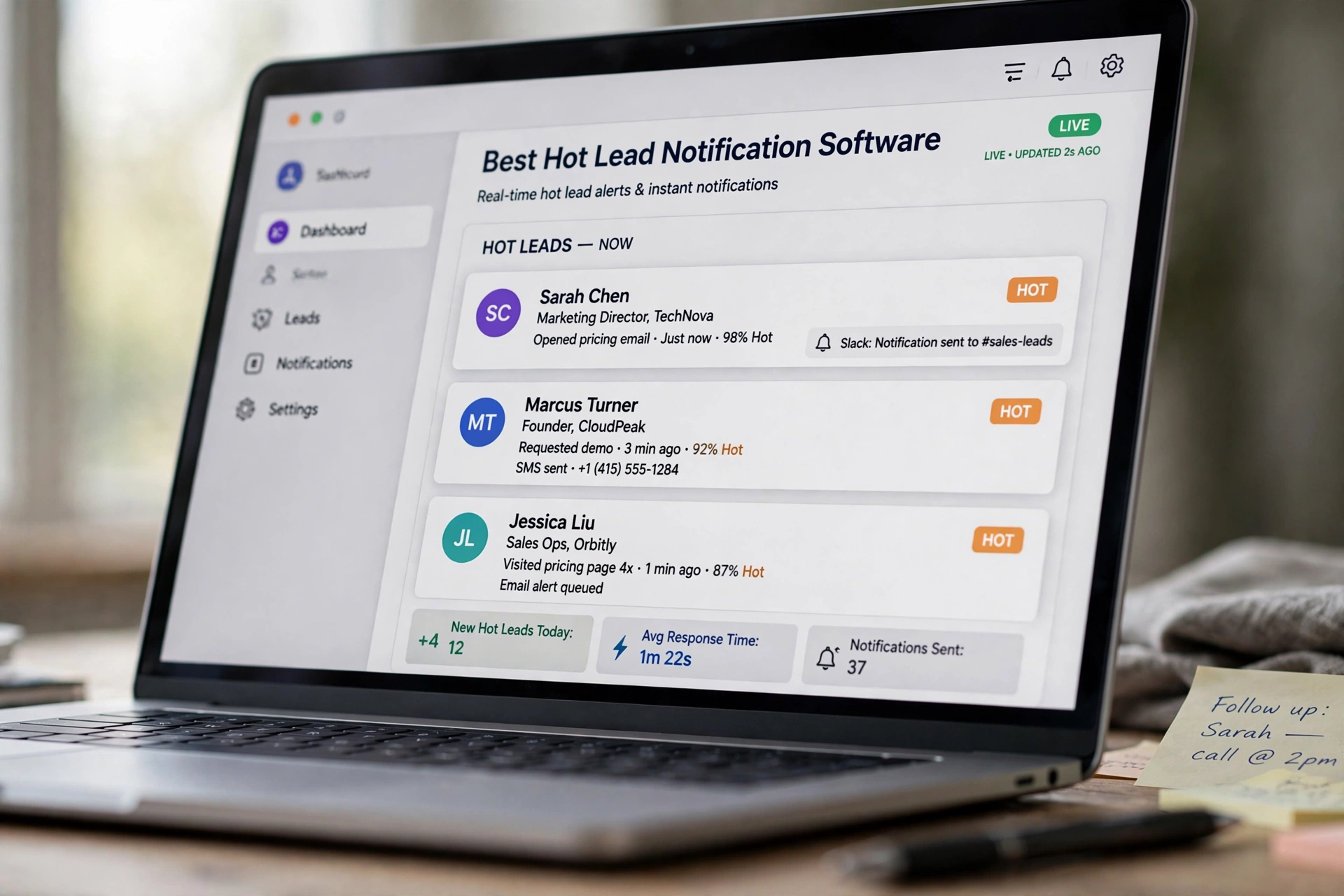
Hot lead notifications are not generic "new lead" emails that notify you when someone fills out a contact form. Instead, they are intelligence-driven signals based on digital body language. In a modern stack, these notifications trigger when a user hits a specific "intent threshold", such as visiting a pricing page three times, downloading a technical whitepaper, and spending more than four minutes on a comparison page within a single session. These signals are captured via web scraping and behavioral tracking, then pushed immediately to a CRM or communication tool like Slack or WhatsApp.
When we built the architecture for BizAI Intelligence, we discovered that the most successful notifications are context-aware. It is not enough to know that a lead is hot; the salesperson needs to know why they are hot. A true hot lead notification includes the specific pages visited, the source of the traffic, and the AI-calculated intent score. This allows the SDR to reach out with a hyper-personalized offer rather than a generic "checking in" message.

By integrating these alerts with a large language model, businesses can now automate the initial outreach. Instead of a human manually checking a dashboard, an AI SDR can initiate a conversation the second the notification triggers, effectively eliminating the lead-response gap. This is a fundamental shift from reactive sales to proactive acquisition, ensuring that the most eager buyers are prioritized over lukewarm prospects.
Why Do Hot Lead Notifications Matter for Your Business?
Hot lead notifications matter because the "speed-to-lead" metric is the single greatest predictor of conversion rates in 2026. According to data from the Harvard Business Review, firms that contact prospects within an hour of their expressing interest are seven times more likely to secure a meeting than those who wait 24 hours. In the B2B SaaS world, where the cost of customer acquisition is skyrocketing, failing to act on a high-intent signal is essentially throwing your marketing budget away.
In the current landscape, buyers are doing 80% of their research before they ever talk to a salesperson. This means by the time a lead fills out a form, they have already decided if they like your product. The real window of opportunity exists during that research phase. By using hot lead notifications, you can intervene while the prospect is still actively engaged with your brand, transforming a passive browsing session into a live sales conversation.
Furthermore, these notifications solve the problem of lead fatigue. Sales teams often struggle with "junk leads", people who download a PDF but have no intention of buying. Behavioral alerts filter the noise. By focusing only on leads that hit a specific intent score, your team stops wasting time on low-probability prospects and focuses 100% of their energy on those with a high probability of closing. This optimization is why many firms are now moving toward AI vs SEO agency models to automate both the traffic generation and the lead qualification process.
To understand the specific operational advantages, you might want to look at the key benefits of hot lead notifications for teams. When a team operates on real-time data, the internal culture shifts from guessing to executing. Managers can see exactly which leads are heating up across the pipeline, allowing for better resource allocation and more accurate revenue forecasting.
How to Implement Hot Lead Notifications effectively?
Implementing a hot lead notification system requires a transition from simple form-capture to a behavioral-intent engine. The first step is defining your "Hot Lead Trigger." You must determine which actions actually correlate with a purchase. For most B2B companies, this includes visiting the pricing page, viewing the "Compare with Competitors" section, or spending excessive time on a high-value case study.
Once the triggers are defined, you need a tracking layer. This is typically achieved through a combination of a CRM and a behavioral tracking tool. The system monitors the user's session in real-time. When the pre-defined threshold is met, the system triggers an API call to your notification channel. For instance, if a user from a Fortune 500 company visits your site and spends 10 minutes on your enterprise pricing page, a Slack alert should be fired immediately to the Account Executive assigned to that territory.
💡
Key Takeaway
The most effective implementation involves a three-step loop: Tracking (Behavioral Signals) $ ightarrow$ Scoring (AI Intent Analysis) $ ightarrow$ Alerting (Instant Notification).
For those scaling rapidly, the manual approach to this is unsustainable. This is where AI blog automation and programmatic SEO come into play. By generating hundreds of high-intent pages, you create more opportunities for users to trigger these notifications. If you have a page specifically targeting "Alternative to [Competitor]," and a user lands there, that is a massive intent signal. A hot lead notification should fire instantly, as that user is in a high-urgency comparison phase.
To truly maximize ROI, integrate these notifications with a direct communication channel. According to industry benchmarks for 2026, converting website visitors into WhatsApp leads yields a 3.4x higher ROI than traditional email follow-ups. By linking your hot lead alerts to an automated WhatsApp agent, you can move the lead from "browsing" to "chatting" in under 30 seconds. You can learn more about this in our guide on how to convert website visitors into WhatsApp leads.
Hot Lead Notifications vs. Traditional Lead Alerts
Many business owners confuse a "New Lead Alert" with a "Hot Lead Notification." The difference is fundamental: one is based on an action (filling a form), while the other is based on intent (behavioral patterns).
| Feature | Traditional Lead Alerts | Generic AI Alerts | BizAI Intelligence Approach |
|---|---|---|---|
| Trigger | Form Submission | Simple Page Visit | Multi-Signal Intent Scoring |
| Timing | After the lead opts in | Periodic updates | Instant, real-time triggers |
| Context | Name and Email only | Basic Page History | Deep Behavioral Persona Analysis |
| Response | Manual Email/Call | Generic Auto-responder | AI SDR Direct Engagement |
| Accuracy | High (but often too late) | Low (lots of noise) | Very High (Intent-validated) |
Traditional alerts are essentially a "request for contact." The customer has already decided they want to talk. While valuable, this is the end of the funnel. Hot lead notifications capture the beginning and middle of the funnel. They tell you who is interested before they are ready to ask for a demo. This allows you to provide value and build trust before the prospect even realizes they need a salesperson.
Generic AI tools often fail here because they lack a sophisticated scoring model. They might alert you every time someone visits the home page, leading to "notification fatigue" where sales reps start ignoring the alerts. The professional approach uses a weighted scoring system. A visit to the "About Us" page might be worth 1 point, while a visit to the "Pricing" page is worth 10 points. The notification only fires when the total score exceeds a threshold (e.g. 20 points), ensuring that only truly "hot" leads reach the sales team.

Common Mistakes to Avoid with Lead Alerts
One of the most frequent errors I see is "Alert Overload." When a company sets their intent threshold too low, the sales team is bombarded with notifications for every casual browser. This creates a psychological effect where the reps stop trusting the system. To avoid this, you must iteratively refine your scoring. If 70% of your "hot leads" are actually cold, your threshold is too low. Increase the requirements, perhaps require a minimum session duration of three minutes before any alert is fired.
Another critical mistake is the "Delayed Response Loop." There is no point in having a real-time notification if the salesperson takes four hours to check their email. If you are utilizing high-intent signals, you must have a response mechanism that matches the speed of the signal. This is why we advocate for replacing manual SDR work with an embedded AI SDR. When a lead hits the hot threshold, the AI agent can immediately pop up on the screen, acknowledging the user's specific interest and offering to book a meeting on the spot.
Furthermore, many businesses fail to integrate their notifications with a clean data pipeline. They get a notification that a lead is hot, but when they open the CRM, the lead's data is outdated or incomplete. Your notification system should ideally pull real-time data from the current session, such as the specific product version the user is looking at, so the outreach is surgically precise.
Finally, avoid using an aggressive, "big brother" approach in your outreach. If you call a prospect the second they land on your pricing page and say, "I saw you were looking at our pricing," it can feel invasive. Instead, use the notification to trigger a helpful, value-driven intervention. The AI agent should say, "I noticed you're exploring our enterprise options; would you like a quick breakdown of how we handle [Specific Feature] for companies your size?"
Frequently Asked Questions
What is the difference between a lead and a hot lead?
A lead is any person who has provided contact information or shown a baseline interest in your product. A hot lead, however, is a prospect who has demonstrated a high level of "buyer intent" through specific behavioral actions. For example, someone who signs up for a newsletter is a lead; someone who spends 15 minutes comparing your pricing with a competitor's and visits your FAQ page three times in one hour is a hot lead. The distinction lies in the urgency and probability of conversion.
How do you determine the intent threshold for a notification?
Setting the threshold requires analyzing your historical conversion data. Look at your last 50 closed-won deals and trace their digital footprint before they converted. Did they visit the pricing page? Did they watch a demo video? Once you identify the common patterns, assign point values to those actions. A typical threshold is set when the cumulative score reaches a level where the probability of conversion increases by at least 50%. This prevents your sales team from being overwhelmed by low-quality alerts.
Can hot lead notifications be automated via AI?
Yes, and in 2026, this is the gold standard. Modern systems use AI SDRs that are embedded directly into the website. When the notification triggers, the AI doesn't just alert a human; it engages the prospect immediately via a chatbot or personalized offer. This ensures the lead is captured while the intent is at its absolute peak, removing the human latency that often kills B2B deals. This is a core component of the Stop the 90% Bounce strategy.
Which tools are best for tracking behavioral intent?
Professional setups typically combine a behavioral tracking tool (like Hotjar or Heap) with a sophisticated CRM (like HubSpot or Salesforce) and an automation layer. However, for those looking for an all-in-one solution, BizAI Intelligence integrates the tracking, scoring, and notification into a single engine. This removes the need to manually stitch together five different SaaS tools, which often leads to data silos and delayed alerts.
Does using hot lead notifications violate privacy laws?
As long as you are compliant with GDPR, CCPA, and other regional data protection laws, behavioral tracking is standard practice. The key is transparency in your privacy policy and ensuring that you are tracking anonymous behavioral data until the user consents to provide their identity. Once a user identifies themselves (e.g. via a cookie or a form), the behavioral data is linked to their profile to trigger the notification. Always ensure your tracking is done ethically and legally.
Conclusion
Hot lead notifications are the bridge between passive marketing and active sales. In an era where buyers are more informed and impatient than ever, waiting for a lead to "reach out" is a losing strategy. By implementing a system that identifies and alerts you to high-intent behavior in real-time, you shift the power dynamic back to the seller. You stop chasing leads and start guiding buyers who have already decided they need a solution.
If you are still relying on static forms and manual follow-ups, you are likely losing 30-50% of your potential pipeline to competitors who respond faster. The transition to an AI-driven, intent-based system is no longer optional for B2B companies that want to scale in 2026. It is the only way to ensure that your sales team is spending their time on the most profitable conversations.
To master this strategy and build a fully automated acquisition machine, dive into our Ultimate Guide to Hot Lead Notifications for Sales and see how to turn your website into a 24/7 revenue generator.
For more information on automating your growth, visit BizAI Intelligence.
AI Search Accelerator: 1-on-1 Strategy Session
Claim one of the 10 monthly slots. Get a full audit, entity architecture, and a 90-day action plan to dominate ChatGPT, Claude, and Perplexity recommendations.