📖This article is part of the complete guide to Ultimate Guide to Hot Lead Notifications for Sales.
In my experience working with high-ticket B2B firms, the cost of a delayed response is not just a lost lead; it is a wasted acquisition budget. I have seen enterprises spend thousands on organic traffic only to let high-intent prospects cool off because their sales team relied on a manual email notification that sat in an inbox for six hours. By the time the salesperson called, the prospect had already booked a demo with a faster competitor.
For a comprehensive overview of this ecosystem, explore our Ultimate Guide to Hot Lead Notifications for Sales.
What are AI Hot Lead Alerts?
📚
Definition
AI hot lead alerts are automated, real-time notifications triggered by artificial intelligence when a prospect exhibits a specific set of high-intent behavioral signals, allowing sales teams to engage the buyer at the peak of their interest.
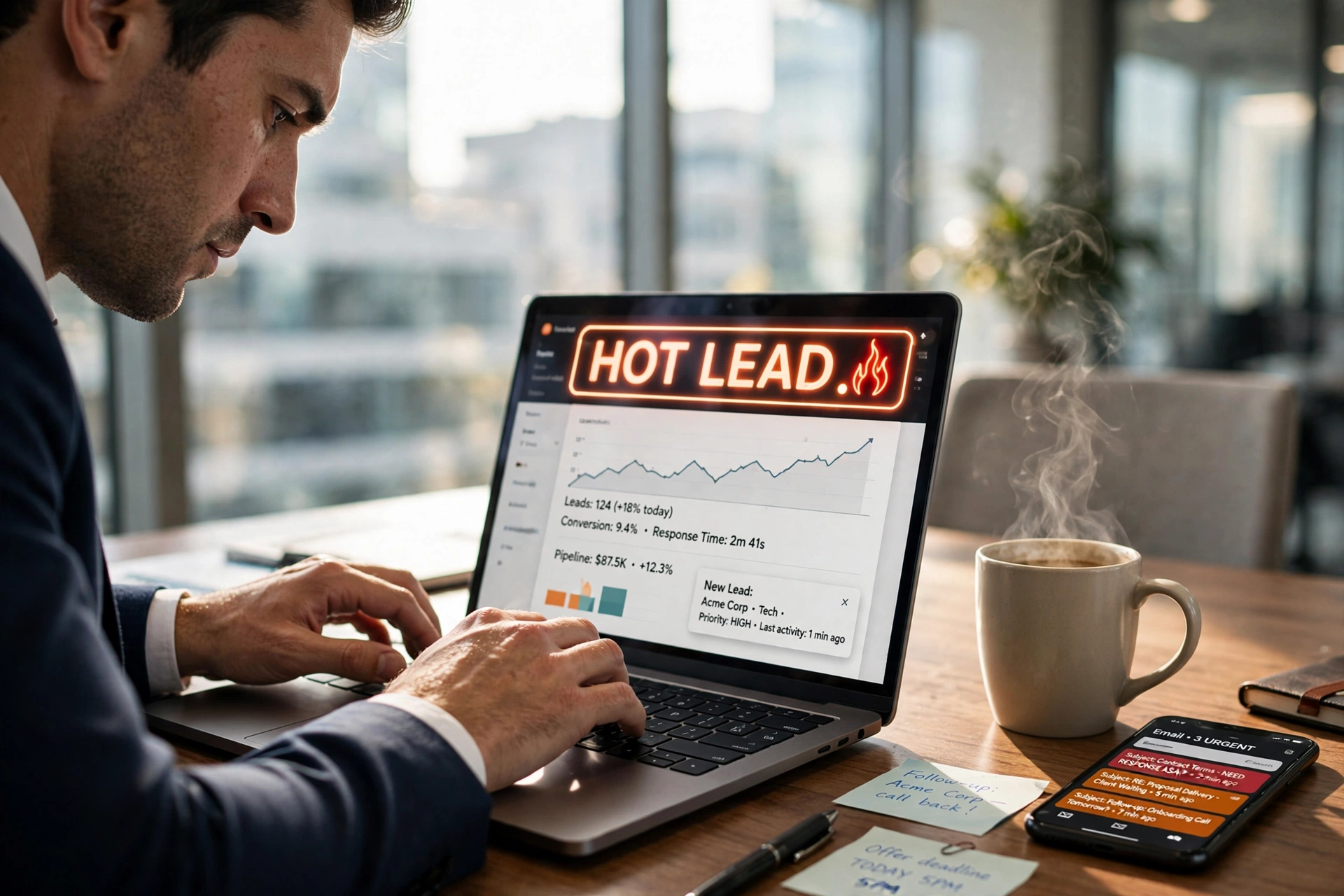
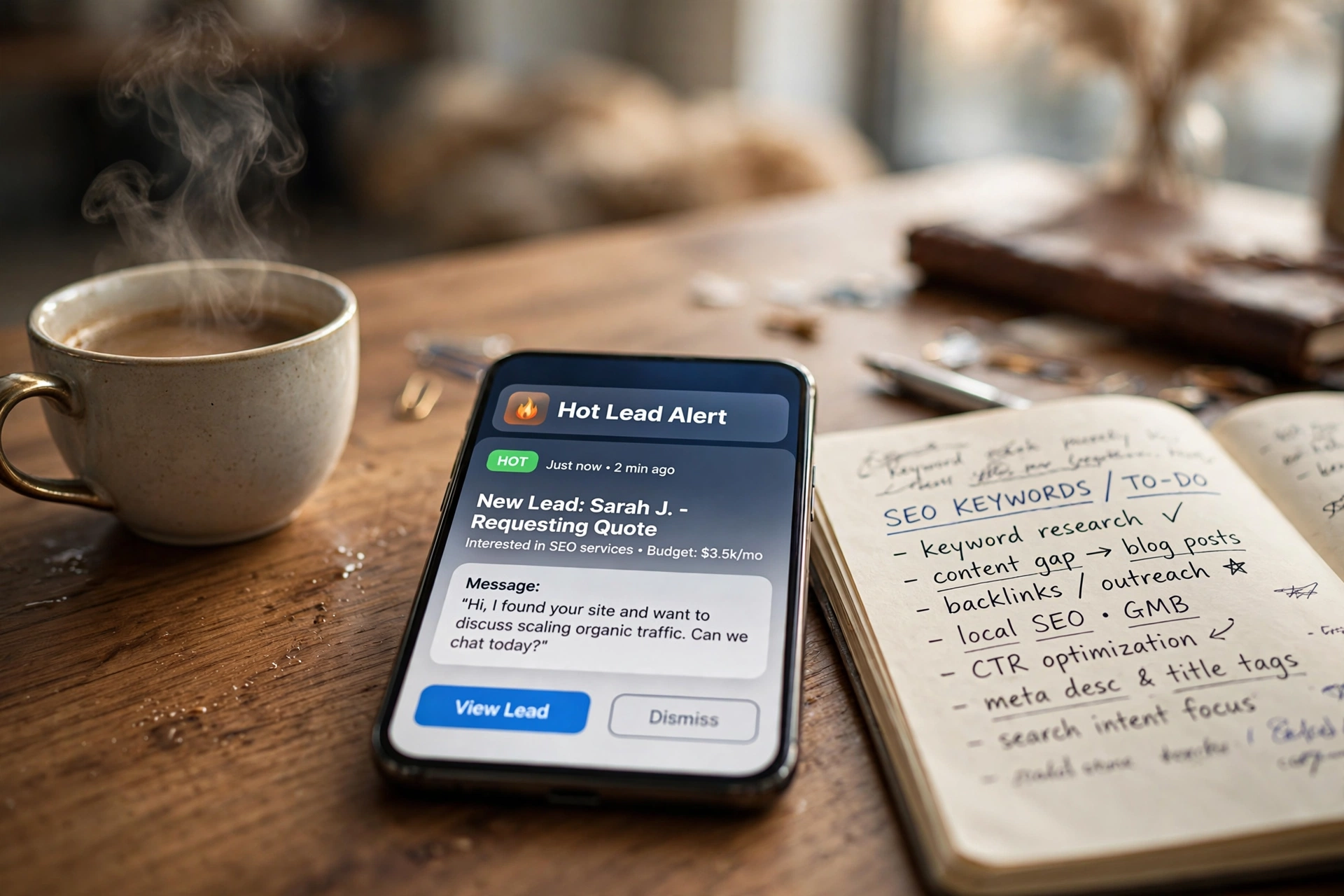
AI hot lead alerts differ from traditional lead notifications because they do not simply trigger when a form is submitted. Instead, they utilize a large language model (LLM) and behavioral tracking to analyze scroll velocity, page dwell time, and the specific sequence of pages visited. While a standard alert tells you that someone contacted you, an AI-powered alert tells you why they are ready to buy right now, which specific pain point they are researching, and their estimated budget based on the services they viewed.
When we built the intelligence engine at BizAI Intelligence, we discovered that the difference between a 'lead' and a 'hot lead' is often measured in minutes of engagement. A user who visits a pricing page, returns to a case study, and then spends four minutes reading a technical specification is exhibiting a high-intent pattern. AI hot lead alerts capture this pattern in real-time and push a notification to a Slack channel or CRM via webhooks, effectively turning a passive website into an active lead generation machine.

Why Do AI Hot Lead Alerts Matter for B2B Growth?
Speed to lead is the single most important metric in modern B2B sales. According to research from the Lead Response Management Study, businesses that respond to a lead within five minutes are 100 times more likely to qualify that lead than those who wait 30 minutes. In 2026, where artificial intelligence has lowered the barrier to entry for content creation, buyers are more informed and less patient. If your team is not responding instantly, you are essentially handing your market share to the most agile competitor.
Beyond speed, these alerts provide critical context. A salesperson doesn't just get a notification saying "John Doe visited the site"; they receive a data-rich brief stating that John Doe from a Fortune 500 company has viewed the Enterprise Pricing page three times in the last ten minutes and spent two minutes on the ROI calculator. This transforms the initial outreach from a cold discovery call into a warm, tailored consultation. When sales teams have this level of insight, they can bypass the generic pitch and move straight to solving the prospect's specific problem.
Furthermore, AI hot lead alerts solve the problem of "lead fatigue." Most sales teams are overwhelmed by low-quality leads generated by broad-reach marketing. By implementing a behavioral intent threshold, you can filter out the "window shoppers" and only alert your high-cost sales assets when a prospect's intent score crosses a specific percentage. This ensures that your best closers are spending their time on the deals most likely to close, significantly increasing the overall ROI of your sales operation.
For those scaling their organic reach, integrating these alerts with a PSEO Architecture Guide for SaaS & Enterprise B2B Growth allows you to cast a wide net with thousands of pages while only alerting sales for the most qualified traffic.
How to Implement AI Hot Lead Alerts in Your Sales Workflow
Implementing an AI-driven alert system requires a shift from static lead capture to dynamic intent tracking. The goal is to create a loop where behavioral data informs the notification, and the notification informs the outreach strategy.
First, you must define your "Intent Signals." Not all clicks are created equal. A visit to a "About Us" page is a low-intent signal, whereas a visit to a "Comparison with [Competitor]" page or a "Pricing" page is a high-intent signal. In my experience, the most effective systems weight these signals differently. For example, a pricing page visit might be worth 30 points, while a case study visit is worth 20. When a user reaches a threshold of 80 points within a single session, the AI triggers the "Hot Lead" alert.
Second, integrate your tracking layer with a communication tool. The alert must meet the salesperson where they already work. Whether it is Slack, Microsoft Teams, or a direct push notification in a CRM like HubSpot or Salesforce, the latency must be near zero. Using How to Connect AI Sales Agents to CRM & Webhooks for Auto Booking can help you automate the bridge between the website's AI agent and the sales team's dashboard.
Third, deploy a context-aware AI agent on your high-traffic pages. A static form is a friction point. Instead, use an AI agent that can interact with the user, qualify them through conversation, and then trigger the alert. The agent can ask, "I see you're looking at our Enterprise plan; would you like to see how we handle SOC2 compliance?" Once the user confirms, the AI agent marks the lead as "Hot" and notifies the team immediately with the transcript of the conversation.
Finally, establish a strict "SLA for Response." The technology is useless if the human element fails. Your team should have a documented agreement that any lead marked as "Hot" by the AI is contacted within 5 to 10 minutes. This creates a high-performance culture where the speed of the technology is matched by the speed of the execution.
AI Hot Lead Alerts vs. Traditional Lead Capture
To understand the shift, we must compare the friction and the timing of these two approaches. Traditional capture is reactive; AI alerts are proactive.
| Feature | Traditional Lead Capture | Generic AI Tooling | BizAI Intelligence Approach |
|---|---|---|---|
| Trigger | Form Submission | Page Visit (Generic) | Behavioral Intent Patterns |
| Timing | Post-conversion (Reactive) | Mid-session (Basic) | Real-time / Peak Intent (Proactive) |
| Context | Name, Email, Company | Basic Page History | Full Intent Score & AI Conversation |
| Speed | Hours to Days | Minutes to Hours | Instant (Sub-5 Minute Response) |
| Friction | High (User must fill form) | Low (Passive tracking) | Zero (AI Agent qualifies in-chat) |
Traditional systems rely on the user taking the initiative to reach out. However, many high-intent buyers are "lurkers" who research extensively but avoid forms to avoid being hounded by sales reps. AI hot lead alerts allow you to identify these lurkers without forcing them into a form, provided you have a non-intrusive way to identify them (such as IP-based company tracking or a soft-conversion AI chat).
When using AI SDR Vs Human SDR: Which Delivers Better ROI in 2026?, it becomes clear that the hybrid approach, AI detecting the lead and a human closing the deal, is the most profitable model for high-ticket B2B services.

Common Mistakes to Avoid with AI Lead Alerts
One of the most frequent errors I see is "Alert Fatigue." When businesses set their intent thresholds too low, every single visitor triggers a "Hot Lead" notification. This results in sales teams ignoring the alerts entirely. To avoid this, you must implement a rigorous scoring system. According to industry benchmarks from the Sales Development Association, a lead should only be considered "Hot" if they exhibit at least three high-intent markers within a 15-minute window. If you alert on every pricing page visit, you are creating noise, not value.
Another critical mistake is the "Creepy Factor." There is a fine line between being responsive and being invasive. If a salesperson calls a prospect and says, "I saw you spent exactly 42 seconds on our pricing page and then clicked our case study," it can feel like surveillance. The correct approach is to use the data to inform the topic of the conversation, not to cite the data itself. Instead of mentioning the tracking, the rep should say, "I noticed you were researching our enterprise capabilities; I thought I'd reach out to see if you had any specific questions about our scaling options."
Finally, many companies fail to integrate their alerts with their CRM. An alert in Slack is great for speed, but if that interaction isn't logged in the CRM, the data is lost. You lose the ability to analyze which behavioral patterns actually lead to closed-won deals. If you cannot track the correlation between an AI alert and a closed contract, you cannot optimize your intent thresholds. This is why using How AI Appointment Setters Automate B2B Demo Booking 24/7 is essential for closing the loop between traffic and revenue.
Deep Dive: The Technical Logic of Intent Scoring
To truly optimize AI hot lead alerts, you must understand the mathematical underpinnings of intent. In a professional B2B environment, we use a weighted scoring model. For instance, if we are targeting law firms, we might assign weights as follows:
- Visit to Homepage: 1 point
- Visit to "About Us": 2 points
- Visit to a Blog Post: 5 points
- Visit to a Service Page: 15 points
- Visit to Pricing Page: 30 points
- Use of ROI Calculator: 40 points
- Repeated visits to the same page within 24 hours: +10 points
When a user's total score hits 70, the system flags them as a "Warm Lead." When they hit 100, they become a "Hot Lead." This prevents the sales team from being overwhelmed while ensuring no high-value opportunity is missed.
💡
Key Takeaway
AI hot lead alerts are only as good as the scoring logic behind them. Without weighted intent markers, you are simply alerting on traffic, not on intent.
Furthermore, the integration of GEO (Generative Engine Optimization) ensures that your site is being found by high-intent users through AI search engines. When a user finds you via a Perplexity or SearchGPT query about "best AI lead qualification tools," they already arrive with a higher baseline intent than a random organic searcher. By combining GEO Vs Traditional SEO: Rank Your Brand in AI Engines in 2026 with real-time alerts, you capture the most qualified traffic available in the 2026 market.
Frequently Asked Questions
How do AI hot lead alerts differ from standard lead notifications?
Standard notifications are triggered by a specific action, usually a form submission. AI hot lead alerts are triggered by patterns of behavior. The AI analyzes multiple signals, such as page sequence, time on site, and engagement with specific elements, to determine if a user is in a "buying mood" even before they fill out a form. This allows sales teams to reach out based on intent rather than just response.
Will AI hot lead alerts make my sales team feel like they are spying on clients?
It only feels like spying if you tell the client exactly what you tracked. The key is to use the data as a guide for the conversation, not as a script. Instead of saying "I saw you on the pricing page," say "I'm reaching out because we've been helping many companies in your industry solve [X problem], and I thought you might find our latest approach useful." The data informs the strategy, not the dialogue.
What is the ideal response time for a hot lead alert?
In the current 2026 B2B landscape, the gold standard is under five minutes. Data shows that the likelihood of qualifying a lead drops precipitously after the first ten minutes. AI alerts are designed to bridge this gap, providing the sales rep with the notification and the context needed to make a high-impact call or send a personalized video message immediately.
Can I use AI hot lead alerts without a huge sales team?
Yes, in fact, they are more important for small teams. If you only have two sales reps, you cannot afford to spend time chasing cold leads. AI alerts act as a filter, ensuring your limited human resources are focused exclusively on the most promising opportunities. This allows a small team to perform with the efficiency of a much larger organization.
How do I prevent my sales team from experiencing alert fatigue?
Prevent fatigue by implementing a high intent threshold. Do not alert on every visit; only alert when a specific score is reached (e.g. 80+ points). Additionally, categorize alerts by "temperature." A "Warm" lead might go into a general queue, while a "Hot" lead triggers an immediate high-priority notification in Slack or Teams.
Conclusion
In 2026, the winner of the B2B race is not the company with the most traffic, but the company that responds to intent the fastest. AI hot lead alerts eliminate the gap between a buyer's moment of peak interest and the salesperson's first contact. By leveraging behavioral data, weighted scoring, and instant notifications, you can transform your website from a passive brochure into a proactive revenue generator.
If you are still relying on static forms and manual follow-ups, you are leaving a significant percentage of your revenue on the table. It is time to move toward an autonomous inbound system that identifies, scores, and alerts you to the leads that actually matter. For a deeper dive into the architecture of these systems, return to our Ultimate Guide to Hot Lead Notifications for Sales.
To implement this level of intelligence across your entire domain, visit BizAI Intelligence and discover how our dual-engine architecture combines programmatic SEO with autonomous AI SDRs to fill your pipeline while you sleep.
AI Search Accelerator: 1-on-1 Strategy Session
Claim one of the 10 monthly slots. Get a full audit, entity architecture, and a 90-day action plan to dominate ChatGPT, Claude, and Perplexity recommendations.