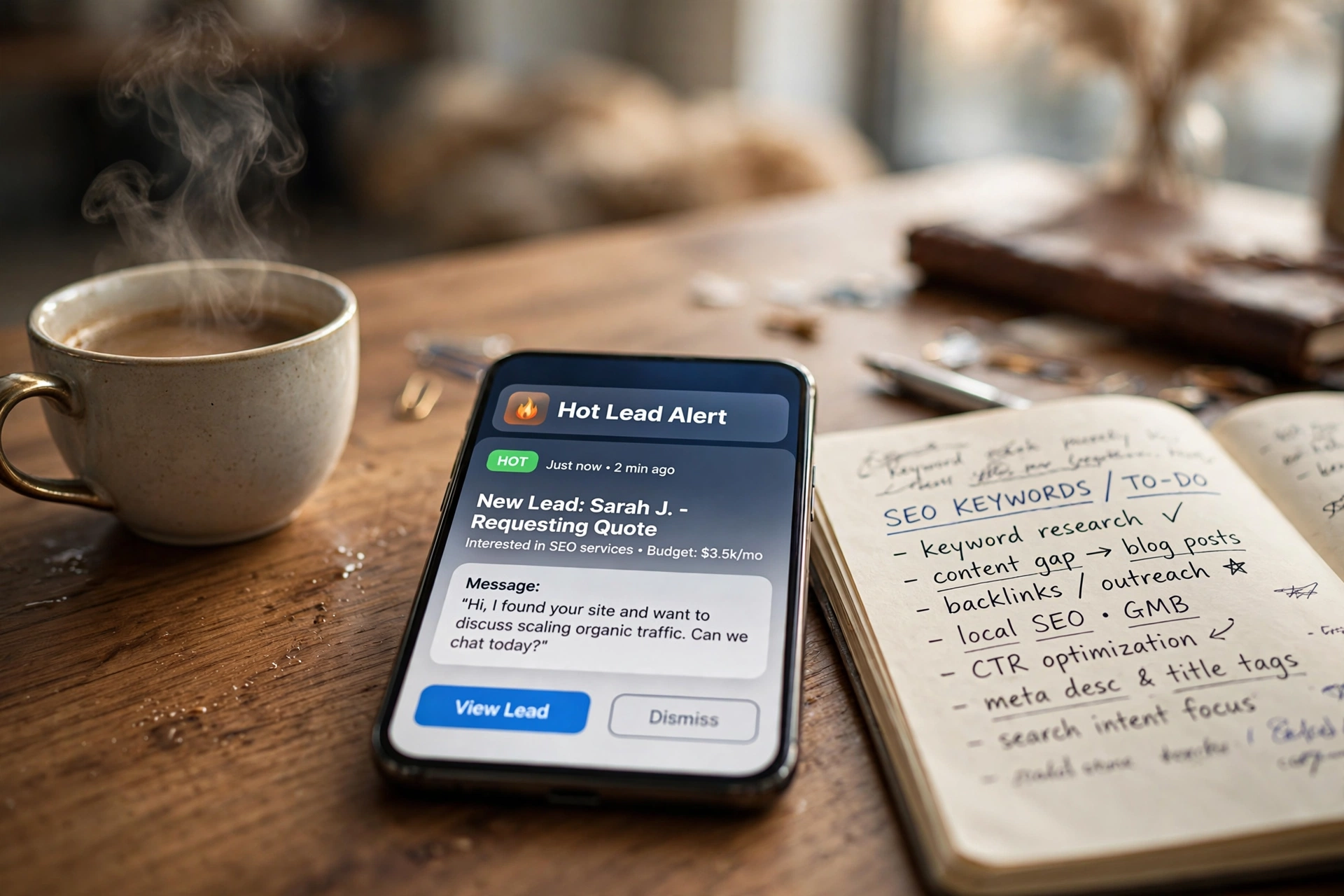
📖This article is part of the complete guide to Ultimate Guide to Hot Lead Notifications for Sales.
In my experience working with high-growth B2B companies, the most expensive mistake a SaaS founder can make is treating all sign-ups as equal. I once analyzed a mid-market SaaS platform that had a 2% conversion rate from trial to paid; after implementing a behavioral-trigger notification system that alerted sales to users hitting 'power-user' milestones in real-time, that rate jumped to 7% within one quarter. The difference wasn't the product, it was the speed of the human intervention.
For a comprehensive overview of this technology, explore our Ultimate Guide to Hot Lead Notifications for Sales.
What are Hot Lead Notifications for SaaS?
📚
Definition
Hot lead notifications for SaaS are real-time alerts triggered when a user exhibits high-intent behavioral signals, such as visiting the pricing page multiple times or accessing advanced API documentation, indicating they are ready to purchase or upgrade.
Hot lead notifications in a SaaS context move beyond simple 'form submissions.' In a traditional B2B environment, a lead is 'hot' when they fill out a 'Contact Us' form. In the 2026 SaaS landscape, however, users often explore the product in stealth mode. They sign up for a free trial, explore the dashboard, and research pricing without ever speaking to a human. If you wait for them to book a demo, you've already missed the window of peak intent.
These notifications leverage artificial intelligence and event-tracking to identify patterns. For example, when a user spends 15 minutes on your 'Enterprise Security' page and then visits the 'Billing' section, they are no longer just 'testing' the software; they are evaluating a purchase. An autonomous system detects this pattern and immediately pushes a notification to a Slack channel or a CRM, alerting an Account Executive to reach out with a personalized offer.
When we built the intent-detection layers at BizAI Intelligence, we discovered that the window for 'hot' intent in SaaS is incredibly narrow. A user is most likely to convert within the first 30 minutes of a high-intent session. If the notification arrives four hours later, the psychological momentum is gone. This is why integrating how to connect AI sales agents to CRM & webhooks for auto booking is essential for modern growth teams.

Why Do Hot Lead Notifications Matter for SaaS Growth?
SaaS businesses operate on a precarious balance of Customer Acquisition Cost (CAC) and Lifetime Value (LTV). The primary reason hot lead notifications are essential is that they drastically reduce the 'leakage' in the sales funnel. According to research by the Lead Response Management Study, the odds of qualifying a lead drop by 10x if the response time exceeds five minutes. In a competitive SaaS market where users can switch between three different alternatives in a single afternoon, speed is your only sustainable moat.
Beyond speed, these notifications allow for 'Intent-Based Routing.' Not every lead should go to the same salesperson. By analyzing the specific triggers, such as a user from a Fortune 500 company visiting the 'SSO Integration' page, the system can route the hot lead notification specifically to an Enterprise Account Executive rather than a general SDR. This level of precision ensures that high-value leads receive a high-touch experience immediately.
Furthermore, this approach solves the 'Trial Ghosting' problem. Many SaaS users sign up for trials and then disappear. By monitoring behavioral signals and triggering notifications only when a user returns to the app and performs a 'core value action' (like uploading their first dataset or inviting a team member), sales teams can prioritize their outreach. This prevents SDRs from burning through their lead list with generic 'just checking in' emails, which often lead to unsubscribe requests.
As noted by the Software Engineering Institute, the integration of automated observability into the sales process allows companies to treat the sales funnel as a data-driven pipeline rather than a guessing game. When you combine this with AI SDR vs human SDR ROI calculations, the data shows that companies prioritizing real-time notifications see a significant increase in Trial-to-Paid conversion rates.
How to Implement Hot Lead Notifications in Your SaaS Pipeline
Implementing a hot lead system requires a transition from 'static' lead capture to 'dynamic' behavioral monitoring. You cannot rely on a simple email notification from a WordPress form. You need a stack that connects your product telemetry to your communication layer.
First, you must define your 'High-Intent Events.' Not every click is a signal. You need to create a matrix of events that correlate with conversion. For most SaaS companies, these include:
- Repeated visits to the Pricing Page (3+ times in 24 hours).
- Accessing the 'Compare Plans' section.
- Reaching a specific usage threshold in the free version (e.g. 80% of storage used).
- Searching for 'Security' or 'Compliance' in the help center.
Second, you need a trigger engine. This is where the artificial intelligence comes in. A basic script might notify you every time someone hits the pricing page, but that creates 'notification fatigue' for your sales team. A sophisticated system, like the one deployed by BizAI Intelligence, uses a scoring threshold. The notification only fires when the aggregate score across multiple events hits a specific trigger point, say, 85% buyer intent.
Third, integrate the alert into the existing workflow. The notification must be actionable. Instead of an email that says "User X is hot," the alert should include a link to the user's activity log, their company size, and a pre-written outreach template based on the specific pages they visited. This is why many teams are now exploring how AI appointment setters automate B2B demo booking 24/7 to bridge the gap between the alert and the meeting.
Fourth, create a feedback loop. Your sales team must report back on whether the 'hot' lead was actually hot. If the system is triggering too many false positives, you must adjust the behavioral weights in your scoring model. This iterative process is the hallmark of an optimized lead generation engine.
| Approach | Traditional Lead Capture | Cheap AI Automation | Modern Intent Engine (BizAI) |
|---|---|---|---|
| Trigger | Static Form Submission | Keyword-based alerts | Multimodal Behavioral Scoring |
| Speed | Hours to Days | Minutes (Generic) | Seconds (Contextual) |
| Accuracy | Low (Manual) | Medium (Hallucinations) | High (Data-Driven) |
| SDR Effort | High Manual Research | High Noise/Filtering | Zero Research, Direct Action |
Common Mistakes When Setting Up SaaS Lead Alerts
One of the most common errors I see is 'Alert Overload.' When a company first implements hot lead notifications, they tend to set the trigger threshold too low. They want to see everything. The result is a Slack channel flooded with notifications for every user who happens to click a pricing link. This leads to SDRs ignoring the notifications entirely, which effectively kills the system. The goal is not more notifications; it is more accurate notifications.
Another critical mistake is the 'Generic Outreach' trap. There is nothing more jarring for a user than visiting a pricing page and receiving an email two minutes later that says, "I noticed you're interested in our plans! Want a demo?" It feels like surveillance and can actually push a user away. The outreach must be framed as a helpful intervention. Instead of "I saw you looking," try "I noticed you're exploring our enterprise security features; we actually have a specific whitepaper on how [Company X] solved that exact problem. Would that be helpful?"
Furthermore, many SaaS teams fail to integrate their notifications with their CRM. If the alert exists only in Slack and isn't logged in HubSpot or Salesforce, you lose the historical data. You cannot analyze which behavioral patterns lead to the highest LTV if the trigger event isn't tied to the customer record. This is why we emphasize PSEO architecture for SaaS and enterprise B2B growth, as it ensures that the traffic entering the site is already pre-qualified through high-intent search queries, making the notifications even more potent.
Lastly, some companies ignore the 'Negative Signal.' A hot lead notification should be suppressed if the user is currently experiencing a critical bug or a system outage. Sending a "Ready to upgrade?" notification to a user whose dashboard is crashing is a recipe for churn. Your lead notification system must be aware of the product's health state through API integrations.

Deep Dive: The Psychology of the 'Hot' SaaS Buyer
To truly master hot lead notifications, you must understand the cognitive state of a B2B buyer in 2026. The modern buyer is experiencing 'Information Overload.' They have already read your reviews on G2, checked your LinkedIn presence, and perhaps even used a competitor's tool. When they enter a 'hot' state, they are usually seeking a specific answer to a specific friction point (e.g. "Does this integrate with my current stack?").
In my experience, the most successful SaaS companies use a 'Tiered Notification' strategy.
Tier 1: Micro-Intent. These are users who visit a blog post about a specific problem. No notification is sent to sales, but a chatbot might offer a relevant case study. This is a core part of how to automate organic traffic and lead capture with AI.
Tier 2: Medium-Intent. These are users who visit the pricing page once or sign up for a trial. They are added to an automated nurture sequence but don't trigger a sales alert yet.
Tier 3: High-Intent (The 'Hot' Lead). These are users who exhibit multiple Tier 2 behaviors within a tight window. These are the leads that trigger the real-time notifications.
According to the Gartner 2025 B2B Buying Journey report, 70% of the buying process is completed before a buyer ever contacts a sales representative. This means your notification system isn't just a convenience; it is the only way to enter the conversation before the buyer has already mentally decided which vendor to choose. If you aren't using behavioral signals, you are essentially gambling that the buyer will be the one to reach out to you, a gamble that most SaaS companies lose.
Frequently Asked Questions
What is the ideal response time for a hot lead in SaaS?
For SaaS, the ideal response time is under five minutes. While some industry standards suggest 24 hours is acceptable, the reality of the 2026 digital economy is that buyers expect near-instantaneous gratification. According to a study by the Harvard Business Review, firms that contact prospects within an hour of receiving a lead are nearly seven times more likely to qualify that lead than those who wait even a few hours. In a high-intent state, the buyer's pain point is top-of-mind; reacting instantly leverages this urgency and prevents them from exploring a competitor's landing page.
How do you avoid creeping out users with real-time alerts?
The key is to lead with value, not surveillance. Instead of telling the user exactly which pages they visited, use that data to personalize the content of your offer. For instance, if a user spent ten minutes on your 'API Documentation' page, your outreach should focus on technical capabilities and integration ease, rather than a generic sales pitch. Framing the interaction as "proactive support" rather than "sales tracking" transforms the experience from invasive to helpful. This is especially effective when using an AI appointment setter for B2B that can engage the user in a helpful conversation on-site before the human sales rep even steps in.
Can hot lead notifications work for low-traffic SaaS startups?
Yes, and they are arguably more important for startups because every single lead is critical. When you have low volume, you cannot afford to let a single high-intent user slip through the cracks. For a startup, a hot lead notification system allows a small team to act like a massive enterprise by focusing 100% of their energy on the 5% of users who are actually ready to buy. Rather than spending hours on cold outreach or generic follow-ups, the founder or first sales hire can focus exclusively on the 'hot' signals, maximizing the ROI of their limited time.
What tools are best for tracking these behavioral signals?
Most modern SaaS stacks use a combination of a product analytics tool (like Mixpanel or Amplitude) and a CRM (like HubSpot or Salesforce). However, the 'glue' that connects these is often a custom webhook or an AI-driven orchestration layer. For those looking for a more automated approach, we recommend exploring best AI search optimization tools and lead capture systems that integrate directly with your site's telemetry. The goal is to move from a disconnected set of tools to a unified 'Intelligence Engine' that captures, scores, and notifies in one fluid motion.
How do I differentiate between a 'curious' user and a 'hot' lead?
This is achieved through 'Intent Weighting.' A curious user might visit your homepage and one blog post; this is low-weight behavior. A hot lead exhibits 'clustering' behavior, meaning they perform multiple high-value actions in a short period. For example, if a user visits the pricing page, then the security page, and then the 'Contact Sales' page within 10 minutes, the clustering indicates a high probability of purchase. By assigning different weights to different pages (e.g. Homepage = 1 point, Pricing = 10 points, API Docs = 5 points), you can set a numerical threshold that must be crossed before a notification is triggered.
Conclusion
In the aggressive SaaS environment of 2026, the difference between a closed-won deal and a lost lead is often measured in minutes. Hot lead notifications transform your sales process from a reactive game of 'catch-up' into a proactive acquisition machine. By monitoring behavioral signals, implementing strict intent thresholds, and responding with personalized value, you can stop the leakage in your funnel and significantly increase your trial-to-paid conversion rates.
However, notifications are only one part of a larger organic growth strategy. To ensure you have a steady stream of these high-intent leads, you need a robust traffic engine that attracts the right buyers before they even hit your pricing page. For a deep dive into the overarching strategy, read our Ultimate Guide to Hot Lead Notifications for Sales.
If you're tired of renting expensive traffic from ads and want to build a compounding organic lead machine, visit BizAI Intelligence to see how we automate the entire process from traffic to booked meeting.
AI Search Accelerator: 1-on-1 Strategy Session
Claim one of the 10 monthly slots. Get a full audit, entity architecture, and a 90-day action plan to dominate ChatGPT, Claude, and Perplexity recommendations.