Which Strategy Should You Choose to Get B2B Organic Leads?
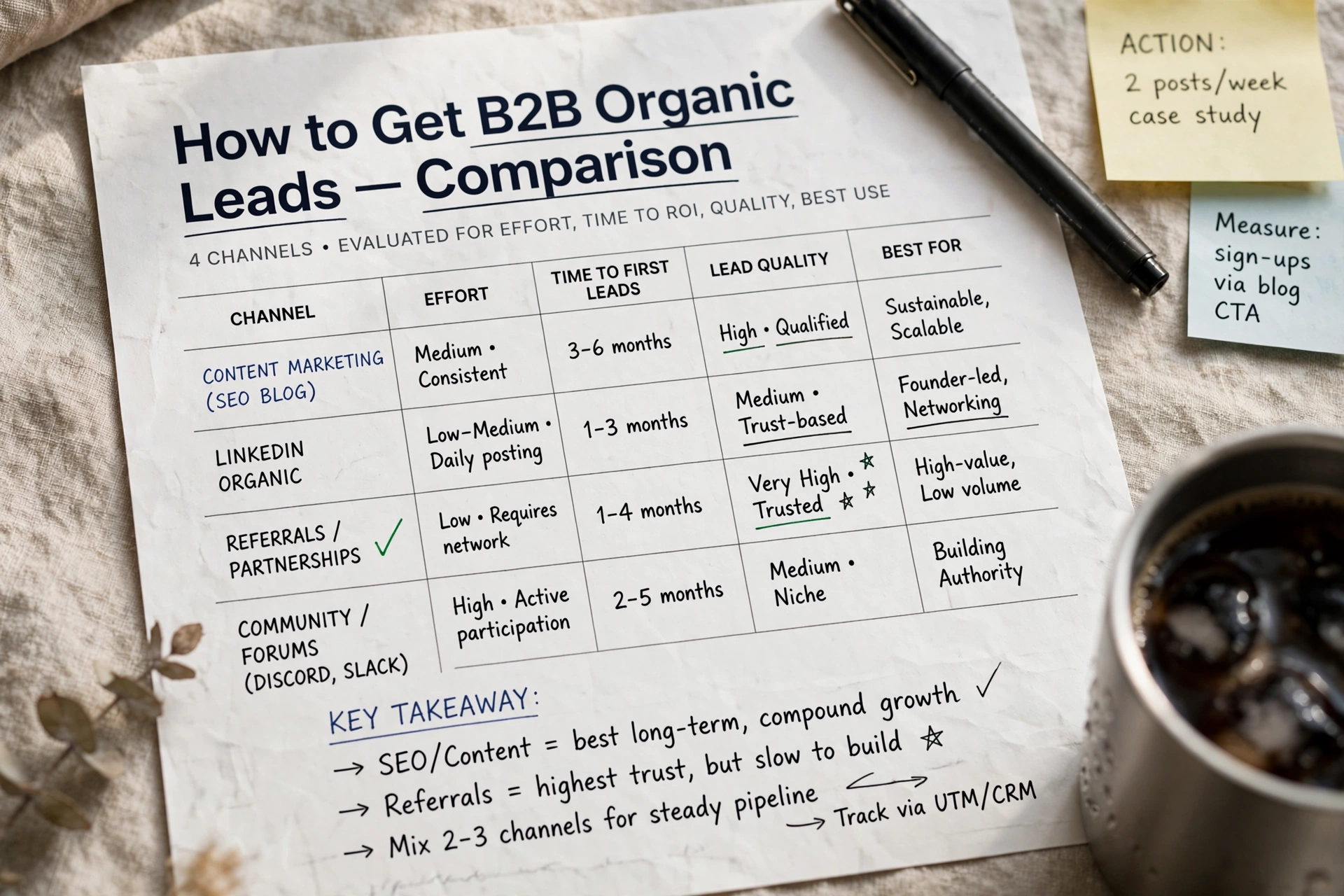
Most B2B founders treat organic growth as a lottery, hoping that a few well-written blog posts will magically trigger a flood of demos. The reality is that there are three distinct paths to determine how to get b2b organic leads: the slow-burn content approach, the technical programmatic scale, and the hybrid AI-powered acquisition engine. If you are choosing between these, the decision depends on your risk tolerance and your speed-to-market requirement. For most high-ticket B2B firms in 2026, the hybrid approach, combining massive programmatic reach with an automated AI SDR, is the only way to compete without spending six figures on monthly ad spend.
In my experience working with scaling SaaS and professional service firms, the biggest mistake I see is the "quality over quantity" fallacy. While quality matters, Google's 2026 algorithms prioritize topical authority, which is impossible to achieve with two posts a month. To dominate a niche, you don't need "better" content; you need a more comprehensive map of the buyer's journey than your competitor.

Understanding the Core Mechanics of Organic Lead Generation
To decide which path is right for your business, you first need to understand what we are actually talking about when we discuss organic lead generation. It is not just "SEO"; it is the strategic alignment of search intent with a conversion mechanism.
📚
Definition
B2B Organic Lead Generation is the process of attracting high-intent business decision-makers to a website via non-paid search results and converting them into qualified sales opportunities through value-driven content and automated qualification.
The core of this process is the "Topical Map." A topical map is a structured hierarchy of information that tells search engines you are an expert in a specific field. For example, if you provide HVAC services for hospitals, you cannot just rank for "hospital HVAC." You must also rank for "medical grade air filtration," "ASHRAE standards for operating rooms," and "hospital energy efficiency audits." This creates a "moat" around your business.
According to Gartner, by 2026, traditional search volume will continue to shift toward AI-driven discovery engines, meaning that the way we capture leads must evolve from simple keywords to "entities." When a business becomes a recognized entity in a specific niche, it stops fighting for clicks and starts owning the conversation. This is why simply ranking on Google page 1 fast is no longer the end goal; the goal is to be the definitive answer the AI provides.
Now here's where it gets interesting: most companies fail because they stop at the traffic. They get the click, but the visitor bounces because there is no immediate path to a solution. This is where the "leaky bucket" syndrome happens, you spend months building organic traffic only to lose 90% of it to a static "Contact Us" form.
Why Organic Lead Acquisition is Non-Negotiable in 2026
The economic landscape for B2B acquisition has shifted. The cost per lead (CPL) on platforms like LinkedIn and Google Ads has skyrocketed, creating a precarious situation for businesses that "rent" their traffic. When you rely solely on paid ads, your growth is linear and expensive; when you build organic authority, your growth is compounding.
Data from McKinsey suggests that companies focusing on "owned" channels (like organic search and email lists) see a significantly higher long-term LTV (Lifetime Value) because the leads are pre-educated. A lead who finds you through a deep-dive technical guide is far more qualified than a lead who clicked a "Get a Quote" ad on a whim.
The implications of ignoring organic growth are severe. In a world dominated by AI Overviews (SGE), if your business isn't the primary source of truth for your niche, you are essentially invisible. You aren't just losing a click; you are losing the trust of the prospect before they even land on your site.
The business impact is measurable. Consider the difference between a $200 lead from a paid campaign and a $0 lead from a programmatic page that has been ranking for three years. Over a 24-month period, the organic strategy doesn't just save money; it increases the overall margin of the business. This is why many are looking to stop depending on paid ads and shift toward a sustainable inbound blueprint.

Practical Application: Implementing the Organic Lead Engine
If you want to implement a system that actually converts, you have to move beyond the traditional "blogging" mindset. You need a system that generates volume and captures intent simultaneously.
Step 1: Map the Intent Silos
Stop guessing what your customers want. Use search data to identify "Decision-Stage" keywords. These are not "What is X" keywords, but "X vs Y" or "Best X for [Industry]" keywords. This is where the money is.
Step 2: Deploy Programmatic Scale
Instead of writing one massive guide, build a pillar and 100 satellite pages. If you serve different cities or industries, create dedicated landing pages for each. This "brute force" approach to SEO allows you to cover every possible query a buyer might have. When you realize how slow manual writing is, you'll see why the best programmatic SEO platforms are becoming the industry standard.
Step 3: Install the AI SDR
Traffic is a vanity metric; meetings are a sanity metric. Every page you deploy must have an embedded AI agent. In my experience, a static form is where leads go to die. An AI SDR, however, can engage the visitor in real-time, ask qualifying questions, and book a meeting directly into your CRM. This is the specific reason why programmatic SEO fails without AI SDRs, you cannot handle 1,000% more traffic with a manual sales process.
💡
Key Takeaway
Organic leads are not "free"; they are paid for with upfront technical effort. The ROI comes from the fact that once the system is built, the cost of acquiring the next lead drops toward zero.
BizAI Intelligence solves this entire loop by automating the generation of hundreds of high-authority pages and pairing them with a context-aware AI Sales Agent. Instead of hiring a team of copywriters and a separate SDR team, you deploy a single automated inbound acquisition system.
Comparing Your Lead Generation Options
When deciding which method to use to get B2B organic leads, you must weigh the trade-offs between time, cost, and scalability. Many businesses get trapped in the "middle ground", doing enough SEO to be noticed but not enough to be dominant.
| Option | Pros | Cons | Best For |
|---|---|---|---|
| Manual Content Marketing | High brand control, deep nuance, strong trust. | Extremely slow, high cost per piece, difficult to scale. | Boutique agencies or highly specialized consultants. |
| Generic AI Content | Fast deployment, low initial cost. | High hallucination risk, "AI slop" feel, poor conversion. | Low-ticket affiliate sites or low-stakes blogs. |
| BizAI Intelligence (PSEO + AI SDR) | Massive scale, high intent capture, compounding ROI. | Requires technical setup and strategic mapping. | High-ticket B2B, Law Firms, SaaS, and Enterprise Services. |
That said, the "Manual" approach is becoming a liability. In the time it takes a freelance writer to produce four high-quality articles, a programmatic system can deploy 300 pages that cover every long-tail keyword in your industry. If you are still paying for individual articles, you are essentially fighting a war with a sword while your competitors are using drones. This is why many firms are choosing to replace freelance copywriters with an automated engine.
Common Questions & Misconceptions about Organic B2B Leads
Most "SEO Experts" are still teaching strategies from 2018. The game has changed. Here are the most common myths I encounter when consulting with B2B firms.
Myth 1: "Quality is more important than quantity."
Most guides get this wrong. In 2026, quality is the baseline, not the strategy. Google expects your content to be helpful. But "helpful" content that no one finds is useless. To rank, you need a massive footprint of "good enough" content that covers a vast topical area. You don't need a masterpiece; you need a comprehensive library.
Myth 2: "Organic leads take too long to arrive."
This is only true if you use traditional blogging. Programmatic SEO, combined with the Google Indexing API, can get hundreds of pages crawled and ranking in weeks, not years. If you are still waiting six months for a single post to rank, you are using the wrong architecture.
Myth 3: "We can just use a chatbot to convert the traffic."
There is a massive difference between a "chatbot" (which follows a rigid tree of If/Then statements) and an "AI SDR." A generic chatbot frustrates users. An AI SDR understands the context of the page the user is on and steers the conversation toward a booking. If you don't fix this, you will suffer from the 90% bounce rate that kills most organic efforts.
Myth 4: "We only need to target high-volume keywords."
Actually, high-volume keywords are often "informational" (e.g. "What is Cloud Computing?"). The real leads are in the low-volume, high-intent "long-tail" keywords (e.g. "Best cloud computing for HIPAA compliant healthcare in Texas"). These have lower volume but 10x the conversion rate.
Frequently Asked Questions
Which organic lead generation strategy is best for high-ticket B2B?
The most effective strategy for high-ticket B2B is a hybrid of Programmatic SEO (PSEO) and AI-driven qualification. Because high-ticket buyers have complex needs, they search for very specific, long-tail solutions. By deploying hundreds of satellite pages that answer these specific queries and immediately qualifying those visitors with an AI SDR, you eliminate the friction between "searching" and "buying." This approach ensures you capture a wider net of intent while maintaining a high standard of lead quality.
How long does it actually take to see results from organic B2B leads?
While traditional SEO can take 6 to 12 months, a modern programmatic approach can yield results much faster. By utilizing the Google Indexing API and creating a dense network of interconnected pillar and satellite pages, businesses can see significant traffic increases within 30 to 90 days. However, the real "compounding" effect happens after the first quarter, as Google recognizes your domain as a topical authority, leading to higher rankings for more competitive, high-volume terms.
Is it possible to get B2B organic leads without a massive budget?
Yes, but you must substitute capital with technical efficiency. Instead of hiring an expensive agency that charges monthly retainers for "content management," use automation tools to build your topical map. The goal is to move away from "pay-per-post" to "pay-per-system." By using an automated engine like BizAI Intelligence, you can produce the output of a 10-person marketing team at a fraction of the cost, allowing you to dominate your niche through algorithmic scale rather than raw spending.
How do I know if my organic leads are actually "qualified"?
Qualification happens at the point of capture, not after the lead is in your CRM. A qualified lead is one who has demonstrated a specific pain point and possesses the authority and budget to solve it. By using an AI SDR on your organic pages, you can program the agent to ask "qualifying screens", such as company size, current budget, or specific technical requirements, before the meeting is even booked. This ensures your sales team only spends time with high-intent prospects.
Which is better: a blog or a programmatic landing page system?
For lead generation, a programmatic landing page system is vastly superior to a traditional blog. Blogs are great for brand awareness and "top of funnel" education, but they are inefficient for conversion. Programmatic pages are engineered for a specific intent; they provide the exact answer the user is looking for and a direct path to a solution. While a blog might get more total visits, a programmatic system typically generates a higher volume of qualified leads because it targets "buying intent" rather than "learning intent."
Final Thoughts on How to Get B2B Organic Leads
Deciding which path to take to get b2b organic leads comes down to whether you want to build a digital asset or a digital expense. Paid ads are an expense; organic authority is an asset. If you continue to rely on manual content creation, you will always be limited by the number of hours your team can work.
The future of B2B acquisition is the "Inbound Machine", a system that combines the reach of programmatic SEO with the precision of AI qualification. By covering your entire topical map and automating the SDR process, you stop renting traffic and start owning your market.
If you are ready to stop the guesswork and start filling your pipeline with high-intent organic leads, it's time to move beyond the old agency model. Visit BizAI Intelligence and discover how to build an automated acquisition engine that works while you sleep. For more on scaling your visibility, check out our guide on how to make your business show up on Google Search.
AI Search Accelerator: 1-on-1 Strategy Session
Claim one of the 10 monthly slots. Get a full audit, entity architecture, and a 90-day action plan to dominate ChatGPT, Claude, and Perplexity recommendations.