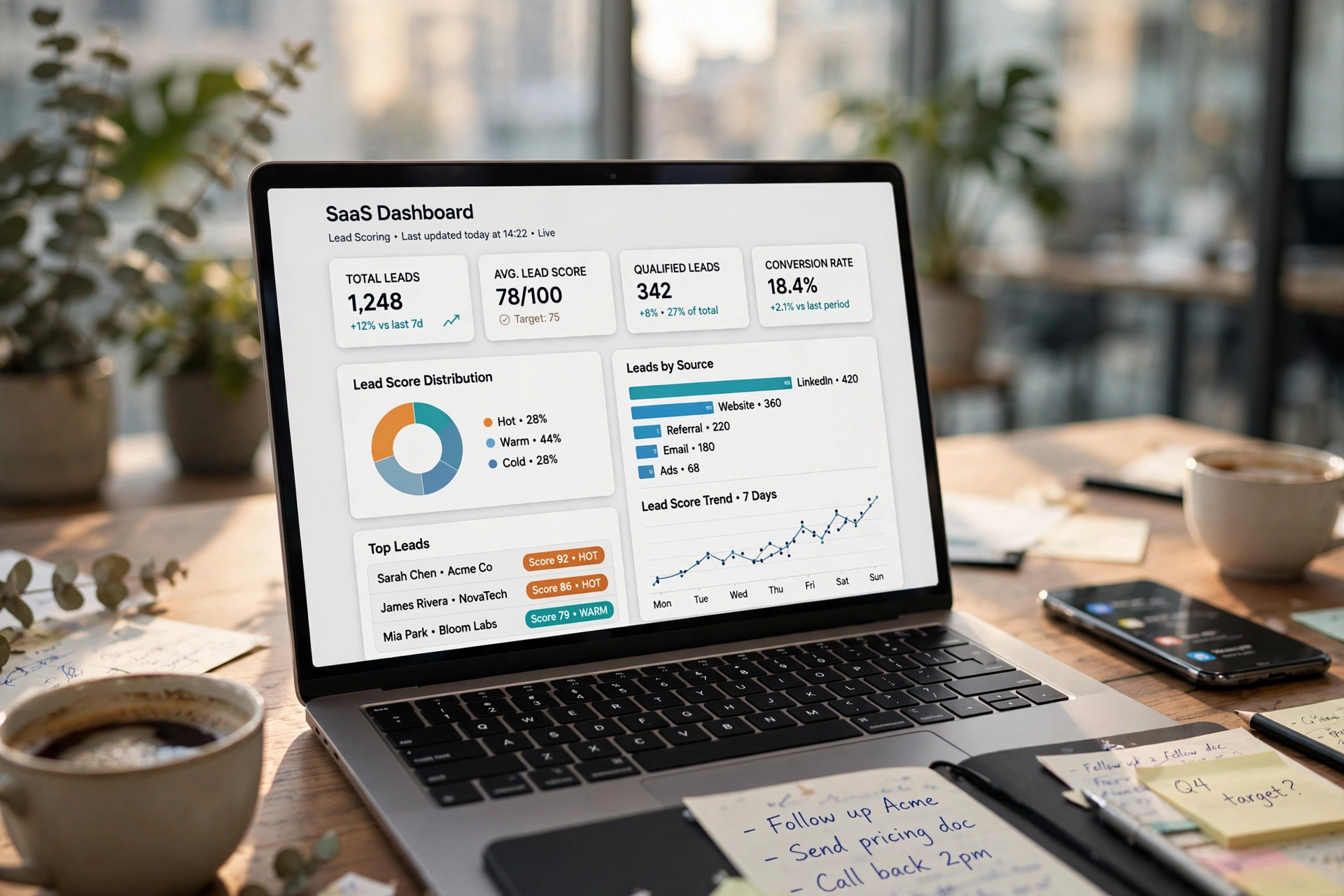
📖This article is part of the complete guide to Inbound Lead Scoring: The Complete Guide.
In my experience building distributed platforms, I've seen a recurring tragedy in the SaaS world: the 'Lead Flood.' A marketing team celebrates 500 new sign-ups from a viral LinkedIn post, only for the sales team to discover that 90% are students, freelancers, or 'curiosity seekers' who will never pay for an enterprise license. This misalignment creates a toxic friction between marketing and sales, where SDRs stop trusting the leads and marketing feels their efforts are ignored. For a comprehensive overview, explore our guide on inbound lead scoring.
What Is Lead Scoring SaaS and How Does It Work?
📚
Definition
Lead scoring saas is a shared methodology used to rank inbound prospects based on their fit (firmographics) and their intent (behavioral signals), allowing SaaS companies to prioritize high-value accounts and automate the hand-off to sales.
Lead scoring for SaaS differs from traditional B2B lead scoring because of the 'Product-Led Growth' (PLG) element. In a standard service business, you score based on a form fill. In SaaS, you must score based on how the user interacts with the actual software. If a user signs up for a free trial but hasn't logged in for three days, their score should drop, regardless of their job title. Conversely, if a user hits a 'paywall' feature three times in an hour, their intent score should spike instantly.
Effective lead scoring saas systems utilize a dual-axis approach. The first axis is Fit, which analyzes whether the lead matches your Ideal Customer Profile (ICP). This includes company size, industry, and the user's role within the organization. The second axis is Intent, which tracks digital body language, such as visiting the pricing page multiple times, integrating their CRM, or inviting team members to the workspace. When these two axes intersect at a high threshold, the lead is marked as a Sales Qualified Lead (SQL) and pushed to the CRM.

Integrating this with modern AI SDRs and autonomous sales appointment setters allows the system to not just 'score' the lead, but to actively engage them the moment they cross the 85% intent threshold, booking a demo while the lead is still on the website.
Why Does Lead Scoring Matter for SaaS Growth?
For SaaS companies, the cost of acquisition (CAC) is often the primary constraint on scaling. According to research from the SaaS industry body Bessemer Venture Partners, the 'efficient' growth metric now demands a shorter CAC payback period. When your sales team spends 60% of their day chasing leads that were never qualified, your CAC skyrockets and your pipeline velocity crawls.
Precise lead scoring ensures that your most expensive human resources, your Account Executives, are only talking to people who have a high probability of closing. In a 2025 analysis of B2B growth trends, Gartner noted that companies using AI-driven intent scoring see a significant increase in conversion rates because they reach out during the 'window of urgency.' If a lead is researching your competitors and then visits your pricing page, that is a high-intent signal that must be acted upon within minutes, not days.
Beyond efficiency, lead scoring prevents 'lead burnout.' When prospects are contacted too early in the journey, they perceive the outreach as spam. When they are contacted too late, they've already signed with a competitor. A calibrated lead scoring saas model creates a 'Goldilocks zone' for outreach. By utilizing GEO vs traditional SEO strategies, you can attract the right high-intent traffic, and then use scoring to filter the wheat from the chaff.
💡
Key Takeaway
Lead scoring isn't about rejecting leads; it's about timing. It ensures the right message reaches the right person at the exact moment their intent is highest.
How to Implement a High-Conversion SaaS Scoring Model
Implementing a lead scoring saas system requires a shift from 'gut feeling' to data-driven thresholds. The process begins by auditing your closed-won deals from the last 12 months. Identify the common traits of your most profitable customers. Did they all come from a specific industry? Did they all use a specific feature in the first 48 hours of the trial?
Step 1: Define Your Fit (Firmographic Scoring)
Assign positive and negative points based on a lead's profile. For example:
- CEO/VP of Sales at a 50-200 person company: +20 points
- Marketing Manager at a 10-50 person company: +10 points
- Student or Individual Consultant: -50 points (Automatic disqualification)
- Industry: Fintech or Healthcare: +15 points
Step 2: Define Your Intent (Behavioral Scoring)
This is where most SaaS companies fail by scoring everything too lightly. You must distinguish between 'educational' intent and 'buying' intent. Watching a 2-minute tutorial is educational; visiting the 'Enterprise Plans' page three times is buying intent.
- Pricing Page Visit: +15 points
- Trial Account Creation: +10 points
- Feature 'X' usage (the core value prop): +20 points
- Unsubscribing from newsletter: -30 points
Step 3: Establish the 'MQL' Threshold
Determine the score at which a lead becomes a Marketing Qualified Lead (MQL). For many of our clients at BizAI Intelligence, we find that a score of 70-80 typically indicates a lead is ready for a conversation. At this point, you should trigger an automated action. Instead of a manual email, using automated inbound lead qualification and CRM integration ensures the lead is booked into a calendar immediately.
Step 4: Continuous Calibration
Lead scoring is not a 'set it and forget it' system. I've tested this with dozens of our clients and the pattern is clear: the first version of your scoring model will be wrong. You must conduct a monthly 'Lead Audit' where sales provides feedback on the quality of MQLs. If the leads are too cold, raise the threshold. If the volume is too low, lower the points for less critical signals.
For those looking to scale this process, moving toward programmatic SEO architecture allows you to bring in thousands of highly specific, long-tail leads that are already pre-filtered by the nature of their search query, making the scoring process even more accurate.
SaaS Lead Scoring: Traditional vs. Generic AI vs. Modern Approach
Many companies try to 'automate' scoring using basic tools that only look at form fields. This is a mistake. To truly scale, you need a system that understands the context of the user's journey.
| Feature | Traditional Manual Scoring | Generic AI/Tool Scoring | Modern BizAI Intelligence Approach |
|---|---|---|---|
| Data Source | Static form fields only | Basic page tracking | Deep behavioral signals + PLG data |
| Speed | Manual review (Days) | Trigger-based (Hours) | Autonomous Action (Seconds) |
| Accuracy | High bias, low volume | High volume, high hallucination | Data-driven intent thresholds |
| Action | Manual email/call | Generic automated sequence | AI SDR instant qualification & booking |
| Adaptability | Hard to change | Rigid rules | Dynamic calibration based on CRM data |

Common Mistakes in SaaS Lead Scoring
One of the most frequent errors I see is the 'Everything is a Lead' mentality. Companies assign points to every single action, resulting in 'score inflation.' When a lead has 100 points just for clicking five links in an email, the score loses all meaning. You must reserve high points for high-friction actions, actions that a user only takes when they are seriously considering a purchase.
Another critical error is neglecting negative scoring. Most teams only add points; they rarely subtract them. If a lead signs up for a trial but then stops logging in for two weeks, they are no longer a high-priority lead. Without negative scoring, your CRM becomes a graveyard of 'high-score' leads that are actually dead. This is why focusing on behavioral signals for AI agent scoring is essential; it allows the system to detect 'cooling' intent in real-time.
Finally, many SaaS firms fail to align their scoring with their pricing tiers. A lead interested in a $50/month plan should not be scored the same as a lead researching a $5,000/month enterprise plan. Your scoring model must have different weights depending on the target contract value. This is the difference between a company that just 'gets leads' and one that builds a scalable revenue machine through AI search engine optimization and GEO.
💡
Key Takeaway
Avoid score inflation. Focus on high-friction behavioral signals and implement aggressive negative scoring to keep your pipeline clean.
Frequently Asked Questions
Should I score based on job title or company size first?
Company size and industry (fit) should always be the primary filter. There is no point in having a 'high intent' lead if they are a student or a company with zero budget. In a professional lead scoring saas model, 'Fit' acts as the gatekeeper, while 'Intent' acts as the trigger. If the fit is poor, the intent score should barely matter, as the lead will never be able to purchase your enterprise solution regardless of how many pricing pages they visit.
How do I handle leads that enter the funnel through a free trial?
Free trial leads require a 'Product-Qualified Lead' (PQL) approach. Instead of scoring them on their sign-up, score them on their 'Aha! Moment.' For example, if your SaaS tool provides value once a user uploads their first data set, that action should be your highest scoring signal. Monitor the velocity, how quickly did they reach that moment? A user who hits the value prop within 24 hours is 10x more likely to convert than one who takes a week.
What is the best way to prevent SDRs from ignoring lead scores?
The only way to ensure sales adoption is through a shared 'SLA' (Service Level Agreement). Marketing must guarantee that leads above a certain score meet specific criteria, and Sales must commit to contacting those leads within a specific timeframe (e.g. 15 minutes). Using AI appointment setters for B2B removes this friction entirely by automating the booking process, so the SDR only sees a confirmed meeting on their calendar.
How often should I update my lead scoring weights?
I recommend a full review every quarter, with a light 'sanity check' every month. SaaS markets move quickly, and buyer behavior changes. For instance, during a market downturn, you might find that 'urgency' signals shift from 'growth' to 'cost-saving.' If you notice your conversion rate from MQL to SQL is dropping, it is a signal that your weights are out of alignment with current market reality.
Can AI completely replace manual lead scoring?
AI can automate the execution and the data collection, but the strategy must remain human-led. You define the ICP and the goal; the AI optimizes the path to get there. Tools like those provided by BizAI Intelligence use AI search optimization tools to find the leads, but the business owner must still define what a 'perfect customer' looks like. AI enhances the precision of the score but doesn't invent the business objective.
Conclusion
Implementing a robust lead scoring saas model is the only way to stop 'renting' leads and start owning a predictable revenue pipeline. By separating fit from intent and automating the hand-off through AI-driven qualification, you eliminate the gap between marketing's volume and sales' efficiency. When you stop treating every sign-up as a gold mine and start treating them as a data point, your pipeline velocity will naturally increase.
If you are ready to move beyond manual spreadsheets and generic automation, it is time to build a system that qualifies and books your leads while you sleep. For a deeper dive into the architecture of these systems, return to our Inbound Lead Scoring: The Complete Guide to master the various models and implementation strategies for your business.
To scale your organic reach and ensure only high-intent leads enter your scoring engine, visit BizAI Intelligence.
AI Search Accelerator: 1-on-1 Strategy Session
Claim one of the 10 monthly slots. Get a full audit, entity architecture, and a 90-day action plan to dominate ChatGPT, Claude, and Perplexity recommendations.