Which Strategy Is Best to Build an Organic Traffic Machine?
Most B2B founders treat organic growth as a side project, hoping that a few well-written blog posts will eventually trigger a landslide of leads. In my experience working with high-ticket service providers, this "hope-based" marketing is why 90% of companies remain tethered to expensive paid ads. When deciding how to build an organic traffic machine, the choice isn't between "doing SEO" or "not doing SEO," but rather between manual content creation, generic AI automation, or a programmatic authority hub. The most effective machine for 2026 is the Programmatic SEO (pSEO) hub integrated with AI SDRs, as it replaces linear growth with exponential scale by dominating thousands of long-tail intent queries simultaneously.
For those struggling to exit the "ad spend treadmill," the first step is understanding that traffic without a conversion mechanism is just a vanity metric. If you want to stop depending on paid ads, you need a system that treats content as an asset, not a chore.
What Exactly Is an Organic Traffic Machine?
An organic traffic machine is a scalable system designed to attract a consistent flow of high-intent visitors from search engines without the recurring cost of per-click advertising. Unlike traditional blogging, which relies on a "hit or miss" approach to viral topics, a true machine is built on predictable architecture. It uses a combination of topical authority, structured data, and intent-based landing pages to capture users at every stage of the buyer's journey.
📚
Definition
Topical Authority is the perceived expertise of a website on a specific subject, established by creating comprehensive, interconnected content that answers every possible question a user might have about that topic.
The core of this machine is the "Pillar and Satellite" model. A pillar page provides a high-level overview of a core service, while hundreds of satellite pages target specific, low-competition keywords, such as "best [service] for [specific industry] in [city]." This creates a semantic web that tells Google your site is the definitive source of truth. According to research from Gartner, B2B buyers now conduct nearly 70% of their research online before ever contacting a sales representative, meaning the "machine" must provide the answers before the human conversation even begins.
Now, here is where it gets interesting: the transition from "content" to "machine" happens when you move from manual writing to programmatic generation. Instead of writing one article a week, a programmatic approach allows a business to deploy 300+ optimized pages in a single month. This is how you move from ranking for one or two keywords to dominating an entire niche. When we developed the architecture at BizAI Intelligence, we discovered that the sheer volume of high-quality, intent-mapped pages creates a "gravity effect," pulling the entire domain's authority upward and making it significantly easier to rank for the most competitive head terms.
Why Building a Traffic Machine Is Non-Negotiable in 2026
The cost of customer acquisition (CAC) through paid channels has reached a breaking point for many B2B firms. As AI-generated ad copy floods the market, click-through rates are dropping while costs per click (CPC) continue to rise. Relying solely on paid traffic is essentially renting your growth; the moment you stop paying, your pipeline dries up. An organic machine, however, represents owned equity.
The business impact of this shift is massive. According to a McKinsey report on digital transformation, companies that prioritize organic search and content authority see a significantly lower long-term CAC compared to those relying on performance marketing. Specifically, organic leads often convert at a higher rate because they are "pull" leads, users seeking a solution, rather than "push" leads who are being interrupted by an ad.
If you fail to build this machine, you risk three critical failures:
- The Trust Gap: Modern buyers distrust ads. They trust search results and peer-reviewed authority.
- The Efficiency Gap: Manual content creation is too slow. If it takes you a month to write four articles, your competitor using AI blog automation will outpace your topical coverage by 100x.
- The Revenue Gap: Most websites have a "leaky bucket" problem. They get traffic but fail to capture it. This is why why programmatic SEO fails without embedded AI SDRs is such a critical point of failure for most businesses.
In my experience, the biggest mistake I see is the "quality vs. quantity" fallacy. Agencies tell you to "focus on quality," but in 2026, quality is the baseline. The winning variable is Scale + Quality. You cannot achieve topical dominance with five "perfect" articles; you achieve it with 500 "excellent" articles that answer every single niche variation of a buyer's problem.
Practical Application: How to Build Your Machine Step-by-Step
Building an organic traffic machine requires a shift from a creative mindset to an engineering mindset. You aren't writing a blog; you are building a lead-capture engine.
Step 1: Map the Intent Universe
Don't guess what your customers want. Use search data to identify "Decision-Stage" queries. These are keywords where the user isn't just researching a problem but is looking for a provider. Examples include "[Service] for [Industry]" or "[Service] near [City]."
Step 2: Construct the Pillar-Satellite Architecture
Create one master pillar page that defines your core offering. Then, build a matrix of satellite pages. If you are a law firm, your pillar is "Personal Injury Law," and your satellites are "Car Accident Lawyer in [Neighborhood A]," "Trucking Accident Lawyer in [Neighborhood B]," and so on. This allows you to rank on Google page 1 fast by targeting low-competition, high-intent local queries.
Step 3: Deploy Programmatic Generation
This is where BizAI Intelligence changes the game. Instead of hiring five copywriters to spend six months on this, you use a programmatic engine to generate these hundreds of pages. These aren't generic AI "slop" articles; they are structured, data-driven pages that follow a strict SEO blueprint, including schema markup and optimized metadata.
Step 4: Install the AI SDR Conversion Layer
Traffic is useless if it doesn't convert. Every page in your machine must have an autonomous AI Sales Agent. This agent tracks user behavior and initiates a conversation to qualify the lead and book a meeting. This solves the "bounce" problem, turning a passive reader into a qualified appointment in the CRM.
💡
Key Takeaway
The goal of an organic traffic machine is not "traffic," but "qualified pipeline." The integration of programmatic scale and AI qualification is the only way to achieve a sustainable, low-CAC growth engine in 2026.

Comparing the Options: Manual, Generic AI, and Programmatic Hubs
When deciding which path to take, you must weigh the trade-offs between speed, cost, and authority. Most business owners are tempted by "cheap" AI tools, but they fail to realize that Google's 2026 algorithms are designed to penalize low-effort AI content.
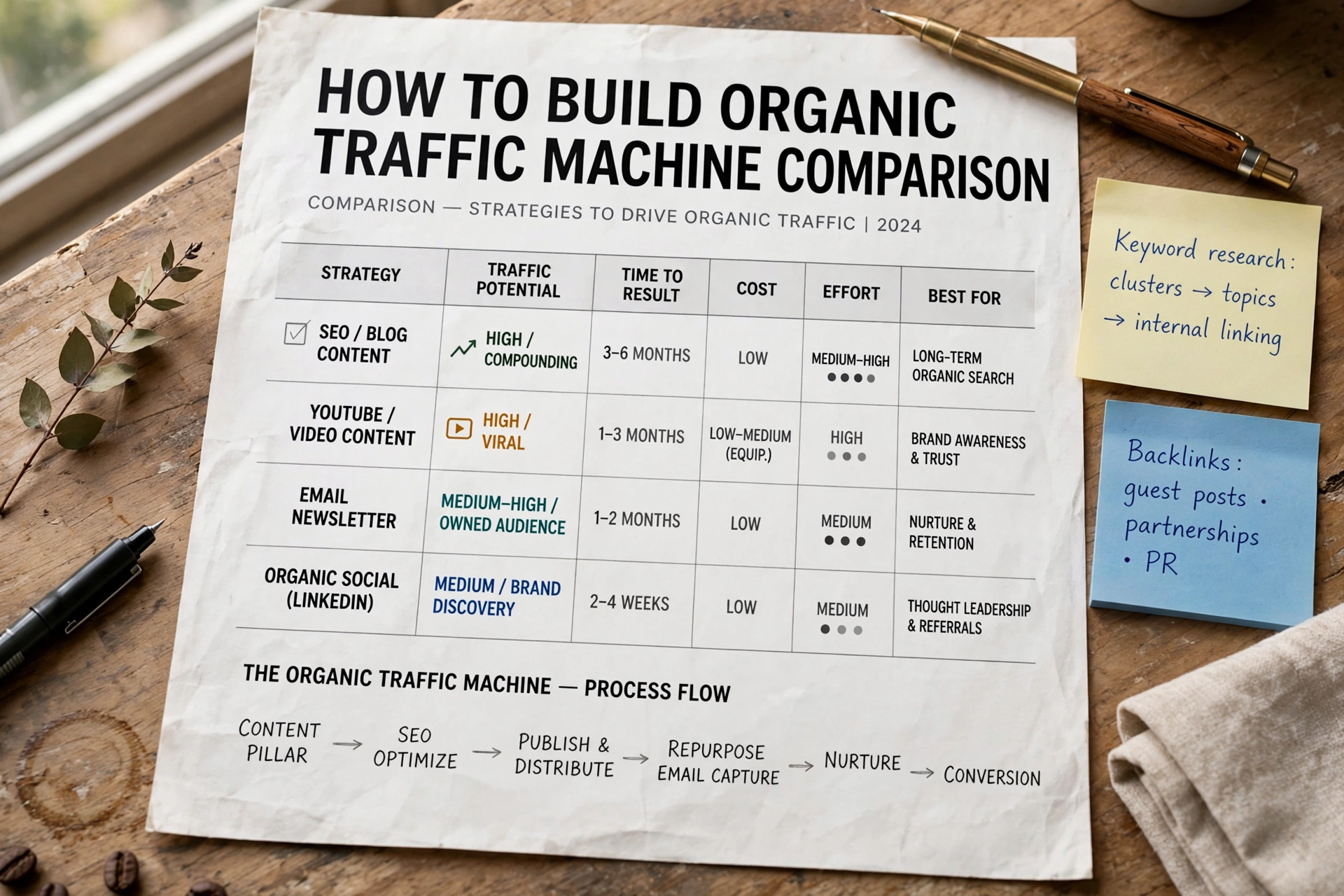
| Feature | Manual Content | Generic AI Tools | Programmatic Hub (BizAI) |
|---|---|---|---|
| Speed to Market | Very Slow (Months) | Fast (Days) | Ultra-Fast (Weeks) |
| Scalability | Linear/Low | High but low quality | Exponential & High Quality |
| Topical Authority | Slow Build | Superficial | Immediate Dominance |
| Conversion Rate | Manual Forms (Low) | Manual Forms (Low) | AI SDRs (High) |
| Long-term ROI | High (if successful) | Low (risk of penalties) | Maximum (Owned Asset) |
| Best For | Brand storytelling | Internal memos | High-ticket B2B Lead Gen |
As the table shows, the manual approach is too slow for the modern market, and generic AI tools create a "content desert", lots of words, but no value. The Programmatic Hub approach is the only one that addresses both the acquisition (traffic) and the conversion (leads) sides of the equation. If you're considering different tools, it's worth looking at Byword vs SEOmatic vs BizAI GPT to see which architecture actually supports B2B lead qualification rather than just "generating text."
Common Questions and Misconceptions
There is a lot of misinformation regarding organic growth. Most guides get this wrong by focusing on "hacks" rather than systems.
Myth 1: "You only need a few high-quality pieces of content to rank."
This is the most dangerous lie in SEO. While quality is essential, Google's ranking algorithms prioritize topical coverage. If you have three great articles but your competitor has 300 pages covering every possible variation of the topic, Google views the competitor as the authority. You don't need "perfect" content; you need "comprehensive" content.
Myth 2: "AI content will get you penalized by Google."
Google has explicitly stated that it rewards helpful content, regardless of how it is produced. The "penalty" people talk about is actually a penalty for low-value content. When you use a professional AI content engine strategy, you aren't just spinning text; you are structuring data to be helpful. The risk isn't AI; the risk is laziness.
Myth 3: "Organic traffic takes years to work."
In the past, this was true. However, by using the Google Indexing API and a programmatic structure, you can force Google to crawl and index hundreds of pages in days. By targeting "long-tail" keywords (queries with lower volume but higher intent), you can see lead flow within weeks, not years. This is how small businesses can make their business show up on Google search without waiting for a decade of domain age.
Frequently Asked Questions
How do I know which keywords are "intent-rich" for my organic traffic machine?
Intent-rich keywords are those that signal a readiness to buy rather than a desire to learn. "What is personal injury law" is an informational query (low intent). "Best personal injury lawyer for car accidents in Miami" is a transactional query (high intent). To build your machine, you must prioritize "Commercial" and "Transactional" intent. Look for modifiers like "best," "service," "cost," "near me," and "company." In my experience, targeting these long-tail variations allows you to capture users who are at the very bottom of the funnel, leading to a much higher conversion rate than targeting broad industry terms.
Can I build an organic traffic machine if I have a brand new domain?
Yes, and in some cases, it is actually easier. A new domain is a blank slate. By deploying a massive, structured hub of 300-900 pages immediately, you signal to Google that you are a specialized authority in a specific niche from day one. The key is to avoid "keyword cannibalization", making sure each page targets a unique, specific query. When you combine a new domain with best programmatic SEO platforms, you can bypass the slow "blogging" phase and move straight into the "authority" phase, provided your internal linking is surgically precise.
Why is a "conversion layer" like an AI SDR necessary for organic traffic?
Traffic is a vanity metric; appointments are a sanity metric. Most organic traffic consists of "scanners" who read a page and leave. According to industry data, the bounce rate for B2B landing pages can often exceed 90%. An AI SDR acts as a 24/7 salesperson that engages the user the moment they show interest. Instead of hoping the user finds your "Contact Us" page, the AI SDR qualifies the lead via a chat interface, scores their intent, and books the meeting directly into your calendar. This is the difference between having a website and having a sales machine.
How does a programmatic approach differ from traditional SEO agencies?
Traditional agencies typically operate on a "retainer" model where they produce 2-4 blog posts per month. This is linear growth. A programmatic approach is algorithmic. Instead of writing individual posts, we build a system that generates hundreds of high-value pages based on data sets. This allows you to dominate an entire region or industry in a fraction of the time. If you compare an AI vs SEO agency, the difference is that the AI-driven programmatic approach scales without increasing the monthly headcount or cost.
Will the "machine" approach work for very niche high-ticket services?
It actually works better for high-ticket services. In a high-ticket B2B environment, you don't need 1 million visitors; you need 100 of the right visitors. Programmatic SEO allows you to create "hyper-specific" pages for every single niche your business serves. For example, if you provide enterprise consulting, you wouldn't just have a "Consulting" page; you would have pages for "Enterprise Consulting for Fintech in New York," "Enterprise Consulting for Healthcare in Chicago," and so on. This precision ensures that the traffic you get is exactly the type of client you want.
Final Thoughts on Building Your Organic Traffic Machine
Building an organic traffic machine is the only sustainable way to scale a B2B company in 2026. The choice is simple: you can continue to rent your traffic from Google and Meta via paid ads, or you can build an asset that generates leads while you sleep. By moving away from the slow, manual processes of the past and embracing a programmatic architecture, you stop fighting for scraps and start dominating your niche.
If you are tired of the volatility of paid ads and want to implement a system that scales your authority and your pipeline simultaneously, it is time to shift your strategy. Stop guessing and start engineering your growth.
To build your own authority hub and deploy an autonomous AI lead qualification system, visit BizAI Intelligence. Whether you need to automate your company blog or replace your entire freelance copywriting team with an AI content engine, the tools to dominate the search landscape are already here.
Only 12 Onboarding Slots Remaining This Month
BizAI deploys 300 AI salespeople scoring purchase intent 24/7. Get your free niche domination blueprint.
AI Search Accelerator: 1-on-1 Strategy Session
Claim one of the 10 monthly slots. Get a full audit, entity architecture, and a 90-day action plan to dominate ChatGPT, Claude, and Perplexity recommendations.