
On This Page (7)
- 01What is Buyer Intent Lead Qualification?
- 02Why Does Buyer Intent Lead Qualification Matter for B2B Growth?
- 03How to Implement Buyer Intent Lead Qualification in Your Pipeline
- 04Traditional vs. AI-Driven Lead Qualification
- 05Common Mistakes to Avoid in Intent Qualification
- 06Frequently Asked Questions
- 07Conclusion
Stop wasting sales time on cold leads. Use intent signals to qualify B2B leads automatically. See how AI identifies high-intent buyers in real-time.
I once watched a high-ticket B2B client lose a six-figure deal because their sales team took 48 hours to respond to a 'contact us' form, while the lead had already spent three hours reading their pricing page and technical documentation. By the time the human SDR reached out, the lead's urgency had evaporated. This is the failure of traditional lead qualification; it treats every form submission as equal, ignoring the digital footprints that signal a buyer is ready to purchase right now.
For a comprehensive overview of the signals themselves, explore our guide on buyer intent signals.
What is Buyer Intent Lead Qualification?
Buyer intent lead qualification is the process of using behavioral data and explicit signals to determine the likelihood of a lead converting into a customer before a human salesperson ever engages.
Buyer intent lead qualification is the strategic shift from qualifying leads based on static demographics (firmographics) to qualifying them based on active behavior. In the traditional model, a lead is 'qualified' if they work at a company with 500+ employees and have a specific job title. In the intent-driven model, a lead is qualified if they have visited your pricing page three times in 24 hours, downloaded a technical implementation guide, and spent five minutes reading a case study about a competitor's failure.
When we built the automation engines at BizAI Intelligence, we discovered that firmographics tell you if a lead can buy, but intent signals tell you if they want to buy. The former is a prerequisite; the latter is the catalyst for revenue. By integrating artificial intelligence and real-time tracking, businesses can now score leads based on their current state of mind rather than their LinkedIn profile. This approach leverages large language model (LLM) capabilities to interpret not just what a user clicks, but the semantic meaning behind their journey. For instance, a user searching for "how to integrate X with Y" shows significantly higher intent than someone searching for "what is X."

Why Does Buyer Intent Lead Qualification Matter for B2B Growth?
Buyer intent lead qualification is essential because it solves the 'leaky bucket' problem in the sales pipeline. According to research by Gartner, B2B buyers are now 70% to 80% through the buying process before they even contact a sales representative. If your qualification process only starts at the form submission, you are missing the most critical part of the buyer's journey. By the time they reach out, they have already formed an opinion about your value proposition; your goal is to identify them the moment that opinion turns into a decision.
Using these signals allows your team to prioritize high-intent leads, effectively increasing the conversion rate from Meeting to Closed-Won. When a salesperson knows exactly which pages a lead visited, they don't start the call with a generic discovery script. Instead, they start with: "I noticed you were looking at our enterprise security architecture and our 2026 compliance roadmap; would you like to dive deeper into how we handle SOC2 audits?" This level of personalization reduces friction and accelerates the sales cycle.
Furthermore, this methodology prevents "lead fatigue" among SDRs. In my experience working with enterprise B2B firms, the biggest killer of morale is the 100-call-a-day grind where 90% of the leads are "just browsing." By applying intent-based qualification, you can reduce call volume by 50% while increasing the meeting set rate. This is particularly important when scaling via programmatic SEO, as the sheer volume of traffic generated by hundreds of satellite pages can overwhelm a manual sales team if not filtered by an AI-driven qualification layer. To see how this scales, check out our PSEO Architecture Guide for SaaS & Enterprise B2B Growth.
How to Implement Buyer Intent Lead Qualification in Your Pipeline
Implementing an intent-based system requires moving away from the binary "Lead vs. No Lead" mindset and adopting a tiered scoring system. The objective is to identify "Hand-Raisers" (explicit intent) and "Silent Buyers" (implicit intent) simultaneously.
Step 1: Define Your Intent Thresholds
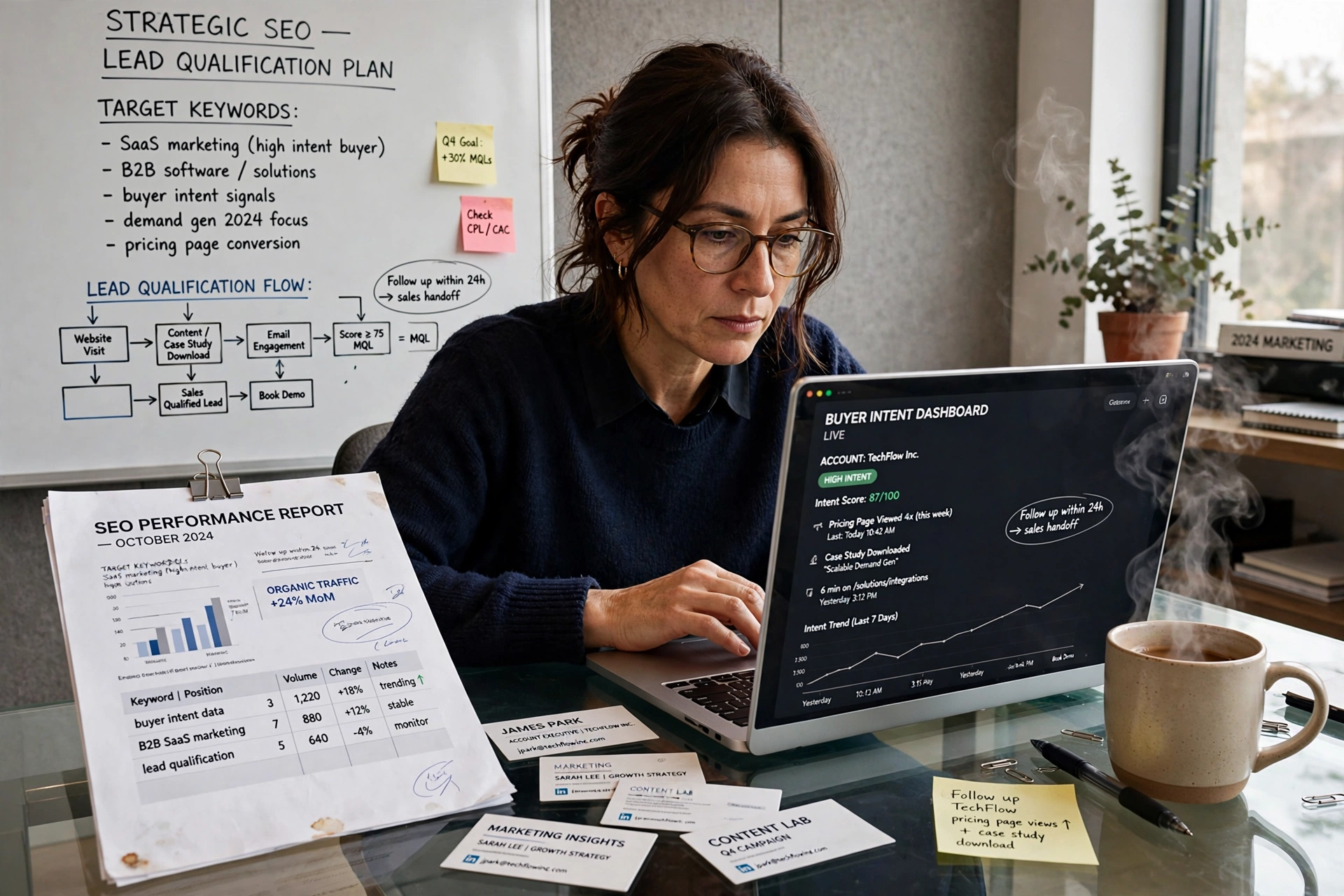
First, you must establish what constitutes a "Hot Lead." I typically recommend a scoring system where a lead reaches a "Hot" status after hitting a specific threshold, for example, 85 points. Points are assigned based on the value of the action. A visit to the 'About Us' page might be 2 points, while a visit to the 'Pricing' page is 20 points. Downloading a technical whitepaper could be 30 points. This creates a mathematical model of intent that removes subjectivity from the qualification process.
Step 2: Deploy Real-Time Tracking
Static forms are no longer enough. You need to track behavioral signals such as how scroll depth signals buyer intent and the frequency of return visits. When a user returns to your site four times in one week, they are no longer researching; they are validating. By tracking these patterns, you can trigger an AI Sales Agent to engage the user with a context-aware prompt, such as "I see you're comparing our Pro and Enterprise plans; would you like a quick breakdown of the ROI for your specific team size?"
Step 3: Integrate AI Qualification Agents
Rather than sending every lead to a CRM, use an AI SDR to conduct the first round of qualification. These agents can analyze the user's behavior and engage them in a conversational screen. For example, if the AI detects urgency language in buyer intent signals, it can bypass the standard nurture sequence and offer a direct booking link to a senior account executive. This ensures that the most urgent buyers are handled with the highest priority. You can learn more about this in our guide on How AI Appointment Setters Automate B2B Demo Booking 24/7.
Step 4: Automate the Handoff
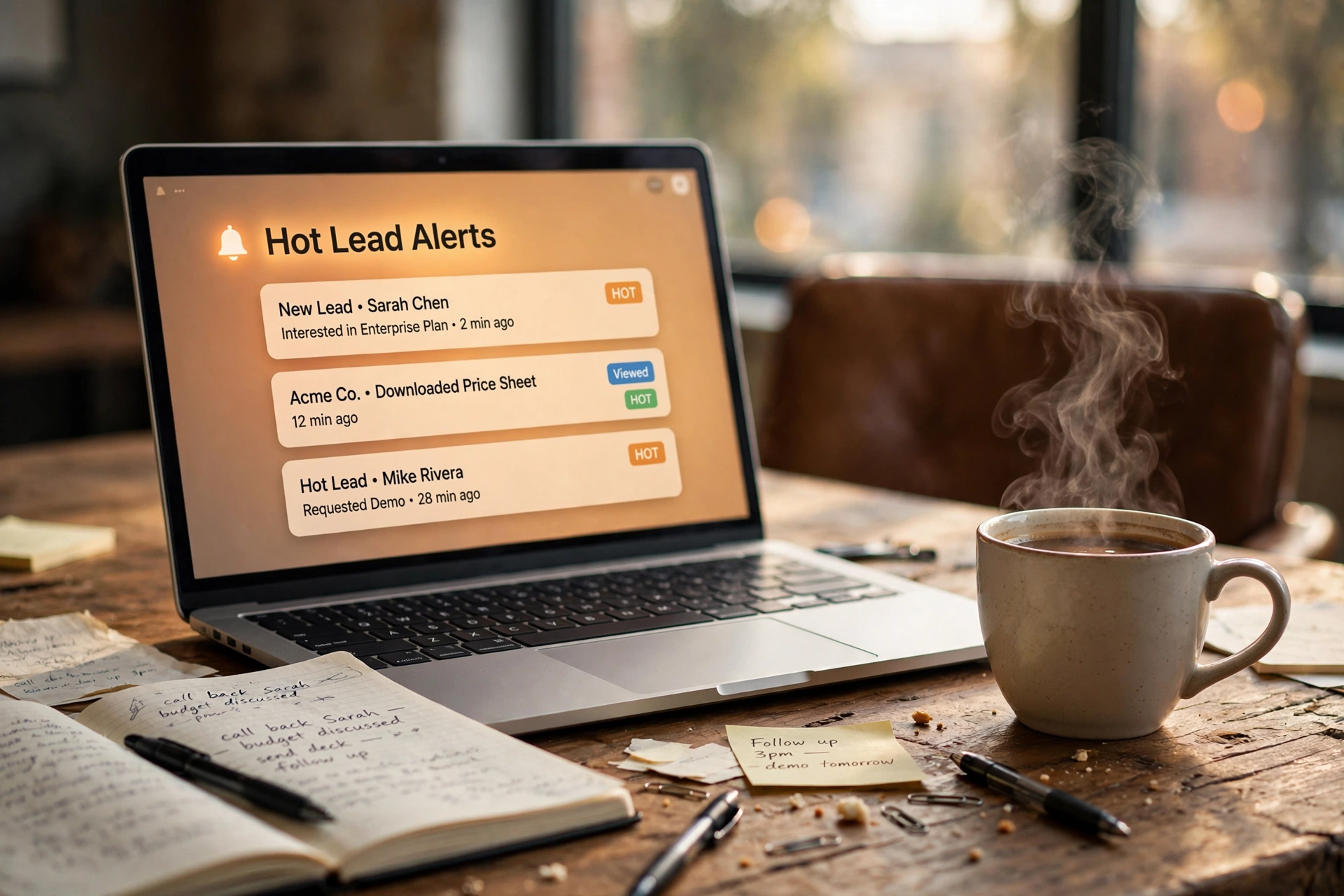
Once a lead hits the intent threshold, the data must flow instantly into the CRM. The salesperson should receive a notification not just that they have a lead, but a "Buyer Intent Brief" detailing: (1) The specific pain point identified via page visits, (2) The urgency level based on behavior, and (3) The exact questions the lead asked the AI agent. This eliminates the need for repetitive discovery questions and moves the conversation directly to the solution phase. For a technical deep dive, see How to Connect AI Sales Agents to CRM & Webhooks for Auto-Booking.

Traditional vs. AI-Driven Lead Qualification
To understand why the shift to intent is mandatory in 2026, we must compare the old way of doing business with the modern AI-powered stack. Most companies are still using a hybrid of 2015-era forms and 2020-era email sequences, which is why their conversion rates are stagnating.
| Feature | Traditional Qualification | Generic AI Approach | BizAI Modern Approach |
|---|---|---|---|
| Data Source | Static form fields (Job title, Company) | Basic keyword tracking in forms | Real-time behavioral signals + LLM analysis |
| Speed to Lead | Hours to Days (Manual review) | Minutes (Auto-reply email) | Seconds (Instant AI SDR engagement) |
| Context | Zero context until first call | Basic "Thanks for downloading" | Full map of user journey & intent score |
| Priority | First-in, First-out (FIFO) | Based on lead magnet type | Based on real-time urgency & value score |
| Scaling | Linear (Need more SDRs to grow) | Volume-based (Spammy) | Algorithmic (High quality at massive scale) |
As the table demonstrates, the generic AI approach often fails because it simply automates the communication without automating the qualification. It sends an email faster, but it doesn't necessarily send it to the right person. The BizAI approach focuses on the intelligence layer, detecting mouse hesitation as buyer intent signal or repeated return visits to understand the psychological state of the buyer before the first message is even sent.
Common Mistakes to Avoid in Intent Qualification
Even seasoned growth engineers make mistakes when implementing intent-based systems. The most common error is "Over-Weighting Top-of-Funnel Actions." Many companies give too many points to a lead for downloading a generic "Industry Trends" PDF. While this shows interest, it does not show buying intent. A lead who downloads a trend report is a student or a researcher; a lead who spends ten minutes on your "Integration Guide" is a buyer. I have seen companies flood their sales pipeline with "MQLs" (Marketing Qualified Leads) that have zero intent to buy, leading to friction between marketing and sales teams.
Another critical error is ignoring the "Dark Funnel." A significant portion of the buyer's journey happens on platforms you don't control, Reddit, Slack communities, or peer-to-peer calls. While you cannot track these directly, you can identify their effects. When a lead arrives at your site via a direct URL to a specific deep-link page, rather than the homepage, it is a signal that they have been discussing your product elsewhere. Failing to recognize this as a high-intent signal often results in treating a highly informed buyer as a cold prospect.
Finally, avoid the "Automation Trap" where you remove the human element too early. AI should qualify and schedule, but the high-ticket close still requires human empathy and strategic nuance. The goal is to use AI to remove the administrative burden of qualification, not to replace the relationship-building phase of the sale. If your AI agent is too aggressive in its capture, it can alienate high-value executives who prefer a low-friction experience. Balance aggressive lead capture with a professional, helpful tone. To optimize this balance, consider reading our analysis on AI SDR Vs Human SDR: Which Delivers Better ROI in 2026?.
Lead qualification should be a dynamic score that fluctuates in real-time, not a static label assigned at the moment of form submission.
Frequently Asked Questions
How do you distinguish between research intent and buying intent?
Research intent is characterized by broad searches, reading high-level blog posts, and exploring general industry trends. Buying intent is signaled by a shift toward specificity. This includes visiting pricing pages, comparing your product with a competitor, and spending significant time on technical documentation or implementation guides. While a researcher asks "What is X?", a buyer asks "How does X solve my specific problem Y at a cost of Z?" By weighting these actions differently in your scoring model, you can filter out the learners and prioritize the buyers.
Does buyer intent qualification work for low-volume, high-ticket B2B services?
Yes, and it is actually more essential for high-ticket services where every lead represents a significant revenue opportunity. In low-volume environments, you cannot afford to let a single high-intent lead go cold. Because the sample size is smaller, the precision of your qualification must be higher. Tracking return visits as strong buyer intent signals allows you to identify the few "whales" in your traffic and ensure they receive white-glove treatment from the moment they show a signal of urgency.
How can AI help in qualifying leads that don't fill out forms?
This is the core advantage of modern AI agents. Instead of waiting for a form submission, an AI agent can monitor engagement signals, such as scroll velocity and page dwell time, to initiate a conversational prompt. If a user is exhibiting high-intent behavior but is hesitant to fill out a long form, the AI can ask a single, low-friction question like "Would you like to see a 2-minute demo of how this works for [Industry]?" This converts anonymous traffic into qualified leads by lowering the barrier to entry.
What is the ideal 'intent threshold' for a lead to be considered sales-ready?
While thresholds vary by industry, a common benchmark is the 80-85% intent score. This typically means the lead has performed a combination of high-value actions: at least one visit to the pricing page, one deep-dive into a case study, and a return visit within 48 hours. However, the threshold should be dynamic. If a lead is from a Fortune 500 company, you might lower the threshold to 60% to ensure they are contacted immediately, whereas a lead from a small startup might require a higher score to prove they have the budget and urgency.
How do I prevent AI from misqualifying leads due to 'bot' traffic?
Bot traffic can inflate intent scores if not properly filtered. It is essential to use advanced bot detection and exclude non-human interactions from your scoring model. Modern systems use mouse-movement analysis and interaction patterns to distinguish between a scraper and a human. Furthermore, focusing on "active intent" (like interactive dialogue with an AI agent) rather than "passive intent" (like page views) ensures that your sales team only spends time on actual humans with real buying power.
Conclusion
Buyer intent lead qualification is no longer a luxury for the few; it is the baseline for survival in the 2026 B2B landscape. The era of "spray and pray" lead generation is over, replaced by a precision-engineered approach that identifies the exact moment a prospect shifts from curious to committed. By implementing a tiered scoring system, deploying real-time behavioral tracking, and leveraging AI SDRs to bridge the gap between traffic and appointments, you can stop renting traffic and start building a compounding revenue machine.
If you are still relying on manual form reviews and static lead lists, you are leaving an immense amount of revenue on the table. The transition to intent-driven growth requires a fundamental shift in how you view your website, not as a digital brochure, but as a real-time qualification engine. For a deeper dive into the technical signals that power this process, return to our Buyer Intent Signals: Ultimate Guide to Detection.
To automate this entire process and deploy a system that qualifies leads while you sleep, visit BizAI Intelligence.
AI Search Accelerator: 1-on-1 Strategy Session
Claim one of the 10 monthly slots. Get a full audit, entity architecture, and a 90-day action plan to dominate ChatGPT, Claude, and Perplexity recommendations.