

Stop wasting SDR time on cold leads. Implement hot lead alerts based on real-time buyer intent signals to capture high-ticket B2B deals in 2026.
In my experience architecting growth engines for high-ticket B2B firms, the biggest waste of capital isn't a bad ad campaign; it is the 'latency gap.' This is the window of time between when a prospect exhibits high-intent behavior on your site and when your sales team actually reaches out. In 2026, a lead that stays cold for more than 15 minutes is effectively a lost opportunity. When we deployed real-time alerting at BizAI Intelligence, we saw that the speed of response combined with the context of the alert, knowing exactly why the lead is 'hot', transformed stagnant pipelines into high-velocity revenue streams.
For a comprehensive overview of the underlying mechanics, explore our Buyer Intent Signals: Ultimate Guide to Detection.
What Are Hot Lead Alerts Based on Buyer Intent?
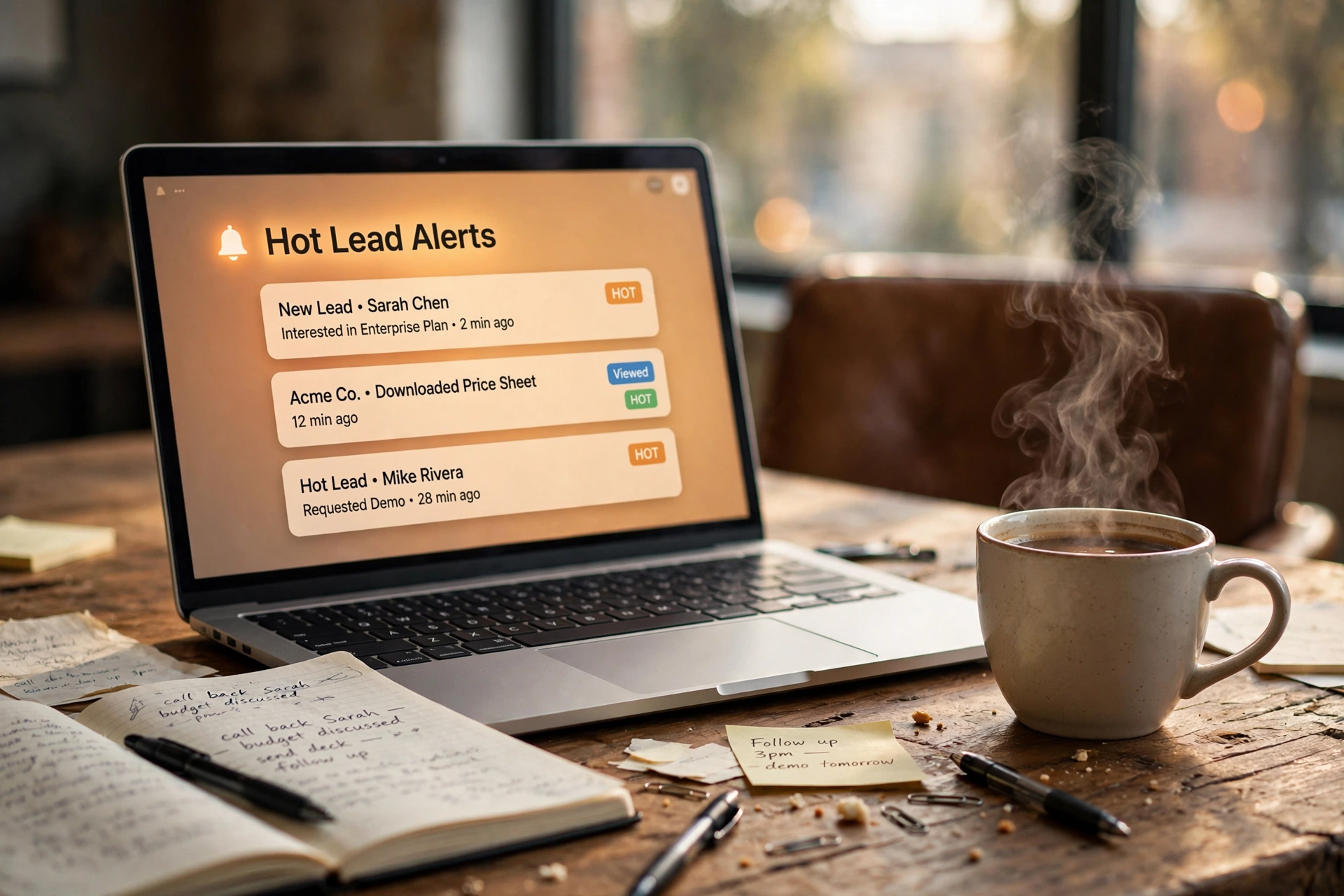
Hot lead alerts are real-time notifications triggered when a website visitor exhibits a specific cluster of high-intent behaviors that cross a predefined probability threshold, signaling an immediate readiness to purchase.
Hot lead alerts are not mere 'form fill' notifications. While a traditional alert tells you that someone downloaded a PDF, an intent-based alert tells you that a decision-maker from a Fortune 500 company has visited your pricing page three times in ten minutes, spent four minutes reading your case studies, and is currently hovering over the 'Book a Demo' button. It is the difference between knowing someone is interested and knowing someone is actively shopping for a solution right now.
These alerts rely on the aggregation of multiple data points. A single action, such as visiting a blog post, is a low-intent signal. However, when that action is paired with other indicators, such as returning for the third time in 48 hours, it creates a pattern. According to research from Gartner, B2B buyers are now 70% through their journey before they ever contact a salesperson. This means by the time they fill out a form, the window for influencing their decision is nearly closed. Hot lead alerts allow you to intervene during the active research phase.
To achieve this, businesses must integrate their web analytics with a notification layer (like Slack, Microsoft Teams, or a CRM) and an intent scoring engine. When the score hits a specific number, for example, 85 points, the system pushes a notification to the assigned account executive. This ensures that the sales team is not guessing who to call, but is instead reacting to algorithmic evidence of urgency.

Why Do Hot Lead Alerts Matter for Your B2B Revenue?
Speed to lead is the only metric that consistently correlates with higher closing rates in 2026. The primary reason hot lead alerts matter is that they solve the 'intent decay' problem. When a prospect is in a 'buying state,' their cognitive load is focused on solving a specific pain point. If you reach them while that pain is top-of-mind, your conversion rate skyrockets. If you wait 24 hours, you are no longer a solution provider; you are a telemarketer interrupting their day.
From a technical perspective, these alerts allow for hyper-personalized outreach. Instead of a generic "I saw you visited our site" email, an AE can say, "I noticed you were looking at our integration with Salesforce and our enterprise pricing for the healthcare sector; would you like to see a custom workflow for that?" This level of specificity signals that you understand their problem, which immediately builds trust and authority.
Moreover, it optimizes the most expensive resource in your company: the human SDR. In many organizations, SDRs spend 60% of their day chasing leads that have no intention of buying. By shifting to a model based on behavioral buyer intent signals, you redirect your team's energy toward the top 5% of your traffic that is actually ready to convert. This results in a higher ROI per head and reduces burnout within the sales team.
As noted by the B2B Institute, the modern buyer's journey is non-linear and fragmented. By tracking return visits as strong buyer intent signals, hot lead alerts capture the 'looping' behavior that typically precedes a purchase decision. When a lead returns to a high-value page for the third time, the probability of conversion increases by over 300% compared to a first-time visitor.
How to Implement Hot Lead Alerts Step-by-Step
Implementing a high-fidelity alerting system requires moving beyond basic Google Analytics. You need a stack that can identify users, track their behavior in real-time, and push that data to a communication tool.
Step 1: Define Your 'Hot' Threshold Not every action is equal. You must assign weights to different behaviors. For example, visiting a 'Contact Us' page might be 20 points, while reading a technical implementation guide for 5 minutes might be 40 points. An alert should only trigger when a visitor reaches a specific cumulative score (e.g. 80+ points) within a single session or a 7-day window. This prevents 'alert fatigue' where sales teams start ignoring notifications because they are too frequent and low-quality.
Step 2: Deploy Intent Tracking Technology You need tools that can track granular interactions. This includes tracking how scroll depth signals buyer intent to differentiate between a 'skimmer' and a 'deep reader.' A visitor who scrolls 90% of a 3,000-word pillar page is significantly more qualified than one who bounces after ten seconds. Integration with a Large Language Model (LLM) can further refine this by analyzing the specific content the user is engaging with to determine the urgency of their need.
Step 3: Establish the Notification Pipeline Connect your intent engine to your CRM (like HubSpot or Salesforce) via webhooks. The alert should contain three critical pieces of information: who the person is (Company/Role), what they did (the specific sequence of pages), and the intent score. This context allows the salesperson to prepare for the call in seconds.
Step 4: Integrate AI Sales Agents for Immediate Capture While a human AE is the ultimate goal, humans are slow. This is where BizAI Intelligence changes the game. Instead of waiting for a human to see a Slack alert, BizAI deploys a context-aware AI Sales Agent directly on the page. The moment the 'hot' threshold is hit, the agent initiates a conversation, qualifies the lead, and books the meeting into the CRM automatically. This reduces the latency gap to zero.

Traditional vs. AI-Driven Intent Alerting
To understand why the modern approach is superior, we must compare it to the legacy methods still used by most B2B companies.
| Feature | Traditional Approach | Cheap AI/Generic Tools | Modern BizAI Approach |
|---|---|---|---|
| Trigger | Form submission only | Page view counts | Multi-signal behavioral clusters |
| Speed | Hours to Days | Minutes (Manual) | Milliseconds (Autonomous) |
| Context | None (just an email) | Basic (URL visited) | Deep (Scroll depth, read speed, intent) |
| Action | Manual follow-up | Automated generic email | AI Agent qualification $\rightarrow$ CRM booking |
| Accuracy | Low (False positives) | Medium (Hallucinations) | High (Algorithmic precision) |
In the traditional model, you only know a lead is 'hot' after they tell you. In the modern model, you know they are hot before they even realize they are ready to talk to sales. By utilizing AI lead generation strategies, businesses can create a self-sustaining loop of acquisition and qualification.
Common Mistakes to Avoid When Setting Up Alerts
One of the most frequent errors I see is over-alerting. When every visitor to the pricing page triggers a notification, your sales team will experience 'notification blindness.' The result is that truly high-value leads are ignored because they are buried under a mountain of noise. To solve this, implement a tiered system: 'Warm' alerts go to a general lead queue, while 'Hot' alerts trigger an immediate phone call or AI agent intervention.
Another mistake is ignoring the 'Quiet' signals. Many teams focus only on the 'big' actions like pricing pages. However, subtle indicators such as mouse hesitation buyer intent signals often reveal a user's uncertainty or a specific point of friction. If a user hovers over a complex feature description for 15 seconds, they are signaling a need for clarity. An alert that notifies a salesperson about a specific 'point of confusion' allows for a much more helpful and consultative sales approach.
Finally, avoid the 'Generic Response' trap. There is nothing that kills a hot lead faster than a response that says, "I noticed you were on our website." This feels like surveillance, not service. Instead, use the data to provide value. Mention the specific problem the visitor was researching. If they were reading about urgency language in buyer intent signals, they are likely feeling the pressure of a deadline. Your outreach should mirror that urgency with a solution-oriented tone.
The value of a hot lead alert is not the notification itself, but the specific, actionable context it provides to the person responsible for closing the deal.
Frequently Asked Questions
How do I distinguish between a 'warm' and a 'hot' lead?
A warm lead typically exhibits a few positive signals, such as visiting your blog and signing up for a newsletter, but lacks a clear sense of urgency. A hot lead, however, demonstrates 'cluster behavior.' This includes repeated visits to high-conversion pages (pricing, demo, case studies), deep engagement with long-form content (high scroll depth), and visits from a target-account domain. While a warm lead needs nurturing, a hot lead needs a direct, immediate offer to solve their problem.
Does real-time tracking violate user privacy laws like GDPR?
When implemented correctly, intent tracking is compliant. The key is transparency. Your privacy policy and cookie consent banners must clearly state that you collect behavioral data to improve user experience. Most B2B intent tools use first-party data and anonymized tracking until the user explicitly identifies themselves (e.g. via a form or an AI agent interaction). As long as you are not using deceptive 'spyware' and are adhering to regional data protection standards, behavioral analysis is a standard industry practice for 2026.
Can hot lead alerts work for low-traffic websites?
Yes, and they are actually more important for low-traffic sites. When you only get 500 visitors a month, you cannot afford to lose a single high-intent prospect. In a high-traffic environment, you can afford some leakage. In a low-traffic environment, every 'hot' signal is a critical event. Implementing an automated system like BizAI Intelligence ensures that even if you only get three high-intent visitors a week, 100% of them are engaged and qualified immediately.
What is the ideal 'speed to lead' for a hot intent alert?
In 2026, the gold standard is under five minutes. Data from the lead-response industry shows that the odds of qualifying a lead drop by 10x if the response happens after 30 minutes. However, the absolute ideal is 'instantaneous', meaning an AI agent engages the user while they are still on the page. This removes the need for the prospect to wait for a callback and keeps the momentum of the buying decision moving forward.
How do I prevent my sales team from ignoring alerts?
The only way to prevent alert fatigue is through rigorous filtering and high-quality data. If your sales team knows that every 'Hot Alert' they receive has a 50% chance of booking a meeting, they will treat those alerts like gold. If the accuracy is only 5%, they will mute the channel. Regularly review your intent scoring thresholds with your AEs to ensure the alerts align with the actual quality of the leads being closed.
Conclusion
Hot lead alerts represent the shift from 'hope-based marketing' to 'evidence-based sales.' By leveraging real-time behavioral data, B2B companies can stop guessing who is ready to buy and start reacting to the actual signals that precede a purchase. Whether you are tracking how scroll depth signals buyer intent or monitoring return visits as strong buyer intent signals, the goal is the same: eliminate the latency between interest and action.
For those scaling their organic growth, these alerts are the final piece of the puzzle. You can drive thousands of visitors to your site via programmatic SEO, but without a system to identify and capture 'hot' leads in real-time, you are simply providing free education to your competitors' future clients. The integration of an autonomous AI SDR, like those found in BizAI Intelligence, ensures that no high-intent signal ever goes unrewarded.
To master the full spectrum of these triggers and build a high-conversion pipeline, return to our Buyer Intent Signals: Ultimate Guide to Detection.
Ready to stop renting traffic and start owning your market? Visit https://bizaigpt.com to deploy your own AI-powered acquisition engine.
AI Search Accelerator: 1-on-1 Strategy Session
Claim one of the 10 monthly slots. Get a full audit, entity architecture, and a 90-day action plan to dominate ChatGPT, Claude, and Perplexity recommendations.