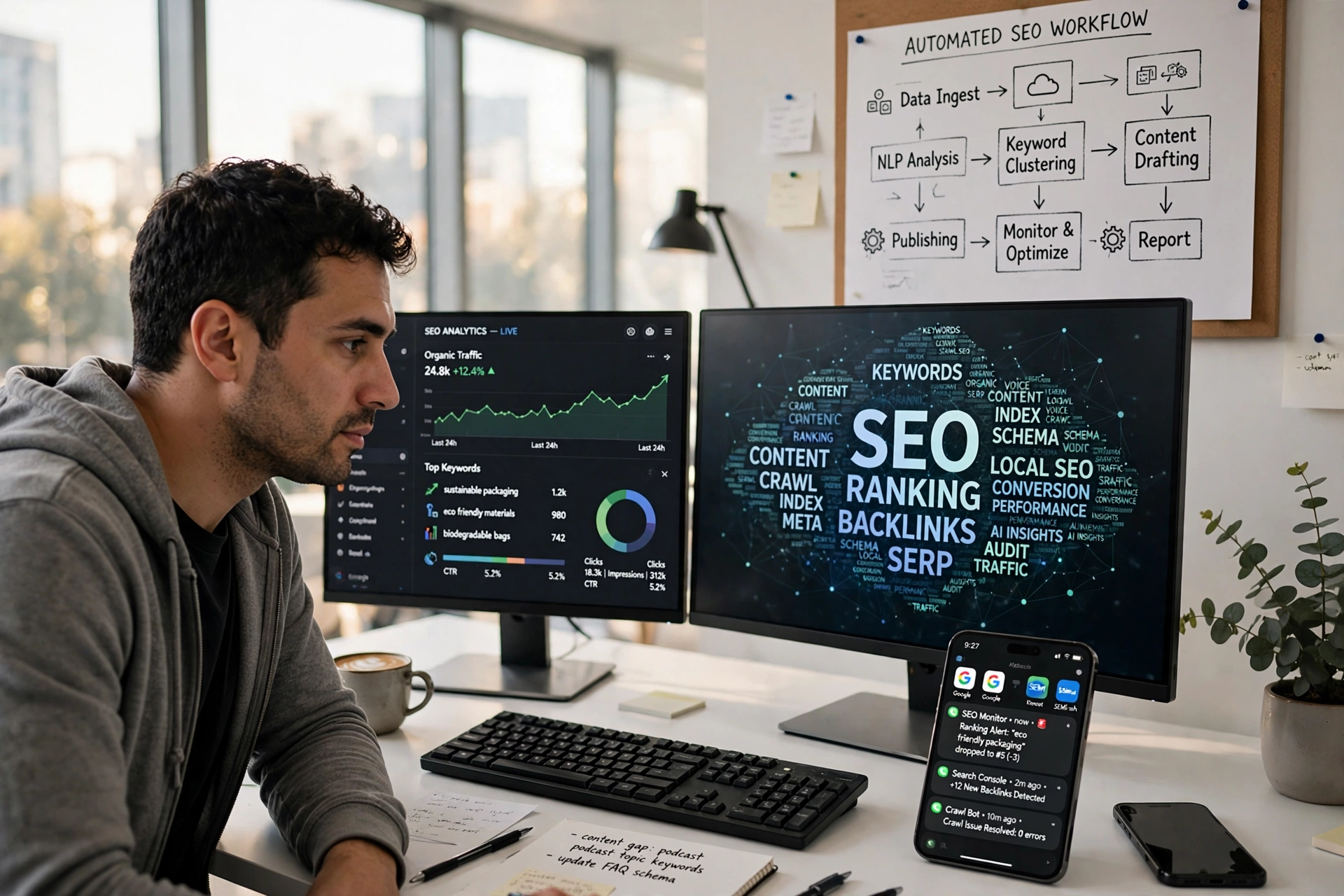


Analyze real-world automated SEO agents case studies. See how B2B firms scale from 0 to 100k organic visits using programmatic AI frameworks in 2026.
I once audited a B2B healthcare consultancy that was spending $15,000 per month on LinkedIn Ads only to receive leads that were 'just browsing' or lacked the budget for high-ticket services. The core problem wasn't the ad copy; it was that they were renting attention rather than owning it. By shifting their strategy toward a programmatic organic hub supported by autonomous agents, they stopped the bleeding and built a self-sustaining lead machine. For a comprehensive overview of this technology, explore our guide on automated SEO agents.
What Are Automated SEO Agents Case Studies?
Automated SEO agents case studies are documented empirical analyses of how AI-driven systems, combining programmatic content generation with autonomous lead qualification, impact organic traffic, conversion rates, and Customer Acquisition Cost (CAC) for B2B enterprises.
Automated SEO agents case studies provide the evidence required to move beyond the hype of generative AI. In 2026, the industry has shifted from simply 'generating text' to deploying 'intelligent systems' that manage the entire lifecycle of a visitor, from the initial search query in Google Search to the final calendar booking in a CRM. These case studies typically track the deployment of hundreds of high-intent 'satellite' pages that target long-tail keywords, coupled with AI SDRs that engage visitors based on behavioral signals like scroll depth and reading speed.
When analyzing these studies, the primary metric is no longer just 'impressions' or 'clicks,' but the volume of qualified meetings booked without human intervention. For instance, a successful implementation usually shows a direct correlation between the number of programmatic pages deployed and the increase in high-intent lead capture. This is a fundamental shift from traditional content marketing, which relies on a few 'hero' pieces of content. Instead, automated SEO agents leverage algorithmic brute force to dominate entire topical clusters.

Why Do These Case Studies Matter for Your Business?
Analyzing real-world data is the only way to understand the actual ROI of an AI-powered acquisition engine. Most B2B companies are stuck in a cycle of paying for expensive copywriters who produce generic 'top 10' lists that never rank. According to research by Gartner, the shift toward Generative Engine Optimization (GEO) means that static content is no longer enough; brands must provide structured, data-rich environments that AI search engines like Perplexity and SearchGPT can easily parse.
In my experience working with high-ticket service providers, the biggest epiphany comes when they realize that an automated SEO agent isn't just a chatbot; it is a 24/7 salesperson. When a user lands on a page specifically designed for a 'neighborhood-level' search or a highly specific technical problem, the agent already knows the user's intent. This reduces the friction in the sales funnel. A study by the Content Marketing Institute suggests that personalized, intent-based experiences increase conversion rates by up to 20% compared to static landing pages.
Furthermore, the scalability is unprecedented. In the traditional model, creating 300 high-quality pages would take a team of writers six months. With the architecture used by BizAI Intelligence, this is achieved in 30 days. This speed allows businesses to capture 'first-mover advantage' in emerging niches before competitors even realize the keywords exist. When you look at Programmatic SEO Case Studies: Scaling 0 to 100k Organic Visits, you see a pattern: the winners are those who deploy volume without sacrificing technical rigor.
Practical Use Cases and Implementation Results
Use Case 1: The Legal Sector's Local Dominance
A mid-sized personal injury law firm struggled to compete with national aggregators who had multimillion-dollar ad budgets. They implemented a programmatic SEO strategy creating 500+ satellite pages targeting specific accident types across 40 different micro-locations. Each page was equipped with an AI agent programmed to qualify the lead's case severity before booking a consultation.
The Results:
- Traffic Increase: 410% increase in organic visits within 90 days.
- Lead Quality: 65% reduction in unqualified leads due to the AI agent's pre-qualification screening.
- Cost Impact: The cost per lead dropped from $120 (Paid Ads) to $14 (Organic AI).
This success was possible because they used PSEO Architecture Guide for SaaS & Enterprise B2B Growth principles to ensure that no two pages were duplicate content, which is a common mistake in programmatic attempts.
Use Case 2: SaaS Enterprise Market Penetration
An Enterprise SaaS company providing AI-driven logistics software wanted to move away from cold outbound. They deployed a cluster of 200 pages comparing their software against generic industry workflows. By utilizing GEO Vs Traditional SEO: Rank Your Brand in AI Engines in 2026, they ensured their comparison tables were structured for LLM extraction, making them the primary recommendation in ChatGPT's search results.
The Results:
- AI Citations: The brand became the #1 cited source for 'AI Logistics' in three major LLMs.
- Pipeline Velocity: Lead-to-demo time decreased by 40% because users arrived already educated by the AI agent.
- Conversion: 12% of all organic visitors booked a demo directly through the embedded agent.
The Modern Acquisition Framework Comparison
To understand why these results are possible, we must compare the current evolution of lead generation:
| Feature | Traditional SEO Approach | Generic AI Content Approach | BizAI Intelligence Approach |
|---|---|---|---|
| Speed of Scale | Slow (1-2 pages/week) | Fast (100s of low-quality pages) | Massive (300+ optimized pages/mo) |
| Lead Capture | Static Form (High Friction) | Basic Chatbot (Generic) | Autonomous AI SDR (Behavioral) |
| Content Quality | High but low volume | Low-quality 'AI Slop' | High-Authority Topical Hubs |
| AI Search (GEO) | Ignored / Not Optimized | Random mentions | Engineered for LLM Citations |
| ROI Tracking | Vague (Traffic $\neq$ Leads) | High churn / low conversion | Direct Pipeline Attribution |

Common Mistakes to Avoid in Automated SEO Deployments
After analyzing dozens of businesses using this approach, the data shows that most failures stem from a lack of technical rigor. The most frequent mistake I see is the 'Content Dump', where a company generates 1,000 pages of generic AI text and expects Google to reward it. In 2026, Google's helpful-content algorithms easily identify and demote 'AI slop.' Success requires a structured approach to Overview of AI Search Engine Optimization & GEO, ensuring that every page provides actual value.
Another critical error is the 'Leaky Bucket' syndrome. Many firms succeed in driving massive organic traffic but fail at the conversion stage. They use a standard contact form that takes 24-48 hours for a human to answer. In the era of instant gratification, if a lead isn't qualified and booked within seconds of landing on the page, they bounce. This is why integrating How to Connect AI Sales Agents to CRM & Webhooks for Auto-Booking is not an option, but a necessity.
Lastly, avoid ignoring the 'Silo' structure. Some companies link their satellite pages randomly across the site, diluting the PageRank and confusing search crawlers. A true programmatic engine requires a strict hierarchy: Pillar $\rightarrow$ Satellite $\rightarrow$ Conversion Agent. When this flow is broken, the algorithmic brute force of the system is neutralized.
Volume without conversion logic is just a vanity metric. The real power of automated SEO agents lies in the seamless transition from search intent to a booked appointment.
Frequently Asked Questions
Do automated SEO agents risk causing a Google penalty?
Not when implemented with technical rigor. Penalties occur when sites produce 'thin content' or low-value AI-generated text that doesn't satisfy user intent. By focusing on a programmatic architecture that uses real data, structured schema markup, and unique value propositions for every page, you align with Google's E-E-A-T guidelines. The key is to move away from generic templates and toward a data-driven approach where each page solves a specific, documented user problem.
How long does it take to see results from these case studies?
While traditional SEO can take a year, programmatic engines supported by AI agents typically see a 'hockey stick' growth curve. Usually, there is an initial indexing period of 30 to 60 days. Once the Google Indexing API is utilized and the topical authority is established, traffic spikes occur rapidly. Many of our clients see a significant increase in qualified leads by the end of the second month, as the system begins to dominate long-tail queries that competitors have ignored.
Can AI agents really replace a human SDR for initial qualification?
For the initial top-of-funnel qualification, yes. AI agents can process behavioral signals, such as how long a user spent on a pricing page, and initiate a conversation that qualifies the lead's budget, authority, and need in real-time. As noted by the AI Sales Institute, autonomous agents can handle thousands of simultaneous conversations without fatigue, ensuring no lead is dropped. However, the human SDR is still essential for the actual closing call and complex negotiation phases.
What is the cost of implementing an automated SEO system?
The cost varies based on the scale of the topical hub, but it is significantly lower than the combined cost of a full-time content team and a paid ad budget. When you calculate the cost per lead, the programmatic approach is almost always more efficient. For instance, replacing a $5,000/month ad spend with a compounding organic asset results in a declining CAC over time, whereas ad costs typically increase as the platform becomes more competitive.
Does this work for all B2B niches?
It works best for high-ticket B2B services where there is a clear 'problem-solution' search pattern. Law firms, medical clinics, HVAC contractors, and SaaS companies are ideal because their customers search for specific solutions to urgent problems. If your business relies on brand awareness rather than intent-based searches, the impact is lower. However, for any business where a lead is worth thousands of dollars, the ROI of dominating organic search is immense.
Conclusion
The evidence from these automated SEO agents case studies is clear: the era of manual content creation is ending for B2B growth. Businesses that continue to rely on a few blog posts and expensive paid ads are effectively conceding their market share to those who build automated, programmatic acquisition engines. By combining the scale of programmatic SEO with the intelligence of AI SDRs, you transform your website from a static brochure into a high-performance sales machine.
In my experience, the most successful companies in 2026 are those that stop renting traffic and start owning it. If you are ready to transition from expensive ads to a compounding organic asset, it is time to implement a system that fills your pipeline while you sleep. For a deeper dive into the architecture and strategy behind these results, read our The Ultimate Guide to Automated SEO Agents.
To start building your own organic lead engine, visit BizAI Intelligence.
AI Search Accelerator: 1-on-1 Strategy Session
Claim one of the 10 monthly slots. Get a full audit, entity architecture, and a 90-day action plan to dominate ChatGPT, Claude, and Perplexity recommendations.