📖This article is part of the complete guide to Ultimate Guide to Hot Lead Notifications for Sales.
In my experience working with high-ticket B2B service providers, the most expensive mistake a company can make is treating a high-intent visitor like a generic lead. I have seen countless firms spend thousands on lead generation only to let the most qualified prospects cool off for 24 hours because their notification system was a static email that landed in a cluttered inbox. When we built the intent-tracking layer at BizAI Intelligence, we discovered that the window of maximum conversion closes within five minutes of a user demonstrating a high-intent signal.
For a comprehensive overview of this ecosystem, explore our Ultimate Guide to Hot Lead Notifications for Sales.
What are Buyer Intent Notifications?
📚
Definition
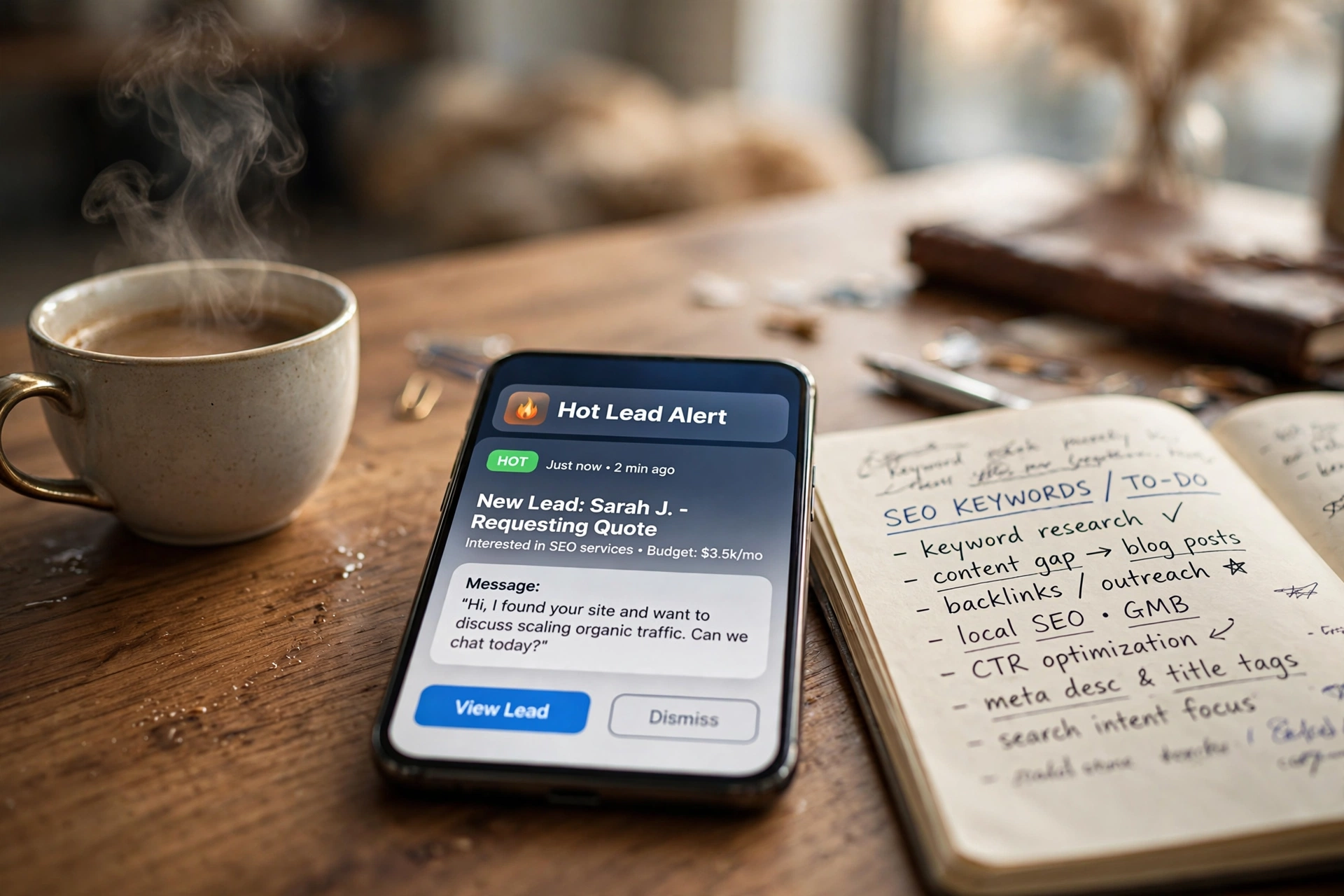
Buyer intent notifications are automated, real-time alerts triggered when a prospect exhibits specific behavioral patterns, such as visiting a pricing page three times in ten minutes, indicating they are in the active purchasing phase of the buyer's journey.
Buyer intent notifications act as a bridge between passive web traffic and active sales engagement. Unlike traditional lead alerts, which trigger only after a form is submitted, intent notifications monitor the behavioral signals of anonymous or known visitors and alert sales teams before the prospect even reaches for a contact form. This allows a sales representative to intervene exactly when the prospect's psychological urgency is at its peak.
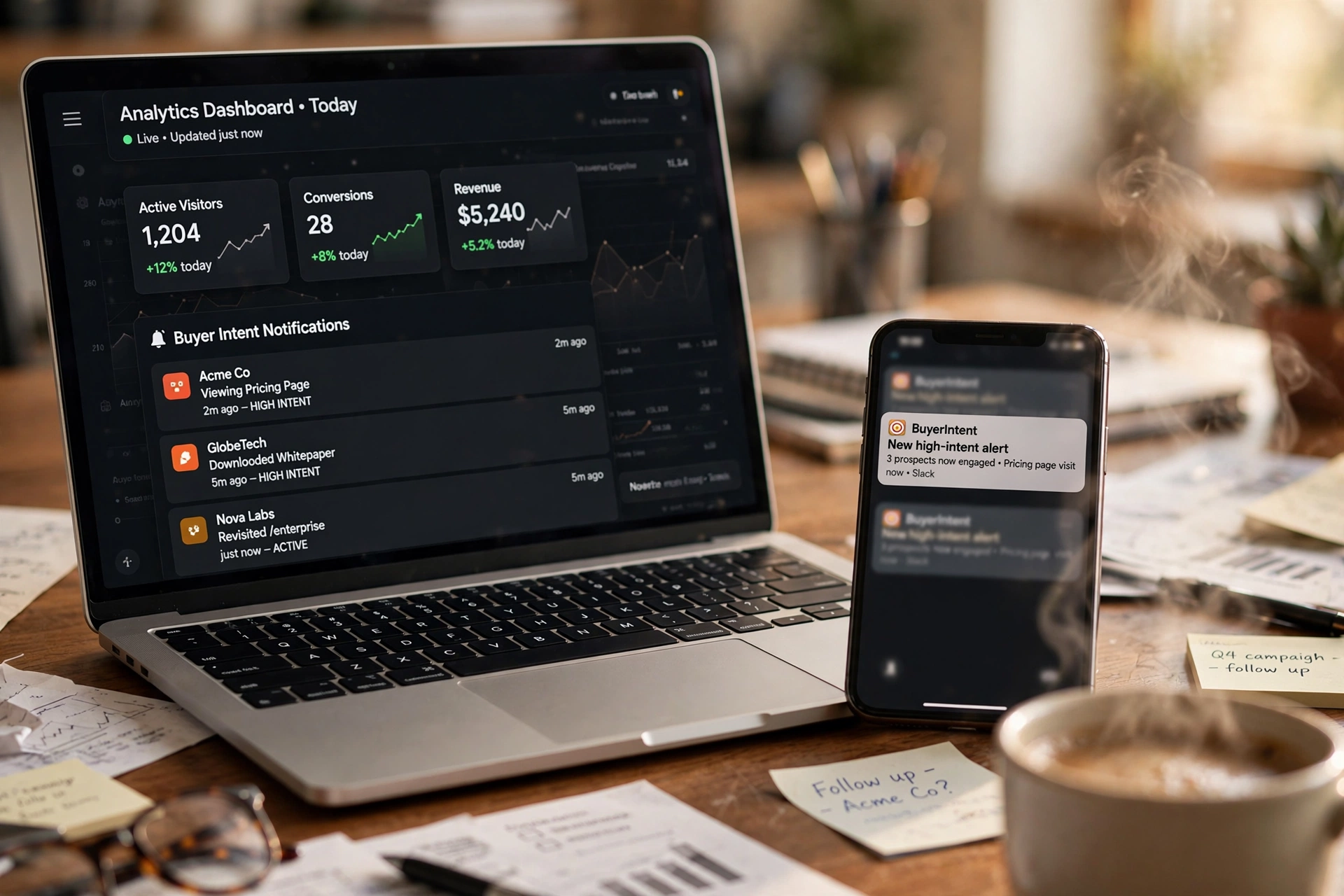
In the context of modern B2B sales, these notifications rely on a combination of first-party data (your own website behavior) and third-party signals (intent data from other platforms). When a user interacts with specific high-value assets, such as a comparison table or a detailed case study, the system calculates an intent score. Once that score crosses a predefined threshold, the notification is dispatched immediately via Slack, Microsoft Teams, or a CRM webhook. This shifts the sales paradigm from 'waiting for a lead' to 'intercepting a buyer.'
This process is fundamentally powered by artificial intelligence and large language models that can categorize user behavior into 'informational' versus 'transactional' intent. By integrating these alerts with AI SDR vs Human SDR workflows, businesses can automate the initial reach-out, ensuring that no high-intent signal goes ignored. When a user exhibits a pattern of high urgency, the notification isn't just a 'ping'; it is a directive for the sales team to move into an aggressive closing posture.

Why Do Real-Time Buyer Intent Notifications Matter for B2B Growth?
Real-time buyer intent notifications are essential because they solve the 'speed-to-lead' crisis. According to research by the Harvard Business Review, companies that respond to leads within an hour are seven times more likely to qualify them than those that wait even just four hours. In the 2026 landscape, 'an hour' is already too slow; the goal is now near-instantaneous engagement.
When a prospect is actively researching your solution, they are in a state of 'active search.' Their cognitive load is focused on solving a specific problem. If you can notify your team the moment this happens, you can deploy a targeted response while the problem is still top-of-mind. This drastically increases the conversion rate from visitor to booked meeting because you are meeting the buyer at their moment of highest need.
Furthermore, these notifications allow for extreme personalization. Instead of a generic "Thanks for your interest" email, a sales rep can reach out with: "I noticed you were looking at our implementation guide for HVAC contractors in Florida; would you like to see how we handled a similar 50-unit rollout last month?" This level of specificity is only possible through the data provided by buyer intent notifications. It transforms the salesperson from a solicitor into a consultant.
From a strategic perspective, utilizing GEO vs Traditional SEO ensures that you attract the right high-intent traffic, but intent notifications ensure that the traffic actually converts. Without this mechanism, you are essentially paying for a storefront with a revolving door and no one standing at the counter to greet the customers. By leveraging lead generation automation, businesses can scale this process across thousands of programmatic pages without increasing their headcount.
How to Implement a Buyer Intent Notification System
Implementing a robust system requires a shift from 'lead capture' to 'intent tracking.' The first step is defining your "Intent Signals." Not every click is a signal of intent to buy. For example, someone reading a blog post on "What is SEO" has informational intent, while someone spending four minutes on a "Pricing Comparison" page has transactional intent. You must map out the specific URLs and behaviors that represent a high probability of purchase.
Once signals are defined, you need a tracking layer that can identify users. This is typically done through a combination of cookies, IP resolution (for B2B account-based marketing), and AI-driven behavioral analysis. When the system detects a sequence of high-intent actions, such as visiting the pricing page, then the case studies, then the 'about' page, the AI assigns a high intent score.
Next, integrate this scoring engine with your communication tools. The notification must be delivered where your sales team already lives. If your team spends their day in Slack, the alert should appear there with a direct link to the prospect's behavioral profile. For those using advanced stacks, connecting these alerts to Automated Inbound Lead Qualification CRM workflows allows for the automatic creation of a deal in HubSpot or Salesforce before the human rep even sees the alert.
Finally, deploy an autonomous layer. Using AI appointment setters can bridge the gap between the notification and the meeting. While the human rep is being notified, an AI agent on the website can initiate a conversational qualification screen, capturing the email and booking the meeting directly into the calendar. This creates a seamless transition from intent detection to scheduled demo.
💡
Key Takeaway
The goal of an intent notification system is to reduce the time between a buyer's signal and a company's response to under five minutes.
Buyer Intent Notifications vs. Traditional Lead Alerts
Most companies still rely on traditional lead alerts, which are fundamentally reactive. A traditional alert triggers only after a user has already decided to give you their information. By that time, the user may have already filled out forms on three of your competitors' sites. Buyer intent notifications, however, are proactive; they alert you that someone is about to become a lead.
| Feature | Traditional Lead Alerts | Generic AI Alerts | Modern Intent Notifications |
|---|---|---|---|
| Trigger | Form Submission | Page Visit (Basic) | Behavioral Pattern Analysis |
| Timing | Reactive (After the fact) | Semi-Reactive | Proactive (Real-time) |
| Context | Name & Email only | Basic URL visited | Full Journey & Intent Score |
| Response | Generic Email | Auto-reply Bot | Hyper-Personalized Outreach |
| ROI | Linear Growth | Moderate Growth | Exponential Pipeline Scaling |
As the table illustrates, the modern approach removes the friction of the form. Many of the best buyers in 2026 prefer to research in stealth mode. If you wait for them to fill out a form, you lose the 70% of the market that prefers a frictionless, guided experience. By using programmatic SEO to cast a wide net and intent notifications to catch the high-value fish, you dominate the niche.

Common Mistakes to Avoid with Intent Notifications
One of the most frequent mistakes I see is "Notification Fatigue." When a company sets its intent thresholds too low, the sales team is bombarded with alerts for every minor action. If every visit to a blog post triggers a "Hot Lead" alert, the team will eventually start ignoring the notifications entirely. You must calibrate your scoring system so that an alert represents a genuine opportunity, not just a curious visitor. In my experience, a "Hot" alert should only trigger when a user exhibits at least three high-intent signals within a single session.
Another critical error is the "Creepy Factor." There is a fine line between being helpful and being intrusive. If a sales rep reaches out and says, "I saw you spent 42 seconds looking at our pricing table on page 4," the prospect may feel surveilled. The key is to frame the outreach around the problem they are solving, not the behavior you tracked. Instead of citing the exact click, mention the topic of the page they were viewing to provide value.
Finally, many businesses fail to integrate these notifications with a clear follow-up protocol. A notification without a defined action plan is just noise. You need a documented "SOP for Intent Alerts" that dictates exactly who handles the lead, what the first message should be, and how many follow-up attempts are made. Without this, the speed-to-lead advantage is wasted. This is where AI SDRs and autonomous agents provide the most value, as they provide a consistent, non-fatiguing response layer that never misses a beat.
Frequently Asked Questions
How do buyer intent notifications differ from standard lead alerts?
Standard lead alerts are triggered by a user action, usually submitting a form. Buyer intent notifications are triggered by behavioral patterns. While a lead alert tells you who is interested, an intent notification tells you that someone is interested, often before they identify themselves, based on their interaction with high-value content and pricing pages.
What are the best "intent signals" to track for B2B services?
High-value signals include visiting the pricing page multiple times, spending significant time on a "Competitor vs Us" comparison page, downloading a technical whitepaper, or visiting the "Contact Us" page without submitting a form. Tracking the frequency and duration of these visits provides a clearer picture of purchase intent than a single click.
Can intent notifications work for anonymous visitors?
Yes, through the use of IP resolution and firmographic data. Many enterprise tools can identify the company a visitor is coming from based on their IP address. This allows a sales team to know that someone from "Fortune 500 Company X" is currently browsing their pricing page, even if the individual hasn't provided their name or email yet.
Do intent notifications risk violating GDPR or privacy laws?
When implemented correctly, intent tracking relies on first-party cookies and behavioral data that are compliant with GDPR and CCPA, provided the company has a clear privacy policy and cookie consent banner. The focus should be on aggregated behavioral data rather than intrusive personal surveillance to remain within legal boundaries.
How quickly should a sales team respond to an intent notification?
For maximum conversion, the response should occur within five minutes. Data suggests that the likelihood of contacting a lead drops by 10x after the first hour. Using AI search optimization tools and autonomous agents can help maintain this speed by engaging the user instantly via a chatbot while the human rep is being notified.
Conclusion
Real-time buyer intent notifications represent the end of the "wait and see" era of B2B sales. By shifting your focus from static lead capture to dynamic intent tracking, you can intercept your most qualified prospects at the exact moment they are ready to buy. This approach doesn't just increase your conversion rates; it shortens your sales cycle and increases the average contract value by allowing you to lead with value and relevance.
To truly scale this, you need an architecture that combines high-volume traffic generation with precision capture. Whether you are using PSEO architecture to dominate your niche or deploying autonomous agents to qualify leads, the core goal remains the same: reducing the friction between a buyer's interest and your solution.
If you are ready to stop renting traffic and start building a self-owned organic machine, it is time to integrate these signals into your pipeline. For a deeper dive into the strategy, return to our Ultimate Guide to Hot Lead Notifications for Sales and start building your high-intent engine today.
Visit bizaigpt.com to see how BizAI Intelligence can automate your organic growth and lead qualification in 2026.
AI Search Accelerator: 1-on-1 Strategy Session
Claim one of the 10 monthly slots. Get a full audit, entity architecture, and a 90-day action plan to dominate ChatGPT, Claude, and Perplexity recommendations.