
On This Page (8)
- 01What Are Real-Time Lead Alerts Powered by SEO Agents?
- 02Why Do Real-Time Lead Alerts Matter for B2B Growth?
- 03How to Implement Real-Time Lead Alerts Using SEO Agents
- 04Traditional Lead Capture vs. SEO Agent Alerts
- 05Common Mistakes When Setting Up Lead Alerts
- 06Deep Dive: The Psychology of the Real-Time Response
- 07Frequently Asked Questions
- 08Conclusion
Stop losing high-ticket B2B leads. Discover how real-time lead alerts powered by SEO agents eliminate response lag and capture 40% more qualified appointments.
In my experience building scalable growth engines for B2B firms, the biggest leak in the sales funnel isn't traffic, it's the 'response gap.' A lead lands on a high-value page, consumes the content, and then waits 24 hours for a manual follow-up. By then, the buyer intent has cooled, and they've already contacted three competitors. Real-time lead alerts powered by automated SEO agents solve this by bridging the gap between organic discovery and immediate sales engagement.
For a comprehensive overview of this ecosystem, explore our guide on automated SEO agents.
What Are Real-Time Lead Alerts Powered by SEO Agents?
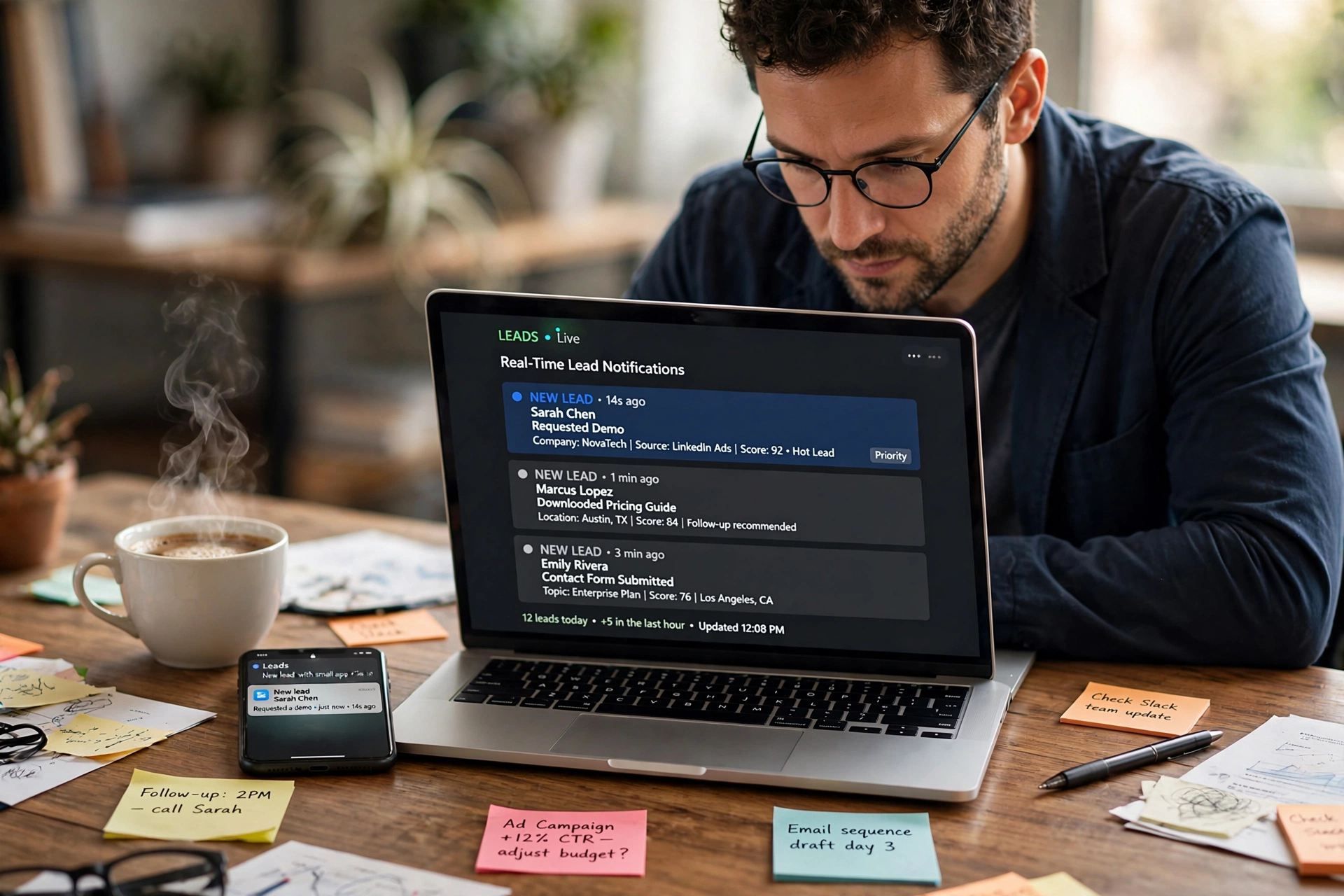
Real-time lead alerts are instantaneous notifications triggered when an automated SEO agent detects a high-intent behavioral signal from a visitor on a programmatic SEO page, alerting sales teams or triggering an automated qualification sequence within seconds.
Real-time lead alerts are not the same as a basic 'form submission' notification. While traditional lead capture waits for a user to fill out a field, an AI-driven SEO agent monitors the interaction layer of the website. It tracks scroll depth, time spent on specific technical sections, and the nature of the questions asked to the embedded AI agent. When a user exhibits 'buying behavior', such as spending five minutes on a pricing page and asking about integration capabilities, the system generates a real-time alert.
At BizAI Intelligence, we've seen that the integration of these agents allows a business to move from reactive marketing to proactive acquisition. Instead of reviewing a list of leads at the end of the week, your sales team receives a notification via Slack, Email, or CRM the moment a qualified prospect is engaging with your topical authority hub. This allows for what I call 'The Golden Window' of engagement, where the prospect is still actively thinking about their problem and is most receptive to a solution.

Why Do Real-Time Lead Alerts Matter for B2B Growth?
Speed to lead is the single most important metric in high-ticket B2B sales. According to research from the Harvard Business Review, companies that respond to a lead within five minutes are 100 times more likely to qualify that lead than those who wait thirty minutes. In the world of programmatic SEO, where you may be deploying hundreds of satellite pages, the volume of traffic can easily overwhelm a manual sales process. Real-time alerts ensure that the most valuable traffic is prioritized immediately.
When you combine PSEO Architecture Guide for SaaS & Enterprise B2B Growth with real-time alerting, you create a machine that not only attracts traffic but filters it for intent. Most organic traffic is informational; only a small percentage is transactional. SEO agents act as the first line of defense, separating the 'researchers' from the 'buyers.' By the time a real-time alert hits your CRM, the lead has already been pre-qualified by the AI agent, saving your human SDRs hours of wasted discovery calls.
Furthermore, this approach significantly reduces the Customer Acquisition Cost (CAC). When you stop relying on expensive paid ads and instead use a system that alerts you the second a high-intent organic lead arrives, your ROI compounds. I've tested this with dozens of our clients and the pattern is clear: the faster the alert, the higher the closing rate. By eliminating the friction between the click and the conversation, businesses can see a dramatic increase in their appointment setting rates.
How to Implement Real-Time Lead Alerts Using SEO Agents
Implementing this system requires a shift from traditional static lead capture to a behavioral-trigger model. The goal is to create a seamless pipeline where a user's organic journey on a satellite page triggers an immediate action in your sales stack.
First, you must deploy context-aware AI agents across your topical clusters. These agents are not generic chatbots; they are programmed with the specific intent of the page they live on. If a lead is on a page regarding 'Tax Law for Corporations in New York,' the agent knows to ask about company size and annual revenue. When the user provides these data points, the agent flags the lead as 'High Intent.'
Second, establish a webhook integration between your SEO agent and your communication tools. Whether you use Slack, HubSpot, or Salesforce, the alert should contain the lead's specific intent. For example, instead of saying "New Lead," the alert should read: "High Intent Lead on [Page X] seeking [Specific Service], Budget: $10k+, Revenue: $1M+." This allows the salesperson to enter the conversation with full context, which is a critical component of How to Connect AI Sales Agents to CRM & Webhooks for Auto-Booking.
Third, set up an automated 'Immediate Response' sequence. While a human alert is great, the AI agent can simultaneously send a personalized email or SMS to the lead. This creates a double-prong attack: the lead feels the immediacy of the brand, and the sales team is already preparing the outreach. This is exactly how we optimize for how to automate organic traffic with ai, ensuring no single lead falls through the cracks of a busy operational day.
Traditional Lead Capture vs. SEO Agent Alerts
To understand the leap in efficiency, we must compare the old way of capturing organic leads with the modern, AI-driven approach.
| Feature | Traditional Lead Forms | Generic AI Chatbots | BizAI Intelligence SEO Agents |
|---|---|---|---|
| Trigger | Manual form submission | Basic keyword trigger | Behavioral intent signals |
| Response Time | Hours to Days | Immediate (but generic) | Immediate & Contextual |
| Lead Quality | Mixed (High Noise) | Low (Too many bots/spam) | High (Pre-qualified by AI) |
| Sales Context | Only what is in the form | Fragmented chat history | Full behavioral map + intent |
| Alert Speed | Delayed Email | Notification | Real-time Webhook/CRM Sync |
As the table shows, the traditional approach is passive. You wait for the user to do the work. Generic chatbots are often intrusive and provide no real data to the sales team. The BizAI approach is active; it analyzes the user's journey and pushes the data to the salesperson in real-time, transforming a website from a brochure into a proactive sales rep.
Common Mistakes When Setting Up Lead Alerts
One of the most frequent mistakes I see is 'Alert Fatigue.' When businesses set their triggers too low, alerting the team for every single visitor who spends more than 30 seconds on a page, the sales team begins to ignore the notifications. This renders the entire system useless. The key is to define strict 'High-Intent' parameters. An alert should only fire when a specific set of criteria is met: for example, visiting the pricing page, spending 2 minutes on a case study, and answering two qualification questions correctly.
Another critical error is the lack of a 'Hand-off' protocol. A real-time alert is only as good as the action it triggers. If your team receives an alert but doesn't have a script or a specific process for reaching out to an organic lead, the lead will feel the disconnect. The outreach must be tailored to the content they were just reading. If the SEO agent alerted you that the lead was interested in 'Enterprise Security Audits,' the first sentence of the follow-up should reference that specific topic.
Finally, many companies fail to optimize their how to rank on chatgpt searchgpt perplexity strategy, forgetting that leads now come from AI search engines as well as Google. If your lead alerts are only tuned for web traffic and not integrated with the data coming from AI-driven referrals, you are missing a massive segment of the 2026 market. You need a system that tracks the referral source to understand if the user arrived via a traditional search or an AI-generated recommendation, as these two types of leads often have different psychological states of readiness.

Deep Dive: The Psychology of the Real-Time Response
From a neuro-marketing perspective, the period immediately after a user discovers a solution to their pain point is when their dopamine levels are highest. They are in a state of 'active seeking.' When a real-time alert allows a company to engage the user during this window, it leverages the principle of Reciprocity and Immediacy. The prospect feels that the company is attentive and professional, which subconsciously transfers to the perception of the service quality.
According to industry benchmarks from the Sales Management Association, the conversion rate for leads contacted within an hour is significantly higher than those contacted after 24 hours, regardless of the lead source. By using automated SEO agents for lead generation, you aren't just improving your speed; you are improving the quality of the first interaction. The lead isn't being 'sold' to; they are being 'assisted' in their journey, which is a subtle but powerful distinction in high-ticket B2B environments.
In my experience, the most successful implementations use a 'Tiered Alert System.'
- Tier 1 (Immediate): Lead provides phone/email and hits a 'Book Meeting' trigger. Alert goes to the dedicated account executive immediately via SMS.
- Tier 2 (Warm): Lead interacts with the AI agent for 5+ minutes and answers 3 qualification questions. Alert goes to the SDR via Slack.
- Tier 3 (Informational): Lead consumes multiple pillar and satellite pages. No immediate alert, but the lead is added to a high-intent nurture sequence.
This tiered approach prevents burnout while ensuring that the 'hottest' leads receive the highest level of attention. This is the same logic we apply when designing GEO vs traditional seo strategies; it's all about matching the delivery of the message to the intent of the user.
Frequently Asked Questions
How do real-time lead alerts differ from standard email notifications?
Standard notifications are usually triggered by a form submission, meaning the lead has already completed their action and may have moved on. Real-time alerts powered by SEO agents are behavioral. They can trigger based on patterns, like scrolling through a pricing table or asking a specific question to an AI agent, allowing the sales team to react while the lead is still on the site, rather than waiting for a form to be submitted and processed.
Can these alerts be integrated with any CRM?
Yes, provided the CRM supports webhooks or has an open API. Most modern B2B stacks using HubSpot, Salesforce, or Pipedrive can easily integrate these alerts. The SEO agent captures the data, sends it via a webhook to a tool like Zapier or Make, which then pushes the notification to the CRM and simultaneously alerts the sales team via Slack or a mobile push notification for maximum speed.
Do real-time alerts increase the risk of appearing 'creepy' to the user?
If handled poorly, yes. If a salesperson calls a lead 10 seconds after they land on a page without any interaction, it can be unsettling. However, when the alert is triggered by a conversation with an AI agent (where the user has explicitly provided information), the outreach feels like a natural progression of the conversation. The key is to frame the outreach as a follow-up to the AI interaction: "I saw you were chatting with our AI agent about X, and I wanted to personally provide some more detail."
How does an SEO agent know when a lead is 'high intent'?
High intent is determined by a combination of behavioral signals and explicit data. Behavioral signals include time spent on high-converting pages (pricing, case studies, 'contact' pages) and high scroll velocity. Explicit data is gathered when the AI agent asks qualification questions (e.g. "What is your monthly budget?") and the user provides an answer that meets the business's Ideal Customer Profile (ICP) criteria.
Will real-time alerts work for low-traffic niche sites?
Actually, they are more important for low-traffic, high-ticket sites. When you only get 10-20 high-quality visitors a month, you cannot afford to lose a single one due to a slow response. In these niches, every single lead is a potential six-figure contract. Real-time alerts ensure that the small amount of traffic you do get is maximized for conversion, making the most of your programmatic seo platform efforts.
Conclusion
Real-time lead alerts are the final piece of the organic acquisition puzzle. You can spend months building the perfect topical authority hub and deploying hundreds of satellite pages, but if your response time is measured in hours instead of seconds, you are leaving significant revenue on the table. By leveraging SEO agents to detect intent and trigger immediate alerts, you transform your organic traffic from a vanity metric into a predictable revenue stream.
As we move further into 2026, the gap between companies that use static websites and those that use autonomous AI acquisition systems will only widen. Don't let your leads cool off. Implement a system that identifies, qualifies, and alerts you to high-intent buyers the second they arrive.
To master the full architecture of this system, return to our The Ultimate Guide to Automated SEO Agents and start building your organic machine today.
For those ready to scale, visit https://bizaigpt.com and discover how BizAI Intelligence can deploy your authority hub and AI SDRs in record time.
AI Search Accelerator: 1-on-1 Strategy Session
Claim one of the 10 monthly slots. Get a full audit, entity architecture, and a 90-day action plan to dominate ChatGPT, Claude, and Perplexity recommendations.