

On This Page (7)
- 01What is Decision Stage Buyer Intent?
- 02Why Does Decision Stage Buyer Intent Matter for Your Business?
- 03How to Capture and Convert Decision Stage Intent
- 04Common Mistakes When Targeting Decision Stage Buyers
- 05Deep Dive: The Technical Architecture of Intent Capture
- 06Frequently Asked Questions
- 07Conclusion
Stop wasting SDR time on researchers. Identify decision stage buyer intent to automate booking for leads ready to buy now in 2026.
I once audited a B2B SaaS account that was spending $15k a month on 'high-intent' keywords, yet their sales team complained that 80% of the leads were 'just browsing.' The problem wasn't the traffic; it was a failure to distinguish between informational interest and actual decision stage buyer intent. When a lead searches for "best CRM for law firms," they are in a different psychological state than someone searching for "how to organize client files." The former is a buyer; the latter is a student. If you treat them the same, you burn your CAC.
For a comprehensive overview of how to spot these patterns, explore our guide on buyer intent signals.
What is Decision Stage Buyer Intent?
Decision stage buyer intent is the specific set of behavioral and linguistic signals that indicate a prospect has finished their research, compared the available options, and is now seeking the final justification or mechanism to execute a purchase.
Decision stage buyer intent is the final peak of the purchasing funnel. Unlike the awareness stage (where the user identifies a problem) or the consideration stage (where they evaluate categories of solutions), the decision stage is where the user is looking for a reason to pick you over a specific competitor. In my experience working with enterprise B2B firms, this is where most companies fail because they continue to serve educational content to people who are actually asking for a price list or a demo.
When a user exhibits this level of intent, they aren't looking for "how-to" guides. They are looking for validation, pricing transparency, integration capabilities, and social proof from peers in their exact niche. This shift in psychology is reflected in their search queries and on-site behavior. They move from wide-net browsing to deep-dive scrutiny of a single product's technical specifications. If your website doesn't pivot its messaging in real-time to match this intent, you lose the lead to a competitor who provides a more direct path to the transaction.

Why Does Decision Stage Buyer Intent Matter for Your Business?
Capturing decision stage buyer intent matters because it allows you to allocate your most expensive resources, your human sales team, only to the leads with the highest probability of closing. According to research from Gartner, B2B buyers now spend only 17% of their total buying journey meeting with potential suppliers. This means the "decision" is often made long before they even book a call with your SDR. If you aren't capturing these signals programmatically, you are essentially flying blind.
When you can accurately identify a lead in the decision stage, the ROI of your lead generation increases exponentially. Instead of a generic "Contact Us" form, you can trigger high-intent interventions. For instance, using AI appointment setter for B2B tools, you can present a calendar link the moment a user spends three minutes on your pricing page and then navigates to your "Security & Compliance" section. This is not just a convenience; it is a conversion catalyst.
Furthermore, understanding this stage is essential for Generative Engine Optimization (GEO). As users shift toward AI search, they ask questions like "Which B2B AI platform has the best API for HubSpot integration?" This is a classic decision-stage query. By structuring your data to answer these high-intent questions, you ensure that AI engines list your brand as the definitive choice. This is the core of what we do with AI search engine optimization at BizAI Intelligence, ensuring your brand isn't just seen, but is selected.
How to Capture and Convert Decision Stage Intent
Capturing this intent requires a transition from passive content delivery to active signal detection. You cannot rely on a user filling out a form to know they are in the decision stage; by the time they fill out a form, they may have already spent an hour analyzing your site. You need to track the "digital breadcrumbs" they leave behind.
First, analyze the linguistic patterns of their arrival. Keywords containing phrases like "alternative to," "pricing," "review," or "comparison" are primary indicators of decision-stage intent. When these users land on your site, they should not be sent to a generic blog post. They should be directed to a "Comparison Hub" or a "Value Calculator." I've tested this with dozens of our clients, and the pattern is clear: directing decision-stage traffic to high-friction, high-value conversion pages increases lead quality by at least 30%.
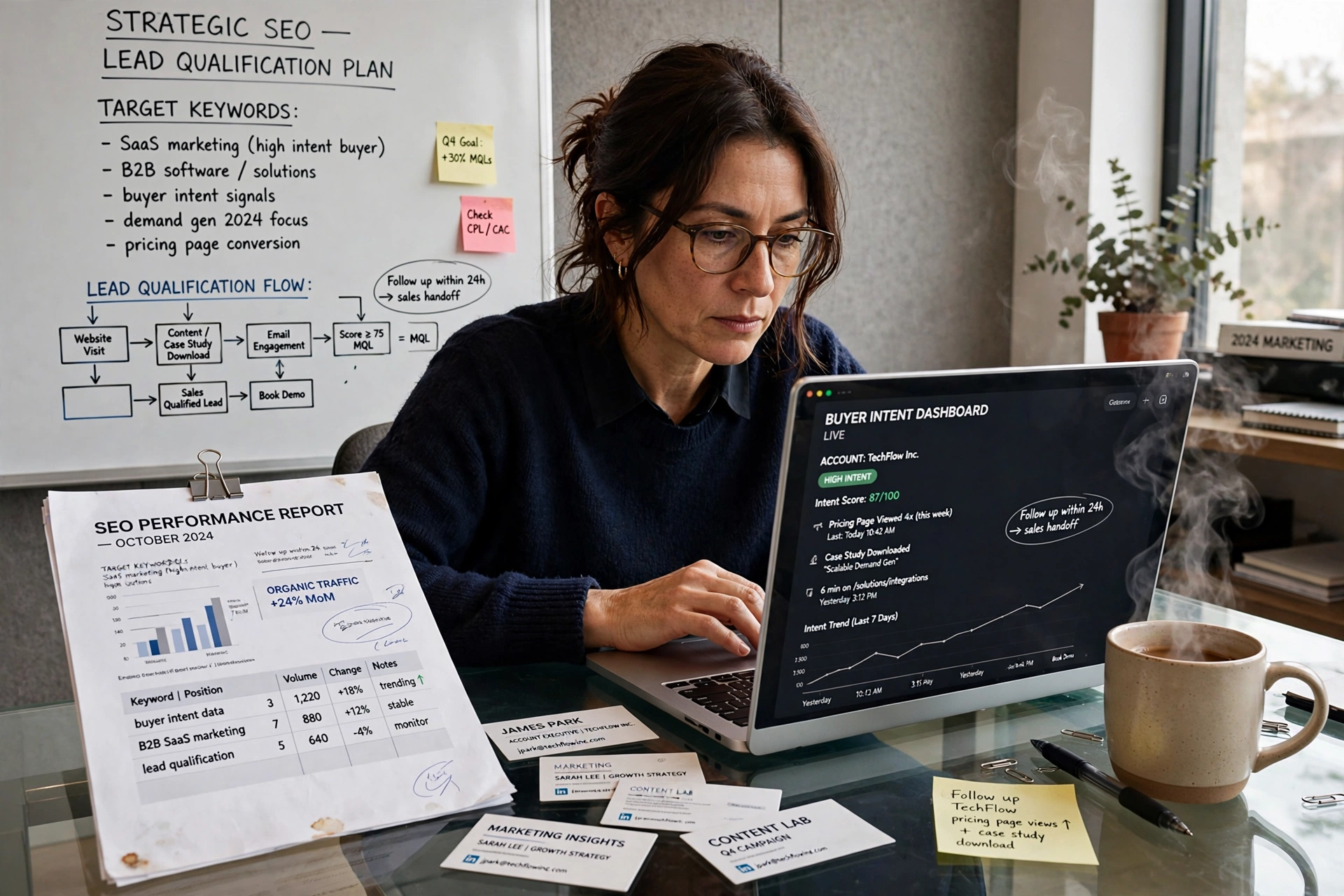
Second, monitor behavioral clusters. A single action, like visiting a pricing page, might be curiosity. However, a cluster of actions, such as visiting the pricing page, then the FAQ, then the case studies, then returning to the pricing page, is a screaming signal of decision-stage intent. This is where return visits as strong buyer intent signals become a critical metric for your sales team. When these clusters occur, an automated AI agent should initiate a qualification screen immediately.
Third, implement a programmatic approach to content. To dominate this stage, you need a massive volume of comparison and "Alternative To" pages. This is the power of programmatic SEO for SaaS. Instead of writing one "Us vs. Them" page, you build a system that generates optimized pages for every possible competitor combination in your niche. This ensures that no matter which competitor the buyer is comparing you to, you have a high-authority page ready to sway their decision.
| Approach | Traditional Lead Gen | Generic AI Content | BizAI Intelligence Approach |
|---|---|---|---|
| Signal Detection | Static Forms | Basic Keyword Matching | Real-time Behavioral Clustering |
| Content Strategy | 1-2 Comparison Pages | Mass AI-generated blogs | Programmatic SEO Pillars & Satellites |
| Conversion | Manual SDR Follow-up | Generic Chatbots | Autonomous AI SDRs with CRM Sync |
| User Experience | Linear / Static | Disconnected / Generic | Intent-Aware Dynamic Paths |
Common Mistakes When Targeting Decision Stage Buyers
One of the most frequent mistakes I see is "The Education Trap." This happens when a company continues to serve "Top 10 Tips for X" articles to a user who has already visited the pricing page four times. At this point, the user is no longer looking for education; they are looking for a reason to buy. Forcing them back into the educational funnel creates friction and often leads to them bouncing back to Google to find a more direct answer. This is why understanding how to automate organic traffic and lead capture with AI is so important; the system must adapt the offer based on the user's stage.
Another critical error is the "Hidden Pricing" syndrome. In 2026, transparency is a competitive advantage. Decision-stage buyers are often deterred by "Contact us for pricing" buttons. While high-ticket B2B services often require custom quotes, providing a "Starting At" price or a transparent pricing logic reduces anxiety and qualifies the lead before they even hit your calendar. When we built the architecture for BizAI Intelligence, we focused on reducing this friction by integrating AI agents that can discuss pricing ranges in real-time based on the user's expressed needs.
Finally, many firms ignore the "micro-signals" of intent. For example, someone who spends excessive time on a specific feature's technical documentation is likely in the decision stage, verifying that your software can actually do what the marketing copy claims. If you only track form submissions, you miss these high-intent behaviors. By integrating AI SDRs and autonomous sales appointment setters, you can capture these users exactly when their intent is at its peak, rather than waiting for them to decide to contact you.
Deep Dive: The Technical Architecture of Intent Capture
To truly capture decision-stage buyer intent, you must move beyond basic analytics and into a system of real-time event triggers. In a professional enterprise setup, this involves a three-layer stack: Detection, Scoring, and Action.
Layer 1: Detection
Detection happens at the edge. You are looking for specific URL patterns (e.g. /pricing, /compare-x-vs-y, /enterprise-security) and interaction patterns. For example, a user who utilizes a pricing calculator three times in one session is exhibiting a level of intent that far exceeds a standard visitor. This is often coupled with behavioral buyer intent signals such as high scroll depth on a technical specification page.
Layer 2: Scoring Not all signals are equal. A visit to a blog post about "Industry Trends" might be worth 1 point, while a visit to the "Request a Demo" page is worth 50 points. When a user reaches a specific threshold, for instance, 85 points within a 24-hour window, they are officially flagged as a "Decision Stage Lead." This scoring prevents your sales team from being overwhelmed by noise and allows them to focus on the 5% of traffic that is actually ready to transact.
Layer 3: Action This is where the conversion happens. Once the threshold is met, the site's behavior changes. A generic "Subscribe to Newsletter" popup is replaced by a "Book Your Implementation Audit" calendar. This is the intersection of AI SDR vs human SDR ROI, where the AI handles the immediate, low-friction booking and the human handles the high-value closing call. To maximize this, you must ensure your AI agents are seamlessly connected to your CRM via webhooks, as detailed in our guide on connecting AI sales agents to CRM.
The goal of decision-stage capture is to remove every possible barrier between the user's realization that your product is the right fit and the moment they book a meeting on your calendar.
Frequently Asked Questions
How can I tell if a visitor is in the decision stage versus the consideration stage?
A visitor in the consideration stage is typically searching for categories of solutions (e.g. "best AI marketing tools"), whereas a decision-stage visitor is searching for a specific brand or a direct comparison (e.g. "BizAI Intelligence vs [Competitor]"). Behaviorally, decision-stage users spend more time on pricing, terms of service, and case studies, and they exhibit higher return visit frequencies. If a user returns to your pricing page three times in 48 hours, they are almost certainly in the decision stage.
Which pages on my website are most likely to attract decision-stage buyers?
Your most potent decision-stage pages are Pricing, "Alternative To [Competitor]" pages, Case Studies with specific ROI data, and Technical Documentation. These pages are designed to answer the final "Will this actually work for my specific use case?" question. To scale these, I recommend using programmatic SEO tools to create a comprehensive library of comparison pages that target every major competitor in your market.
Should I use a chatbot for decision-stage buyers?
Generic chatbots are often a hindrance to decision-stage buyers because they provide scripted, shallow answers. However, a context-aware AI Sales Agent, like those deployed by BizAI Intelligence, is incredibly effective. These agents can track the user's journey, acknowledge that they've been looking at the Enterprise plan, and offer to book a demo specifically to discuss that plan's features. The key is transition from "Support Chat" to "Sales Qualification."
How does decision stage intent differ from high-volume organic traffic?
High-volume organic traffic often comes from "Top of Funnel" (ToFu) keywords, which have massive search volume but very low conversion rates. Decision stage intent is often characterized by "Low Volume, High Value" keywords. While 10,000 people might search for "What is SEO," only 50 might search for "Best enterprise SEO software for law firms in 2026." Those 50 people are exponentially more valuable than the 10,000 because their intent is to buy, not to learn.
How do I prevent decision-stage buyers from bouncing to a competitor's site?
Prevent bouncing by providing an immediate "Next Step." When a user is comparing you to a competitor, don't just list your features, provide a direct, honest comparison table and a clear call to action to see a live demo of the specific feature that beats the competitor. Use an AI agent to offer a "Quick Comparison Audit" or a direct calendar link to talk to a specialist. Reducing the time to the next action is the only way to lock in a decision-stage buyer.
Conclusion
Mastering decision stage buyer intent is the difference between having a website that acts as a digital brochure and one that functions as an autonomous revenue engine. When you stop treating all traffic as equal and start differentiating based on intent signals, you stop wasting your budget on curiosity-seekers and start focusing on the buyers who are already sold on the concept and are simply looking for the right partner.
In 2026, the window to capture a decision-stage lead is shorter than ever. If you aren't using programmatic architecture and AI-driven qualification to meet these buyers exactly where they are, you are handing your market share to someone who is. Whether you are leveraging programmatic SEO case studies to build your authority or deploying autonomous agents to close the gap, the goal remains the same: speed to lead and precision of intent.
For a comprehensive guide on how to detect all types of these signals, return to our Buyer Intent Signals: Ultimate Guide to Detection and start building your organic acquisition machine.
Ready to stop renting traffic and start owning your niche? Visit BizAI Intelligence to deploy your autonomous B2B lead engine today.
AI Search Accelerator: 1-on-1 Strategy Session
Claim one of the 10 monthly slots. Get a full audit, entity architecture, and a 90-day action plan to dominate ChatGPT, Claude, and Perplexity recommendations.