📖This article is part of the complete guide to Ultimate Guide to Hot Lead Notifications for Sales.
In my experience working with high-ticket B2B service providers, the difference between a closed deal and a lost opportunity usually comes down to a window of exactly seven minutes. When a prospect is actively engaging with your pricing page or a detailed service guide, their intent is at a peak that will never be replicated. Waiting two hours to respond via email isn't just slow; it's a failure to capitalize on the only moment the buyer is truly ready to talk.
For a comprehensive overview of the underlying technology, explore our Ultimate Guide to Hot Lead Notifications for Sales.
What Are Hot Lead Notifications Case Studies?
📚
Definition
Hot lead notifications case studies are documented real-world implementations where businesses use real-time alerts to identify and contact prospects who have crossed a specific behavioral intent threshold.
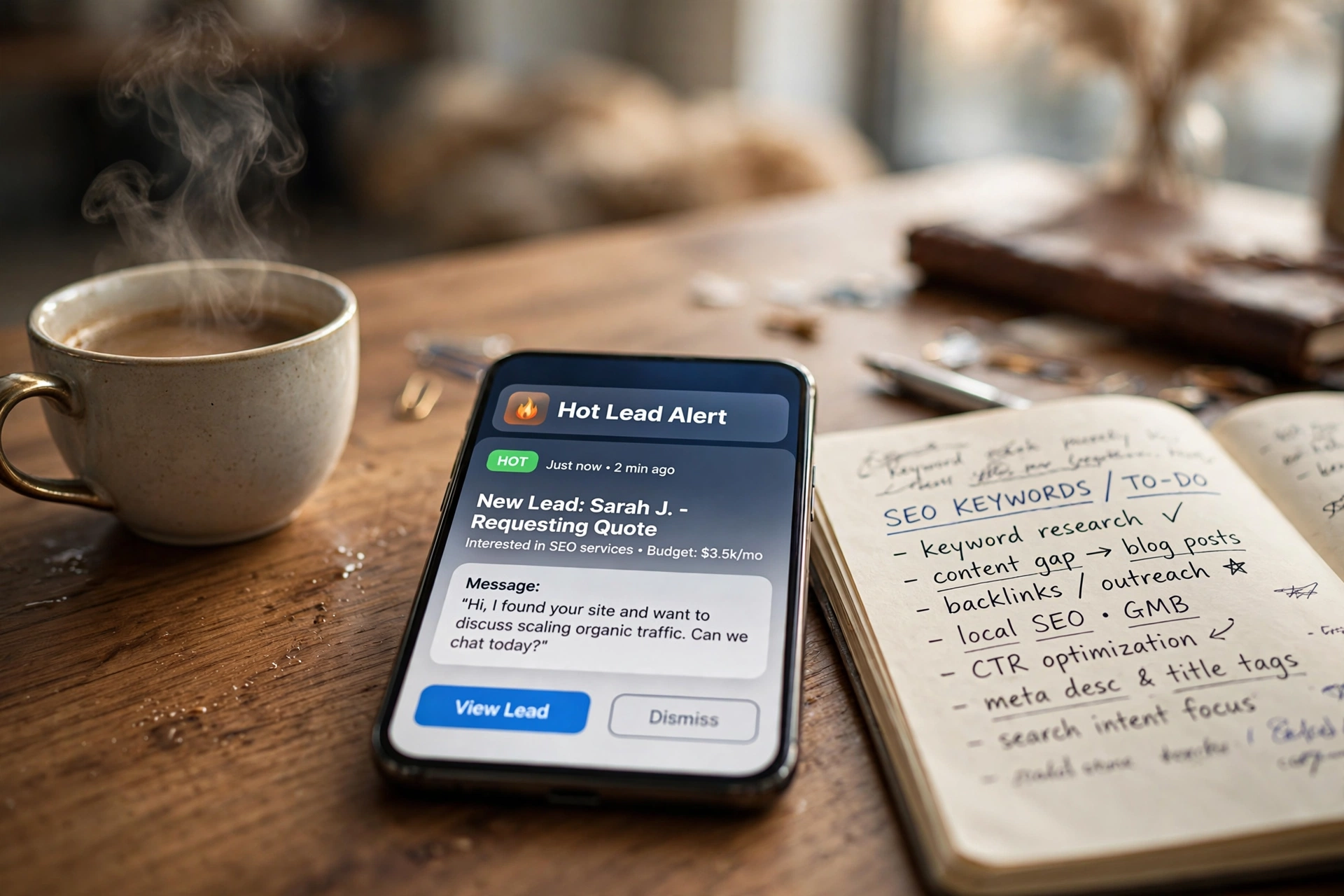
Hot lead notifications case studies serve as the empirical evidence that speed-to-lead is the most critical variable in modern B2B acquisition. Unlike traditional lead generation, where a user fills out a form and waits for a manual callback, these systems trigger an alert the second a high-intent signal is detected. This allows a sales representative, or an autonomous AI agent, to intervene while the prospect is still on the website.
When we analyze these case studies, we aren't just looking at "more leads." We are looking at lead quality and conversion velocity. In 2026, the focus has shifted toward Generative Engine Optimization (GEO) and AI-driven qualification. By integrating AI lead generation tools, companies can now distinguish between a casual browser and a buyer with a concrete budget and urgency. The result is a pipeline that doesn't just grow in volume, but in efficiency.

Why Real-World Results Matter for Your Business Growth
Implementing a notification system without understanding the benchmarks is like flying a plane without an altimeter. You might be moving, but you don't know if you're crashing. The data from global implementations consistently shows that the "Golden Window" of response is shrinking. According to research by the Lead Response Management Study, businesses that respond within five minutes are 100 times more likely to qualify a lead than those who wait thirty minutes.
For a high-ticket B2B firm, this isn't just about a percentage; it's about thousands of dollars in missed Contract Value (CV). When you employ how to automate organic traffic with AI, you create a massive influx of visitors. Without a real-time notification system, most of that traffic becomes "ghost traffic", people who visited, found the answer, and left without ever speaking to a human.
In the current 2026 market, the competition for attention is fierce. Prospects are using AI tools to summarize your site before they even contact you. If your system doesn't alert you that a high-value account is currently reading your "Enterprise Comparison" page, you are essentially giving your competitors a head start. This is why analyzing benefits of hot lead notifications allows a CEO to move from a reactive sales posture to a proactive acquisition engine.
💡
Key Takeaway
The primary value of hot lead notifications is not the alert itself, but the reduction of friction between the buyer's peak intent and the sales conversation.
Practical Use Cases and Implementation Results
To understand how this works in practice, we must look at different industry deployments. The implementation of these systems usually follows a tiered approach: identification, notification, and action.
Case Study 1: The Enterprise Law Firm (High-Ticket Legal Services)
An immigration law firm specializing in corporate visas was struggling with a high volume of low-quality leads. They were getting hundreds of form submissions, but only 2% were high-net-worth corporate clients. They implemented a behavioral tracking system that triggered a "Hot Lead Alert" only when a visitor viewed the "Corporate Relocation Fees" page more than three times in a single session and spent over 120 seconds on the page.
By utilizing how hot lead notifications work in real-time, the firm shifted its focus. Instead of calling every form filler, the senior partners were alerted via Slack the moment a corporate lead was active. Within 90 days, the firm reported a 35% increase in qualified consultations. The reason was simple: they contacted the lead while the lead was still thinking about the visa process, not three days later when the lead had already contacted three other firms.
Case Study 2: The B2B SaaS Platform (Scaling Organic Growth)
A mid-market SaaS company focused on financial automation used a programmatic SEO strategy to generate 500+ landing pages targeting specific industry pain points. While traffic grew, the conversion rate remained flat. They integrated an AI-powered notification layer that monitored scroll velocity and engagement signals.
When a user from a Fortune 500 company (identified via IP enrichment) spent more than 60 seconds on a pricing table, the system triggered an immediate prompt via an AI Sales Agent. This agent, powered by the architecture found in the comprehensive AI SDRs & autonomous sales appointment setters, offered a live demo booking immediately. The result was a 42% increase in demo bookings per month, proving that the right alert at the right micro-moment beats a generic follow-up email every time.
Case Study 3: Local Home Services Network (HVAC and Plumbing)
In the home services sector, urgency is everything. A regional HVAC network implemented alerts that triggered when users in specific high-income zip codes visited their "Emergency Repair" page. By using best hot lead notification software, the dispatchers received a push notification with the user's estimated location and the specific service they were viewing.
This allowed the team to call the prospect and say, "We have a technician in your neighborhood right now; would you like us to stop by?" This level of hyper-responsiveness led to a 28% increase in immediate booking rates. They stopped fighting for the lead after the form was submitted and started winning the lead while the problem (the broken AC) was still an active crisis.

Comparing Notification Approaches
Not all notification systems are created equal. Many businesses mistake a simple "Form Submission Email" for a hot lead notification. In reality, the traditional approach is often too slow for the modern buyer's journey.
| Feature | Traditional Form Email | Cheap/Generic AI Bot | BizAI Intelligence Approach |
|---|---|---|---|
| Trigger | Manual form submission | Basic keyword trigger | Behavioral intent + IP enrichment |
| Response Time | 15 mins to 24 hours | Instant but generic | Instant, context-aware, & personalized |
| Qualification | Self-reported (often wrong) | Basic chatbot logic | Real-time scroll & engagement scoring |
| Outcome | High friction, low conversion | High annoyance, medium lead qty | Low friction, high close rate |
As noted by the Sales Enablement Society, the integration of intent data into the immediate sales workflow reduces the sales cycle length by an average of 18%. When you move from the "Traditional" column to the "Modern" column, you are essentially optimizing for the psychology of the buyer.
Common Mistakes to Avoid in Lead Notification Workflows
In my years of architecting distributed platforms, I've seen companies ruin a great tool with a terrible process. The most common mistake is "Alert Fatigue." If your sales team receives a notification for every single page visit, they will eventually mute the notifications. This is a catastrophic failure because the one truly "hot" lead will be ignored along with the ninety-nine "lukewarm" ones.
To avoid this, you must set a strict intent threshold. At BizAI Intelligence, we recommend a multi-signal trigger: the user must be from a target industry, must have visited a high-intent page (like pricing), and must have a dwell time that suggests active reading rather than accidental clicking. This is the core of what are hot lead notifications when implemented at an enterprise level.
Another critical error is the "Creepy Factor." If a salesperson calls a prospect and says, "I saw you were looking at our pricing page for exactly 42 seconds," it can feel invasive. The art of the hot lead notification is to use the data to inform the timing, not necessarily the script. Instead, use the alert to trigger a helpful, timely outreach: "I noticed you're researching our enterprise options; I have a few specific case studies for your industry that might help you decide."
Finally, many firms fail to connect their notifications to a CRM. An alert that lives only in a Slack channel is a volatile asset. To truly scale, you need to understand how to connect AI sales agents to CRM & webhooks for auto booking. This ensures that every hot lead is logged, tracked, and followed up on, regardless of whether the first attempt was successful.
Frequently Asked Questions
How do hot lead notifications improve conversion rates?
Hot lead notifications improve conversion rates by drastically reducing the time between a prospect's peak interest and the brand's response. When a user is actively researching a solution, their cognitive load is focused on the problem. By intervening at that exact moment, you eliminate the "decay period" where the prospect might lose interest or find a competitor. Data shows that responding within minutes increases the likelihood of qualifying a lead by up to 100x compared to waiting 30 minutes, as it capitalizes on the buyer's current state of urgency.
What is the ideal intent threshold for a "Hot Lead" alert?
An ideal threshold should be based on a combination of identity and behavior. For most B2B companies, this includes: 1) A visit to a high-intent page (Pricing, Request a Demo, or Comparison pages), 2) A minimum dwell time of 60-120 seconds, and 3) A scroll depth of at least 50%. Adding an IP enrichment layer to ensure the visitor belongs to a target company or industry further refines this. Setting the bar too low leads to alert fatigue, while setting it too high misses genuine opportunities.
Can AI agents handle hot lead notifications without humans?
Yes, and in 2026, this is the preferred model for scaling. Using how AI appointment setters automate B2B demo booking 24/7, a business can deploy a context-aware AI agent that triggers based on the same hot lead signals. Instead of a human calling, the AI agent initiates a conversational qualification screen on the page, scores the lead's intent, and books the meeting directly into the CRM. This ensures 100% lead capture regardless of the time zone or staff availability.
How do I prevent my sales team from experiencing alert fatigue?
Prevent alert fatigue by implementing a tiered notification system. Low-intent signals (e.g. visiting a blog post) should be logged in the CRM for future nurturing but should not trigger a push notification. Medium-intent signals can trigger a daily digest. Only high-intent signals, those meeting the strict behavioral thresholds mentioned earlier, should trigger an immediate, high-priority alert. Regularly reviewing the conversion rate of alerted leads allows you to tune the triggers to ensure only high-value opportunities disrupt your team.
Which software is best for tracking hot lead signals in 2026?
The best software for 2026 integrates programmatic SEO with real-time behavioral tracking and AI-driven response. While generic tools offer basic alerts, an integrated system like BizAI Intelligence provides the full stack: the pages that attract the traffic, the signals that identify the intent, and the AI agents that close the meeting. For those comparing options, we recommend reviewing best hot lead notification software reviewed to see how different tools handle the balance between accuracy and response speed.
Conclusion
Real-world data is clear: the companies winning the B2B battle in 2026 are not the ones with the biggest ad budgets, but the ones with the fastest response times. Hot lead notifications transform your website from a static brochure into a dynamic, real-time sales floor. By focusing on behavioral intent and minimizing the gap between a prospect's curiosity and your solution, you can fundamentally change your close rates.
If you are still relying on manual form submissions and 24-hour follow-up cycles, you are leaving a significant portion of your revenue on the table. The transition to an automated, intent-based acquisition system is no longer a luxury; it is a requirement for survival in an AI-driven search landscape. For a deeper dive into building this architecture, return to our Ultimate Guide to Hot Lead Notifications for Sales.
Ready to stop renting traffic and start owning your pipeline? Visit BizAI Intelligence to deploy the machine that fills your calendar while you sleep.
AI Search Accelerator: 1-on-1 Strategy Session
Claim one of the 10 monthly slots. Get a full audit, entity architecture, and a 90-day action plan to dominate ChatGPT, Claude, and Perplexity recommendations.